2020 · Niu — Hydrogen Attenuates Allergic Inflammation by Reversing Energy Metabolic Pathway Switch
Super-Abstract
Hydrogen curbs allergic airway inflammation by resetting a disturbed energy metabolism of the immune cells. In asthma patients and in the asthma mouse model, metabolism had switched from healthy cellular respiration to fermentation — H₂ reversed this switch and mitigated the inflammation. (Scientific Reports, 2020.)
Commentary
This study provides a new, elegant mechanism of action for hydrogen in allergies and asthma. The researchers examined two things together: monocytes from asthma patients and a mouse model of allergic airway inflammation. In both they found the same pattern — a switch in energy metabolism: more lactic-acid production and increased fermentation enzymes (so-called aerobic glycolysis), while at the same time less ATP and throttled cellular respiration in the mitochondria. Put simply: the immune cells switch from clean energy production to an inflammation-promoting emergency mode. And it is exactly this switch that hydrogen turns back: in the treated mice, H₂ normalized the fermentation enzymes and the factor HIF-1α, revved up the mitochondrial respiratory-chain complexes and protective proteins such as PGC-1α and sirtuins 1, 3, 5 and 6 — and the airway inflammation receded. This means: H₂ does not act merely as a simple radical scavenger but intervenes in the cell's energy metabolism in a regulatory way. Honestly: this is a <strong>preclinical</strong> work — patient cells in the lab plus an animal model, no clinical proof of therapy in humans.
Key quotes
- „This study explored the possibility that H2 exerts its anti-inflammatory effect by modulating energy metabolic pathway switch.“ — the central hypothesis: H₂ acts via energy metabolism
- „Treatment of ovalbumin-sensitized and challenged mice with hydrogen reversed the energy metabolic pathway switch, and mitigated airway inflammation.“ — the core finding in the animal model
- „Hydrogen inhibits airway inflammation by reversing this switch. Hydrogen regulates energy metabolic reprogramming by acting at multiple levels in the energy metabolism regulation pathways.“ — the mechanistic conclusion
Our assessment
Valuable as a mechanism study: it goes beyond the classical „H₂ = antioxidant“ picture and shows that hydrogen can reprogram the energy metabolism of immune cells — a modern explanatory approach for the anti-inflammatory effect in allergy and asthma. For us it provides a deeper „why“ behind the observations in airway and allergy applications. Limitations, stated honestly: this is a purely preclinical investigation (human monocytes in the lab + ovalbumin mouse model, no treatment outcome in patients). The study is listed as an observational study; statements on clinical symptom improvement in humans cannot be derived from it. Mechanistically it flanks the small human pilot study on nasal lavage in allergic rhinitis.
Study design
- Type: preclinical (human monocytes from asthma patients + ovalbumin-sensitized mouse model of allergic airway inflammation) · H₂ delivery: H₂ treatment of the mice (abstract without concentration)
- Result metrics: allergic inflammation with a metabolic switch (↑ glycolysis/lactate, ↓ ATP & mitochondrial respiratory chain I/III); H₂ reversed the switch, normalized HIF-1α, respiratory-chain complexes, PGC-1α and sirtuins 1/3/5/6, dampened airway inflammation (qualitative/relative endpoints, no p-values in the abstract)
Abstract
Mechanisms mediating the protective effects of molecular hydrogen (H2) are not well understood. This study explored the possibility that H2 exerts its anti-inflammatory effect by modulating energy metabolic pathway switch. Activities of glycolytic and mitochondrial oxidative phosphorylation systems were assessed in asthmatic patients and in mouse model of allergic airway inflammation. The effects of hydrogen treatment on airway inflammation and on changes in activities of these two pathways were evaluated. Monocytes from asthmatic patients and lungs from ovalbumin-sensitized and challenged mice had increased lactate production and glycolytic enzyme activities (enhanced glycolysis), accompanied by decreased ATP production and mitochondrial respiratory chain complex I and III activities (suppressed mitochondrial oxidative phosphorylation), indicating an energy metabolic pathway switch. Treatment of ovalbumin-sensitized and challenged mice with hydrogen reversed the energy metabolic pathway switch, and mitigated airway inflammation. Hydrogen abrogated ovalbumin sensitization and challenge-induced upregulation of glycolytic enzymes and hypoxia-inducible factor-1α, and downregulation of mitochondrial respiratory chain complexes and peroxisome proliferator activated receptor-γ coactivator-1α. Hydrogen abrogated ovalbumin sensitization and challenge-induced sirtuins 1, 3, 5 and 6 downregulation. Our data demonstrates that allergic airway inflammation is associated with an energy metabolic pathway switch from oxidative phosphorylation to aerobic glycolysis. Hydrogen inhibits airway inflammation by reversing this switch. Hydrogen regulates energy metabolic reprogramming by acting at multiple levels in the energy metabolism regulation pathways.
Source & links
Screenshot of the PubMed page
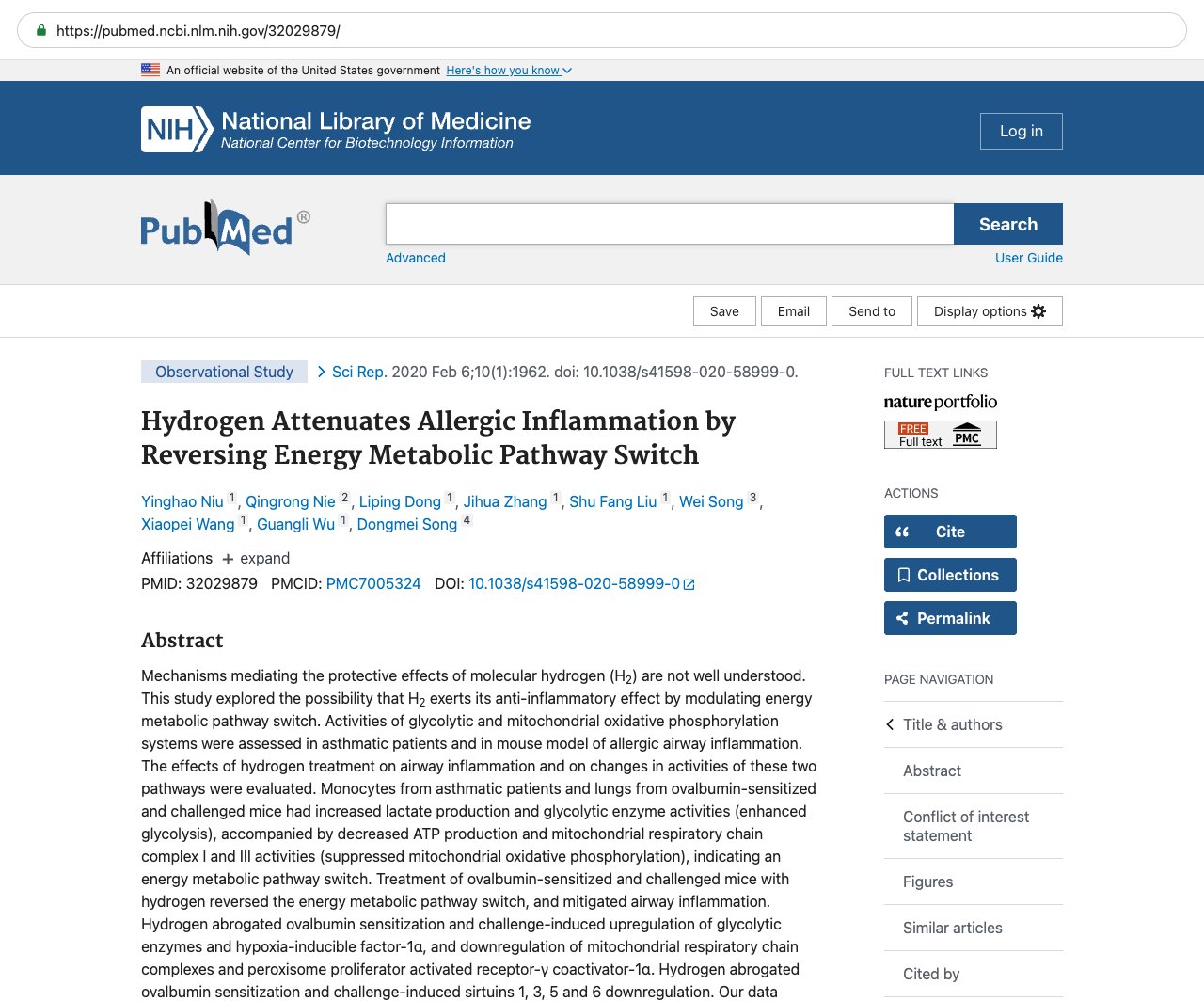
This page mirrors the published abstract (© the authors / publisher) for reference and citation. The canonical source is the PubMed record linked above. This is not medical advice.