2021 · Zhang et al. — Hydrogen Gas: A Novel Type of Antioxidant in Modulating Sexual Organs Homeostasis.
Super-Abstract
Molecular hydrogen (H₂) appears to benefit reproductive health in both males and females — from improving sperm motility and erectile function to protecting ovarian function and reducing uterine inflammation — acting primarily through antioxidant and anti-inflammatory mechanisms. This review synthesises preclinical findings across a wide range of reproductive endpoints. (Oxidative Medicine and Cellular Longevity, 2021.)
Commentary
This review brings together a scattered body of preclinical evidence on H₂ and reproductive organ function. The breadth is notable: male fertility (sperm motility, testicular protection, erectile dysfunction), female fertility and health (ovarian reserve, uterine inflammation, preeclampsia), and even breast cancer protection are covered. The mechanistic thread throughout is oxidative stress: H₂ selectively neutralises cytotoxic reactive oxygen species without disturbing physiological redox signalling. The review is honest that the fundamental link between nitric oxide (NO) and sexual physiology is well established, while H₂'s role is more novel. However, the evidence base is almost entirely animal or in-vitro; clinical human data are sparse.
Key quotes
- „H₂ has strong abilities to attenuate excessive oxidative stress by selectively reducing cytotoxic oxygen radicals, modulate immunity and inflammation, and inhibit injuries-induced cell death.“ — the three core mechanisms underlying H₂ effects on reproductive organs
- „The lightest and diffusible gas molecule hydrogen (H2) has been shown to improve erectile dysfunction (ED), testis injuries, sperm motility in male, preserve ovarian function, protect against uterine inflammation, preeclampsia, and breast cancer in female.“ — the full range of reproductive endpoints covered in this review
- „H2 is a novel bioactive gas molecule involved in modulating sexual organs homeostasis.“ — the authors' framing of H₂ as a homeostasis regulator rather than a drug
Our assessment
This is a review of preclinical literature — the great majority of evidence cited comes from animal models and in-vitro experiments. Results are not directly transferable to human reproductive health without dedicated clinical trials. The biological plausibility is reasonable given H₂'s antioxidant profile, but reproductive medicine is a sensitive area where preclinical-to-clinical translation has historically been unreliable. Honest limitation: no human randomised controlled trials on H₂ for any of the reproductive endpoints are cited; this remains a hypothesis-generating review.
Study design
- Type: narrative review · n: n/a (literature synthesis, mainly animal/in-vitro studies) · H₂ delivery: inhalation and topical/bath (reported across cited studies)
- Result: preclinical evidence supports H₂ effects on multiple reproductive endpoints in both sexes; clinical human evidence is absent; mechanistic focus on antioxidant and anti-inflammatory pathways
Abstract
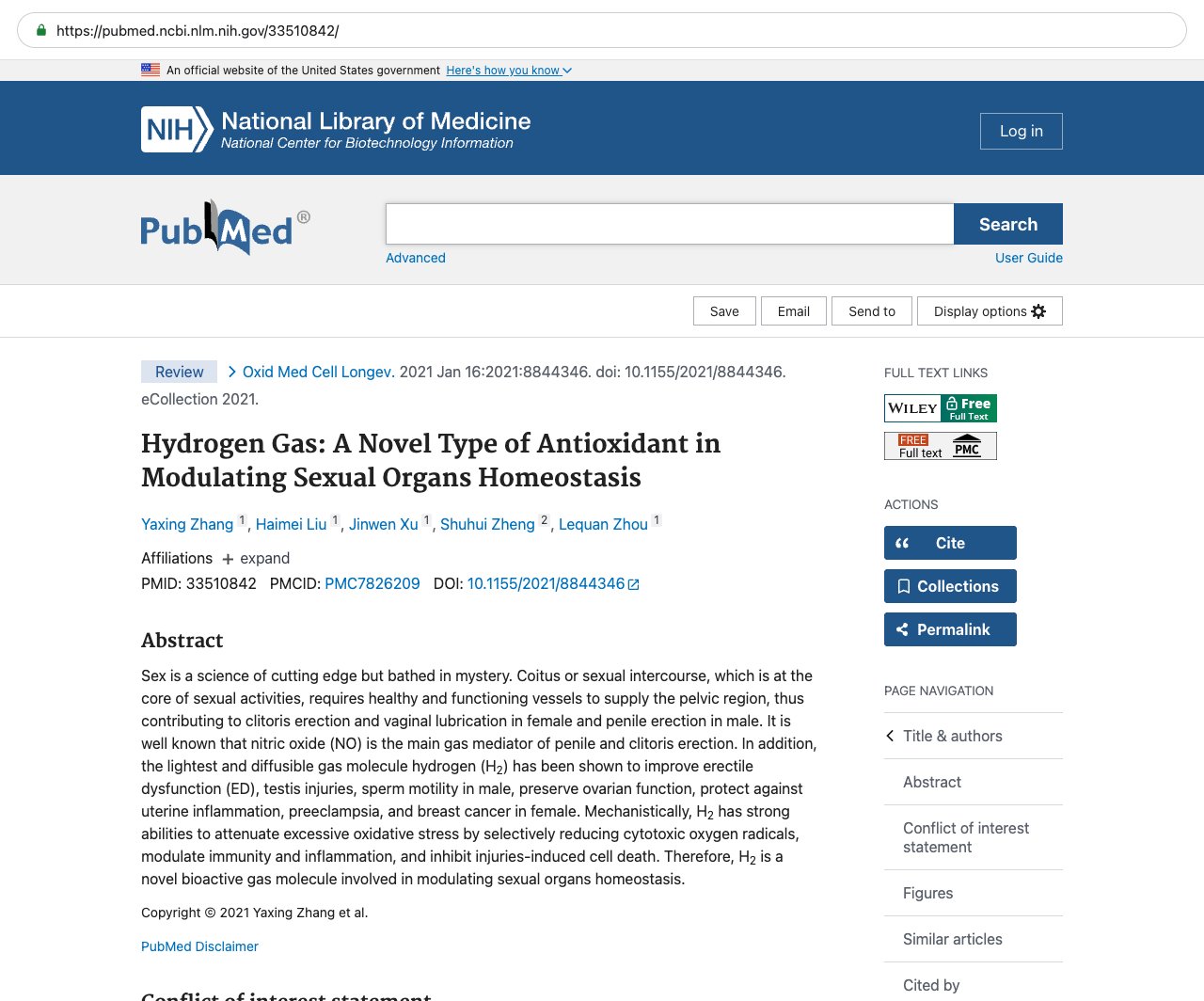
Sex is a science of cutting edge but bathed in mystery. Coitus or sexual intercourse, which is at the core of sexual activities, requires healthy and functioning vessels to supply the pelvic region, thus contributing to clitoris erection and vaginal lubrication in female and penile erection in male. It is well known that nitric oxide (NO) is the main gas mediator of penile and clitoris erection. In addition, the lightest and diffusible gas molecule hydrogen (H2) has been shown to improve erectile dysfunction (ED), testis injuries, sperm motility in male, preserve ovarian function, protect against uterine inflammation, preeclampsia, and breast cancer in female. Mechanistically, H2 has strong abilities to attenuate excessive oxidative stress by selectively reducing cytotoxic oxygen radicals, modulate immunity and inflammation, and inhibit injuries-induced cell death. Therefore, H2 is a novel bioactive gas molecule involved in modulating sexual organs homeostasis.
Source & links
Screenshot of the PubMed page
This page mirrors the published abstract (© the authors / publisher) for reference and citation. The canonical source is the PubMed record linked above. This is not medical advice.