2023 · Artamonov — Molecular Hydrogen: From Molecular Effects to Stem Cells Management and Tissue Regeneration
Super-Abstract
H₂ as a tool of regenerative medicine: by the end of 2022, more than 2,000 papers on hydrogen medicine had appeared. This review systematises the molecular, cellular and systemic effects of H₂ — including its effect on stem cells — and sees in it a potentially effective approach to tissue regeneration. (Antioxidants, 2023.)
Commentary
This review by Artamonov and colleagues — with Tyler LeBaron, a well-known figure in H₂ research, as co-author — maps out a huge field: by the end of 2022, more than 2,000 papers on hydrogen medicine had been published, many of them original studies. The authors honestly note that, despite several reviews, the research direction has remained „unsystematic“ — and that is exactly what they aim to organise. They describe the historical beginnings of H₂ biology, the various routes of administration and the effects on four levels: molecular, cellular, tissue and systemic. The special focus is on stem cells: how does H₂ influence different cell types, including stem cells? Their conclusion: the molecular and cellular properties qualify H₂ as a potentially effective agent in regenerative medicine. Staying honest: this is a review, not proof of efficacy — it synthesises and systematises but provides no data or clinical endpoints of its own.
Key quotes
- „By the end of 2022, more than 2000 articles have been published in the field of hydrogen medicine, many of which are original studies.“ — the sheer size of the research field
- „the purpose of this review was to systematize ideas about the nature, characteristics, and mechanisms of the influence of molecular hydrogen on various types of cells, including stem cells.“ — the stated goal: systematisation
- „The existing literature indicates that the molecular and cellular effects of hydrogen qualify it to be a potentially effective agent in regenerative medicine.“ — the deliberately cautious core statement
Our assessment
A broad orientation review from the journal Antioxidants (MDPI), useful as a map of the entire H₂ field and especially of the less well-known stem-cell/regeneration perspective. Mainly usable as evidence of the breadth and volume of research (2,000+ papers), not as a specific product argument. Limitation, stated honestly: a narrative review, no measurements of its own; the wording „potentially effective“ is deliberately cautious. In addition: the DOI listed in the raw data was erroneous (different publisher/year) and was omitted — please verify via the PubMed link.
Study design
- Type: narrative review · n: n/a (literature synthesis, 2,000+ papers as background) · Duration: n/a · H₂ delivery: described in the review (various routes of administration)
- Result: no measurements of its own; conclusion: H₂ as a „potentially effective“ agent of regenerative medicine
Abstract
It is known that molecular hydrogen is a relatively stable, ubiquitous gas that is a minor component of the atmosphere. At the same time, in recent decades molecular hydrogen has been shown to have diverse biological effects. By the end of 2022, more than 2000 articles have been published in the field of hydrogen medicine, many of which are original studies. Despite the existence of several review articles on the biology of molecular hydrogen, many aspects of the research direction remain unsystematic. Therefore, the purpose of this review was to systematize ideas about the nature, characteristics, and mechanisms of the influence of molecular hydrogen on various types of cells, including stem cells. The historical aspects of the discovery of the biological activity of molecular hydrogen are presented. The ways of administering molecular hydrogen into the body are described. The molecular, cellular, tissue, and systemic effects of hydrogen are also reviewed. Specifically, the effect of hydrogen on various types of cells, including stem cells, is addressed. The existing literature indicates that the molecular and cellular effects of hydrogen qualify it to be a potentially effective agent in regenerative medicine.
Source & links
Screenshot of the PubMed page
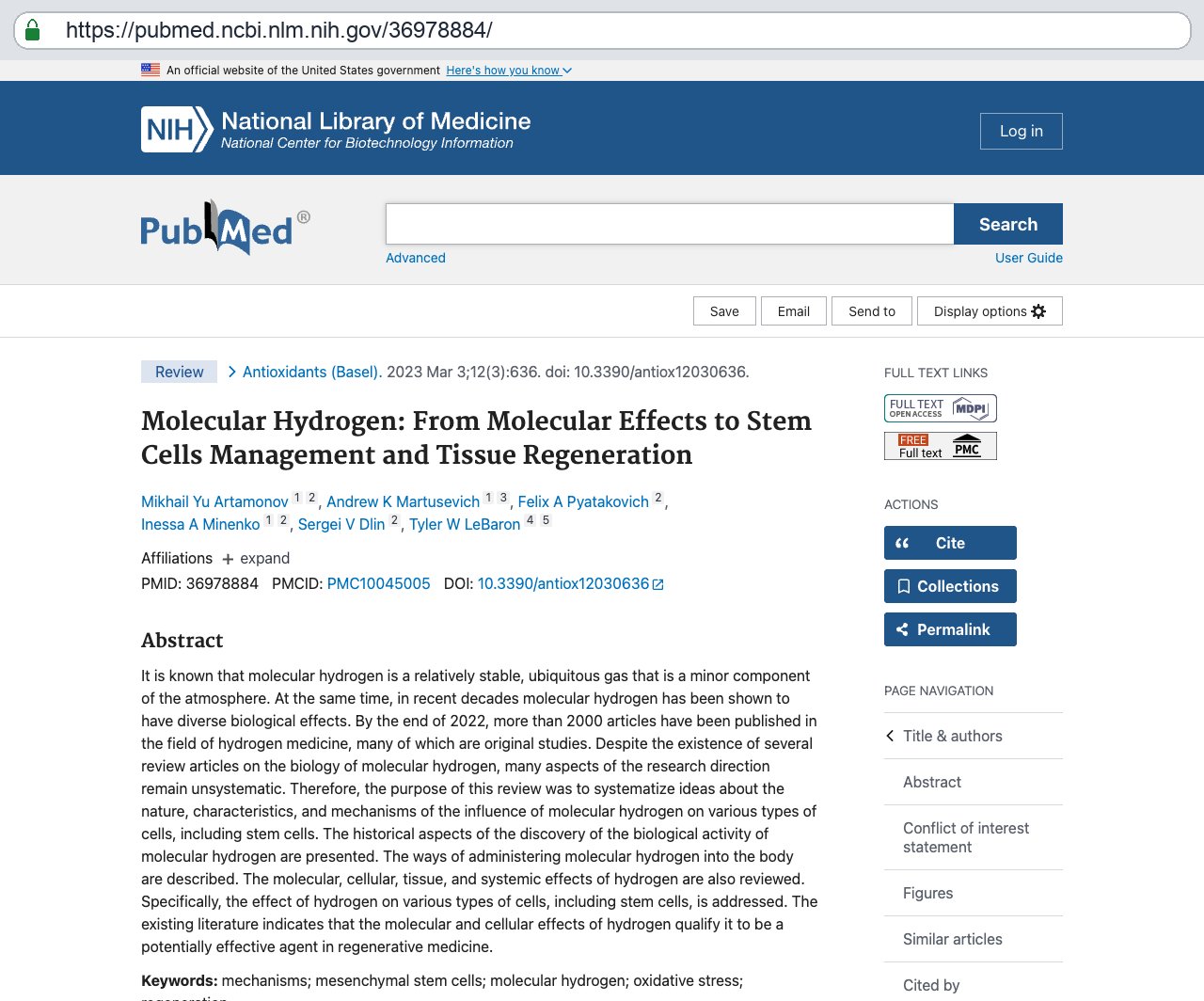
This page mirrors the published abstract (© the authors / publisher) for reference and citation. The canonical source is the PubMed record linked above. This is not medical advice.