2012 · Baxter et al. — Evaluation of outgassing, tear strength, and detail reproduction in alginate substitute materials.
Super-Abstract
This study compares dental impression materials (alginate substitutes) to traditional alginate for three performance properties: the release of hydrogen gas (outgassing), tear strength, and detail reproduction quality. All tested alginate substitutes showed superior performance to traditional alginate. The „hydrogen" relevance here is entirely technical: hydrogen gas is released as a byproduct when alginate substitutes react with water, causing surface porosity in dental casts — a problem the study quantifies and evaluates.
Commentary
This paper is a dental materials science study with no connection to molecular hydrogen (H₂) as a health-relevant gas or therapeutic agent. The „hydrogen" in this context refers to hydrogen gas liberated as a chemical reaction byproduct during the setting of alginate substitute impression materials — a technical challenge in dental laboratory work that can produce surface porosity in plaster dental models. The study's findings — that alginate substitutes outperform traditional alginate in tear strength and that outgassing is minimal at 60 minutes post-mixing — are relevant to dental practice but have no bearing on H₂ biology, oxidative stress, or human physiology. This entry appears in H₂ research databases due to keyword matching on „hydrogen gas release," not due to any biological relevance.
Key quotes
- „All alginate substitute materials passed the detail reproduction test.“ — baseline quality confirmation for all tested materials
- „Significant variation in outgassing existed between materials and pouring times (p<0.05).“ — the key technical finding: hydrogen gas release varies by material and timing
- „All alginate substitute materials exhibited the least outgassing and cast porosity 60 minutes after mixing.“ — practical recommendation: wait 60 minutes before pouring the dental cast
Our assessment
This paper is not relevant to molecular hydrogen (H₂) biology or therapy. It is a dental materials science study evaluating impression materials. The „hydrogen" reference concerns gaseous H₂ released as a chemical byproduct during dental material setting — a materials engineering issue, not a biological or health topic. No conclusions relevant to H₂ health research can be drawn from this study. It appears in H₂ research databases as an indexing artifact based on keyword overlap.
Study design
- Type: in-vitro materials science study · n: 12 samples per material for tear strength; 5 impressions per material for outgassing · H₂ relevance: none — hydrogen gas is a chemical reaction byproduct in dental impression materials
- Result: all alginate substitutes passed detail reproduction standards; tear strength superior to alginate; minimal outgassing at 60 min post-mixing across all alginate substitutes
Abstract
OBJECTIVE: To compare three alginate substitute materials to an alginate impression material for cast surface porosity (outgassing), tear strength, and detail reproduction. MATERIALS AND METHODS: Detail reproduction tests were performed following American National Standards Institute/American Dental Association (ANSI/ADA) Specification No. 19. To measure tear strength, 12 samples of each material were made using a split mold, placed in a water bath until testing, and loaded in tension until failure at a rate of 500 mm/min using a universal testing machine. For cast surface porosity testing, five impressions of a Teflon mold with each material were placed in a water bath (37.8°C) for the in-mouth setting time and poured with vacuum-mixed Silky Rock die stone at 5, 10, 30, and 60 minutes from the start of mixing. The gypsum samples were analyzed with a digital microscope for surface porosity indicative of hydrogen gas release by comparing the surface obtained at each interval with four casts representing no, little, some, and significant porosity. Data analysis was performed using parametric and Kruskal-Wallis analysis of variance (ANOVA), Tukey/Kramer post-hoc tests (α=0.05), and individual Mann-Whitney U tests (α=0.0167). RESULTS: All alginate substitute materials passed the detail reproduction test. Tear strength of the alginate substitute materials was significantly better than alginate and formed three statistically different groups: AlgiNot had the lowest tear strength, Algin-X Ultra had the highest tear strength, and Position Penta Quick had intermediate tear strength. Significant variation in outgassing existed between materials and pouring times (p<0.05). All alginate substitute materials exhibited the least outgassing and cast porosity 60 minutes after mixing. CONCLUSIONS: Detail reproduction and tear strength of alginate substitute materials were superior to traditional alginate. The outgassing effect was minimal for most materials tested. Alginate substitute materials are superior replacements for irreversible hydrocolloid.
Source & links
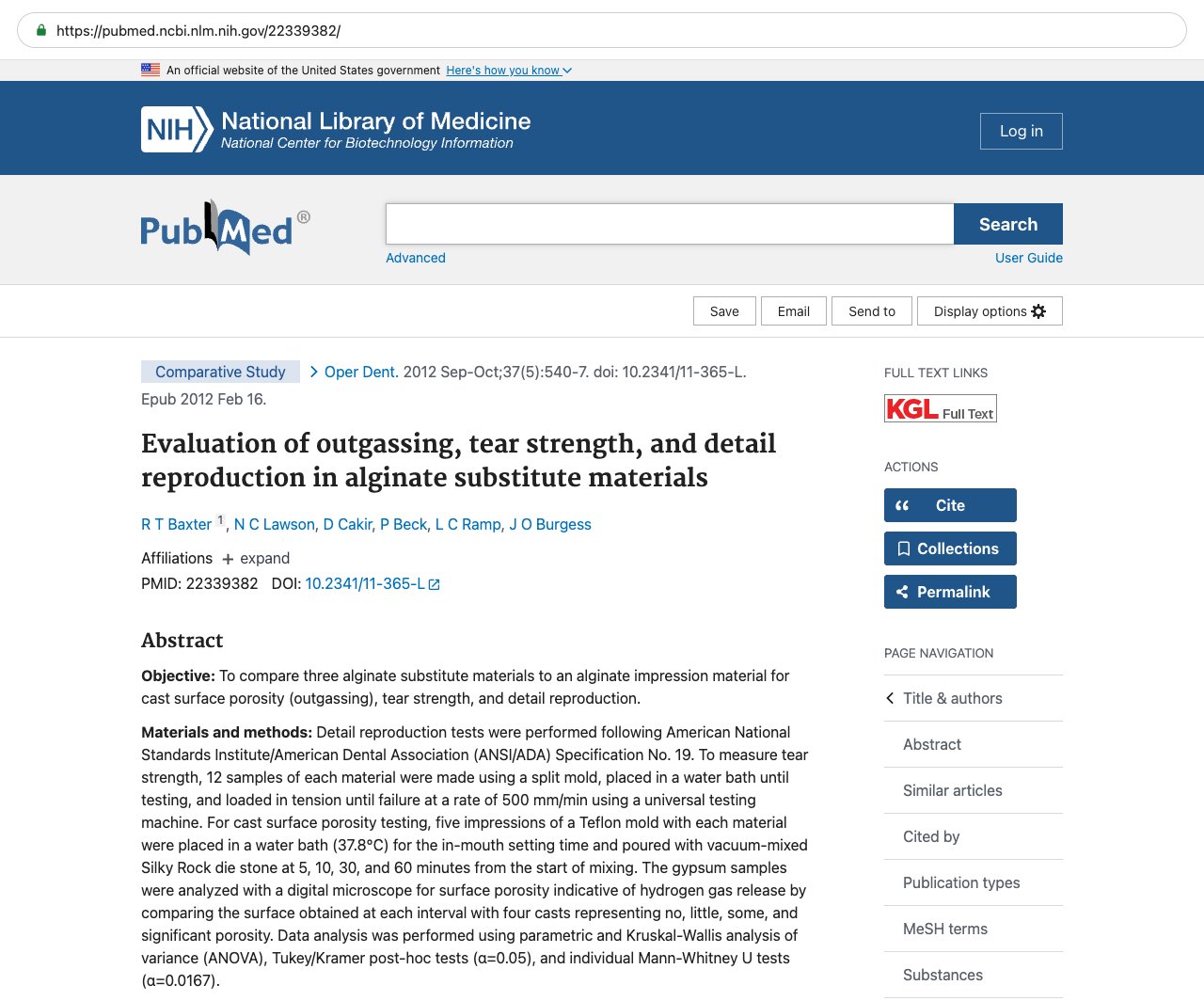
Screenshot of the PubMed page
This page mirrors the published abstract (© the authors / publisher) for reference and citation. The canonical source is the PubMed record linked above. This is not medical advice.