2011 Journal of materials science. Materials in medicine Mechanism / Preclinical InhalationBath / Topical
2011 · Gao — Fabrication and Characterization of Bioactive Composite Coatings on Mg-Zn-Ca Alloy by MAO/Sol-Gel
Super-Abstract
This in-vitro materials science study develops a two-layer protective coating for magnesium alloy implants that dramatically reduces corrosion and supports cell adhesion — addressing one of the main obstacles to using biodegradable magnesium in medical implants, namely the rapid release of hydrogen gas during degradation. This is biomaterials engineering research, not a study of molecular hydrogen therapy. (Journal of Materials Science: Materials in Medicine, 2011.)
Commentary
Magnesium alloys are attractive for biodegradable bone implants because they dissolve in the body over time, eliminating the need for implant removal surgery. However, their rapid corrosion in physiological fluids generates hydrogen gas (H₂) at the implant surface, creating gas pockets that delay healing and can cause tissue damage. This study tackles that problem by applying a micro-arc oxidation (MAO) porous base layer followed by a propolis/polylactic acid sol-gel top layer to Mg-Zn-Ca alloy samples. The composite coating reduced corrosion current density by roughly 50-fold and shifted the corrosion potential positively by 240 mV. Cell viability and adhesion tests with Wharton's jelly-derived mesenchymal stem cells showed improved biocompatibility. The mention of hydrogen in this paper refers to unwanted H₂ gas as a corrosion byproduct — not to H₂ as a therapeutic agent.
Key quotes
- „High corrosion rate and accumulation of hydrogen gas upon degradation impede magnesium alloys' clinical application as implants.“ — the problem: H₂ gas accumulation from magnesium corrosion is an obstacle to clinical use
- „the corrosion current density of the samples with composite coatings decreased from 5.37 × 10⁻⁵ to 1.10 × 10⁻⁶ A/cm² and the corrosion potential increased by 240 mV.“ — the main quantitative result: dramatically improved corrosion resistance
- „Composite coatings exhibit homogeneous corrosion behavior and can promote WJCs cell adhesion and proliferation.“ — biocompatibility confirmed with mesenchymal stem cells
Our assessment
This is an in-vitro biomaterials study. It does not investigate any therapeutic effect of molecular hydrogen. Hydrogen appears here as an unwanted corrosion byproduct that the coating aims to suppress. Honest note: this paper is not evidence for H₂ therapy and should not be cited in that context. It is valid engineering research on biodegradable implant coatings. Results are from laboratory corrosion tests and cell culture; clinical performance in living tissue would require animal and human studies.
Study design
- Type: in-vitro materials science study · Model: Mg-Zn-Ca alloy discs with MAO/sol-gel composite coatings; Wharton's jelly mesenchymal stem cells (WJCs) · H₂ relevance: H₂ gas as corrosion byproduct to be suppressed — not therapeutic H₂
- Result: ~50-fold reduction in corrosion current density; +240 mV corrosion potential shift; improved cell adhesion and proliferation; stable pH during immersion testing
Abstract
High corrosion rate and accumulation of hydrogen gas upon degradation impede magnesium alloys' clinical application as implants. In this work, micro-arc oxidation (MAO) was used to fabricate a porous coating on magnesium alloys as an intermediate layer to enhance the bonding strength of propolis layer. Then the composite coatings were fabricated using sol-gel method by dipping sample into the solution containing propolis and polylactic acid at 40 °C. The corrosion resistance of the samples was determined based on potentiodynamic polarization experiments and immersion tests. Biocompatibility was designed by observing the attachment and growth of wharton's jelly-derived mesenchymal stem cells (WJCs) on substrates with MAO coating and substrates with composite coatings. The results showed that, compared with that of Mg-Zn-Ca alloy, the corrosion current density of the samples with composite coatings decreased from 5.37 × 10⁻⁵ to 1.10 × 10⁻⁶ A/cm² and the corrosion potential increased by 240 mV. Composite coatings exhibit homogeneous corrosion behavior and can promote WJCs cell adhesion and proliferation. In the meantime, pH value was relatively stable during the immersion tests, which may be significant for cellular survival. In conclusion, our results indicate that composite coatings on Mg-Zn-Ca alloy fabricated by MAO/sol-gel method provide a new type bioactive material.
Source & links
Screenshot of the PubMed page
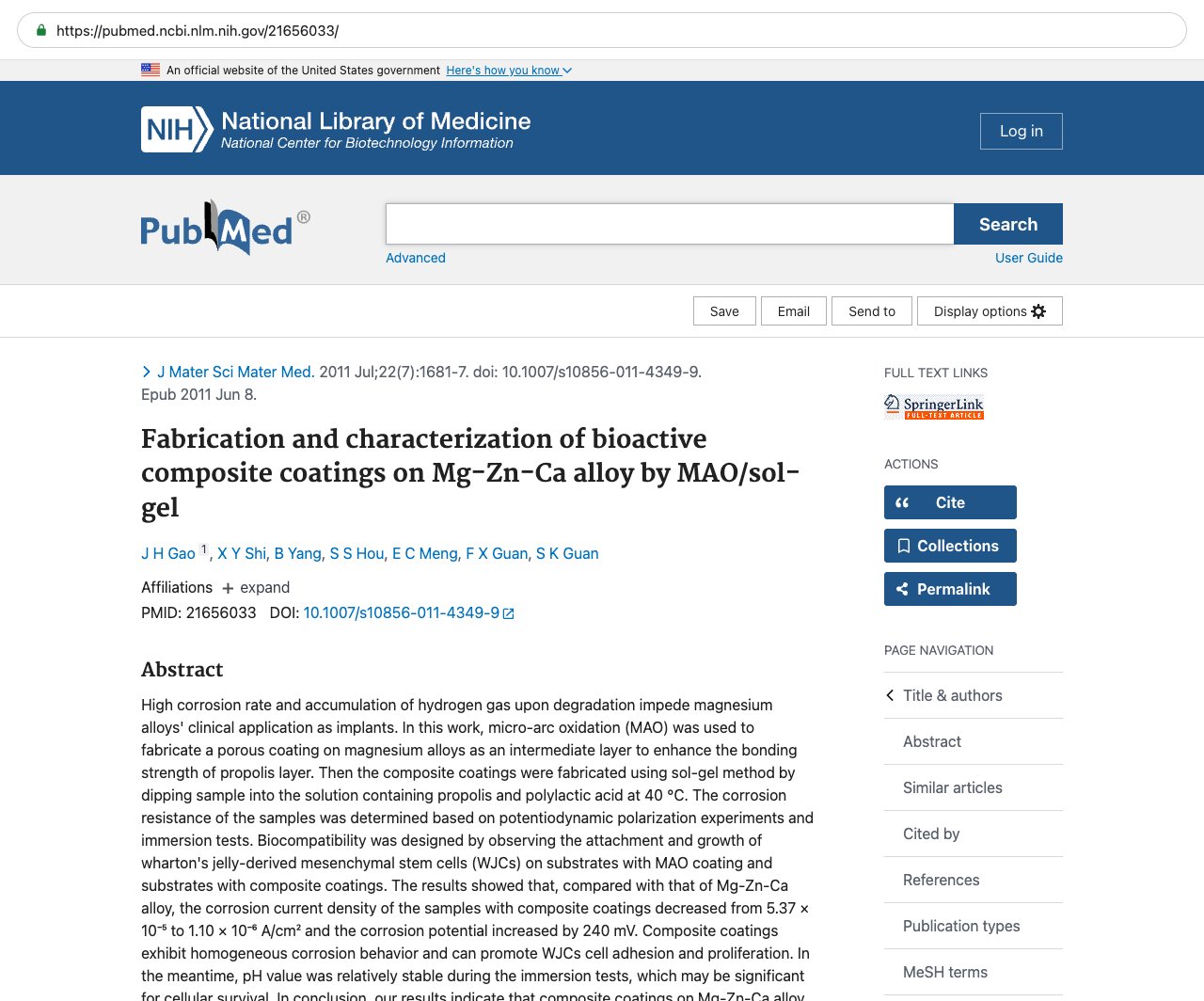
This page mirrors the published abstract (© the authors / publisher) for reference and citation. The canonical source is the PubMed record linked above. This is not medical advice.