2014 · Chen — Controlling initial biodegradation of magnesium by a biocompatible strontium phosphate conversion coating
Super-Abstract
Magnesium implants dissolve too quickly after implantation — a strontium phosphate (SrP) coating developed in this in-vitro study significantly slows this degradation. A side effect of Mg degradation is hydrogen gas evolution; the coating suppresses this as well. The cells (human mesenchymal stem cells) tolerated the coated implants without impairment of proliferation or differentiation. (Acta Biomaterialia, 2014.)
Commentary
This is a materials-science and cell-biology study on biodegradable magnesium implants. The hydrogen gas mentioned here is a byproduct of magnesium corrosion in body fluids — not the therapeutic molecular hydrogen (H₂) studied in hydrogen medicine. Coating Mg implants at 80 °C with strontium apatite (SrAp) produced the densest, most crystalline layer and the best corrosion protection over 14 days in minimum essential medium. The study contributes to implant engineering, not to any anti-oxidant or therapeutic H₂ application. It appears in the H₂ literature database because hydrogen gas evolution from Mg is a known implant safety concern and the coating addresses this.
Key quotes
- „The present study suggests that the SrP conversion coating is a promising option for controlling the early rapid degradation rate, and hence hydrogen gas evolution, of Mg implants without adverse effects on surrounding cells and tissues.“ — main conclusion: the coating reduces H₂ gas byproduct from Mg corrosion — not a therapeutic H₂ study
- „Coatings produced at 80 °C are primarily made up of strontium apatite (SrAp) with a granular surface, a high degree of crystallinity and the highest protective ability, which arises from retarding anodic dissolution of Mg in MEM.“ — the best-performing coating condition
- „the SrP coatings are biocompatible and permit proliferation to a level similar to that of pure Mg.“ — cell compatibility result
Our assessment
This is a preclinical materials study with no relevance to therapeutic molecular hydrogen. The hydrogen mentioned is unwanted corrosion gas from magnesium implants, which the coating is designed to suppress. The study itself is solid cell-biology and surface-chemistry work, but it does not provide any evidence — positive or negative — for H₂ as a health intervention. It is indexed here due to the keyword „hydrogen gas evolution.“ No human evidence, no therapeutic H₂ application.
Study design
- Type: in-vitro materials science · Model: minimum essential medium (MEM) immersion + human mesenchymal stem cells · H₂ relevance: H₂ gas as corrosion byproduct of Mg implants (not therapeutic)
- Coating process: strontium phosphate conversion at 40 °C and 80 °C · Key result: 80 °C SrAp coating maintained integrity after 14 days, retained cell proliferation comparable to uncoated Mg
Abstract
A simple strontium phosphate (SrP) conversion coating process was developed to protect magnesium (Mg) from the initial degradation post-implantation. The coating morphology, deposition rate and resultant phases are all dependent on the processing temperature, which determines the protective ability for Mg in minimum essential medium (MEM). Coatings produced at 80 °C are primarily made up of strontium apatite (SrAp) with a granular surface, a high degree of crystallinity and the highest protective ability, which arises from retarding anodic dissolution of Mg in MEM. Following 14 days' immersion in MEM, the SrAp coating maintained its integrity with only a small fraction of the surface corroded. The post-degradation effect of uncoated Mg and Mg coated at 40 and 80 °C on the proliferation and differentiation of human mesenchymal stem cells was also studied, revealing that the SrP coatings are biocompatible and permit proliferation to a level similar to that of pure Mg. The present study suggests that the SrP conversion coating is a promising option for controlling the early rapid degradation rate, and hence hydrogen gas evolution, of Mg implants without adverse effects on surrounding cells and tissues.
Source & links
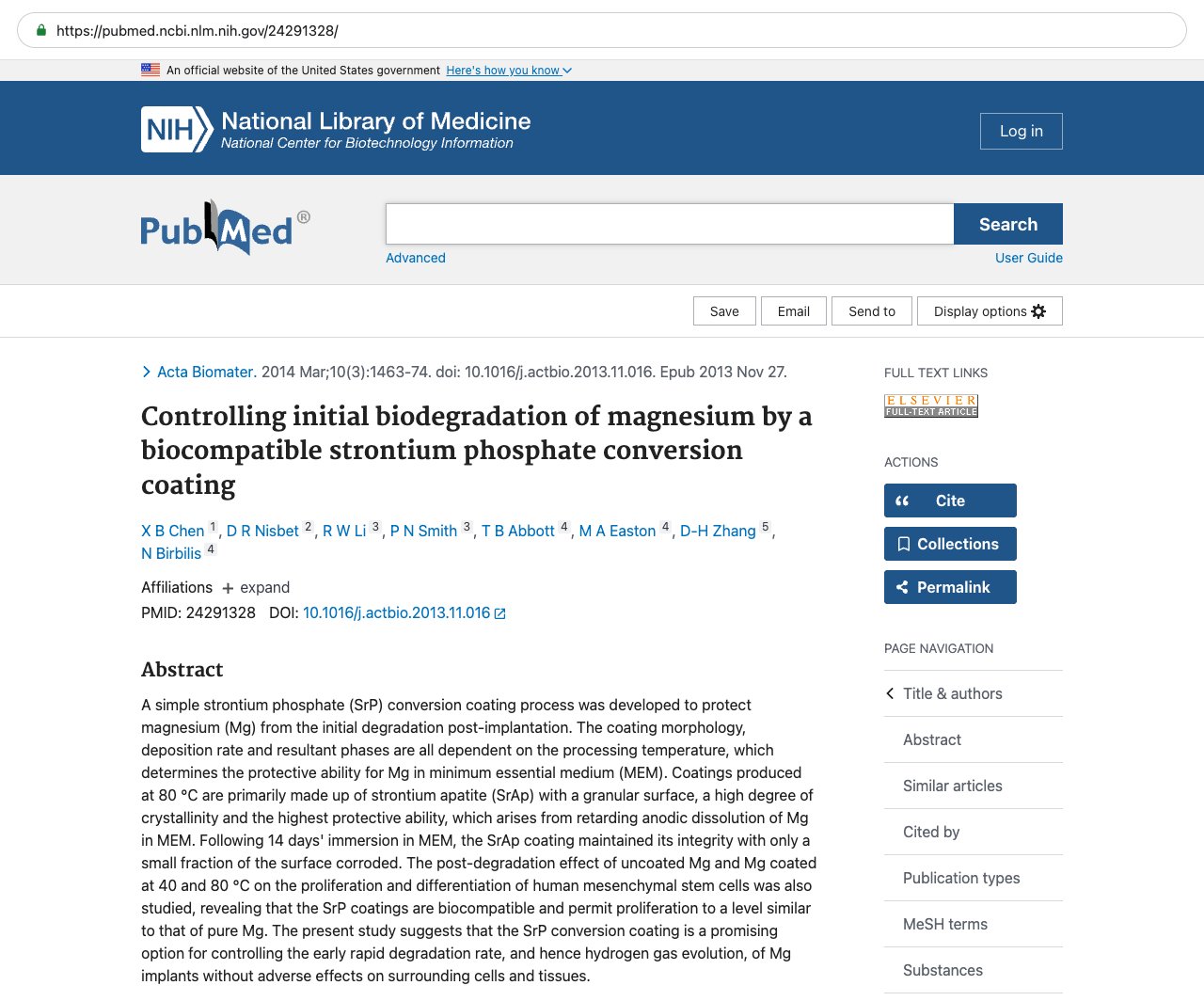
Screenshot of the PubMed page
This page mirrors the published abstract (© the authors / publisher) for reference and citation. The canonical source is the PubMed record linked above. This is not medical advice.