2026 · Pozdnyakova — The combined use of inhaled nitric oxide and molecular hydrogen in patients with post-COVID-19 syndrome
Super-Abstract
Combined inhalation of nitric oxide (NO) and molecular hydrogen (H₂) relieves post-COVID syndrome better than NO alone. In a controlled trial with 60 patients, shortness of breath, cough and fatigue improved, the distance in the 6-minute walk test rose, and reactive oxygen species fell — significantly more so only in the combination group (p < 0.05). (Terapevticheskii arkhiv, 2026.)
Commentary
This Russian study tests H₂ as an add-on to established nitric oxide inhalation in long/post-COVID. The design is a prospective, open-label, controlled trial with 60 patients (mean age 58 years, 18 men, 42 women), randomized into three groups: NO+H₂, NO alone and a control group. Treatment ran for ten days, 90 minutes each via nasal cannula, with H₂ at under 4% concentration. Measurement used a whole arsenal of questionnaires — dyspnea scale, fatigue scale, anxiety/depression scale, quality of life (SF-36) — plus 6-minute walk test and oxidative status in blood. Result: both NO+H₂ and NO alone brought the clinical complaints back and improved quality of life and microcirculation versus control. The decisive point: only the combination therapy additionally increased the walking distance significantly and lowered reactive oxygen species more than NO alone (p < 0.05). No serious adverse events. Honestly: it is an open (non-blinded) study with small group size (n = 20 per arm), and H₂ here works only in combination with NO — the isolated H₂ effect cannot be cleanly read from it.
Key quotes
- „The course of iNO/iН2 and iNO led to regression of the clinical manifestations of PS (dyspnea, cough, fatigue), improved the physical and psychological component of quality of life“ — complaints and quality of life improve
- „In combination therapy, there was an increase in distance traveled by 6-minute walk test and decrease in reactive oxygen species compared to iNO and control groups (p < 0.05).“ — the added benefit of H₂: more exercise capacity, less oxidative stress
- „No serious adverse events were noted.“ — safety profile unremarkable
Our assessment
Relevant for the H₂ inhalation segment and the long-COVID topic that concerns many customers. The study shows a measurable additional benefit of H₂ beyond NO — especially for oxidative stress, the mechanistic core argument of H₂. Limitation, stated honestly: open design (no blinding, so placebo/expectation effects possible), small arms (n = 20), and H₂ was tested only as a co-intervention with NO — the pure H₂ contribution remains unclear. Evidence level 2 (controlled pilot study, not blinded).
Study design
- Type: prospective, open-label, controlled RCT (3 parallel groups) · n: 60 (3 × 20) · Duration: 10 days, 90 min/day · H₂ delivery: inhalation via nasal cannula, 4 L/min, iH₂ < 4%, iNO 60 ppm
- Result figures: regression of dyspnea/cough/fatigue and better quality of life in both gas groups vs. control (p < 0.05); only combination NO+H₂: significantly greater 6-minute walk distance and stronger ROS reduction vs. NO and control (p < 0.05); no serious adverse events
Abstract
BACKGROUND: Medical gases, inhaled nitric oxide (iNO) and molecular hydrogen (iH2), have been used in the therapy for various medical conditions. When combined, these gases have shown to be more effective and safer for patients, and may become a promising treatment option for various diseases рost-COVID-19 syndrome (PS). AIM: To compare the efficacy and safety of combined therapy iNO/iH2 with monotherapy iNO and a control group in patients with respiratory disorders during with PS. MATERIALS AND METHODS: A prospective, open-label, controlled trial involving 60 patients with PS was conducted in parallel groups (the mean age of the participants was 58.1 ± 12.9 years, and the sample consisted of 18 men and 42 women). The participants were randomly assigned to 3 groups: 1 (n = 20) - iNO/iH2 treatment; 2 (n = 20) - only iNO treatment; and 3 (n = 20) - control group. The duration of treatment was 10 days, and the treatment involved inhalation through a nasal cannula for 90 minutes (flow rate of 4 liters per minute, iH2 concentrations < 4%, iNO - 60 pmm). Clinical outcomes were assessed using self-observation diaries, Modified Medical Research Council Dyspnea Scale questionnaires, the "Language of Dyspnea" Scale, Fatigue Assessment Scale, Hospital Anxiety and Depression Scale, and Short Form-36 Health Status Survey questionnaires. Additionally, a 6-Minute Walk Test was performed, and indicators of oxidative status in blood serum and microcirculation in the bulbar conjunctiva were measured. RESULTS: The course of iNO/iН2 and iNO led to regression of the clinical manifestations of PS (dyspnea, cough, fatigue), improved the physical and psychological component of quality of life, and contributed to improvement in microcirculation (increased venule diameter and velocity) compared to the control group (p < 0.05). In combination therapy, there was an increase in distance traveled by 6-minute walk test and decrease in reactive oxygen species compared to iNO and control groups (p < 0.05). No serious adverse events were noted. CONCLUSION: The study demonstrates the advantage of the iNO/iH2 course in comparison with iNO and control in the rehabilitation program of patients with PS. The safety and effectiveness of the iNO/iH2 course has been proven in the form of regression of clinical manifestations of PS, improvement of quality of life, exercise tolerance, microcirculation parameters, and restoration of the oxidative status of the body.
Source & links
Screenshot of the PubMed page
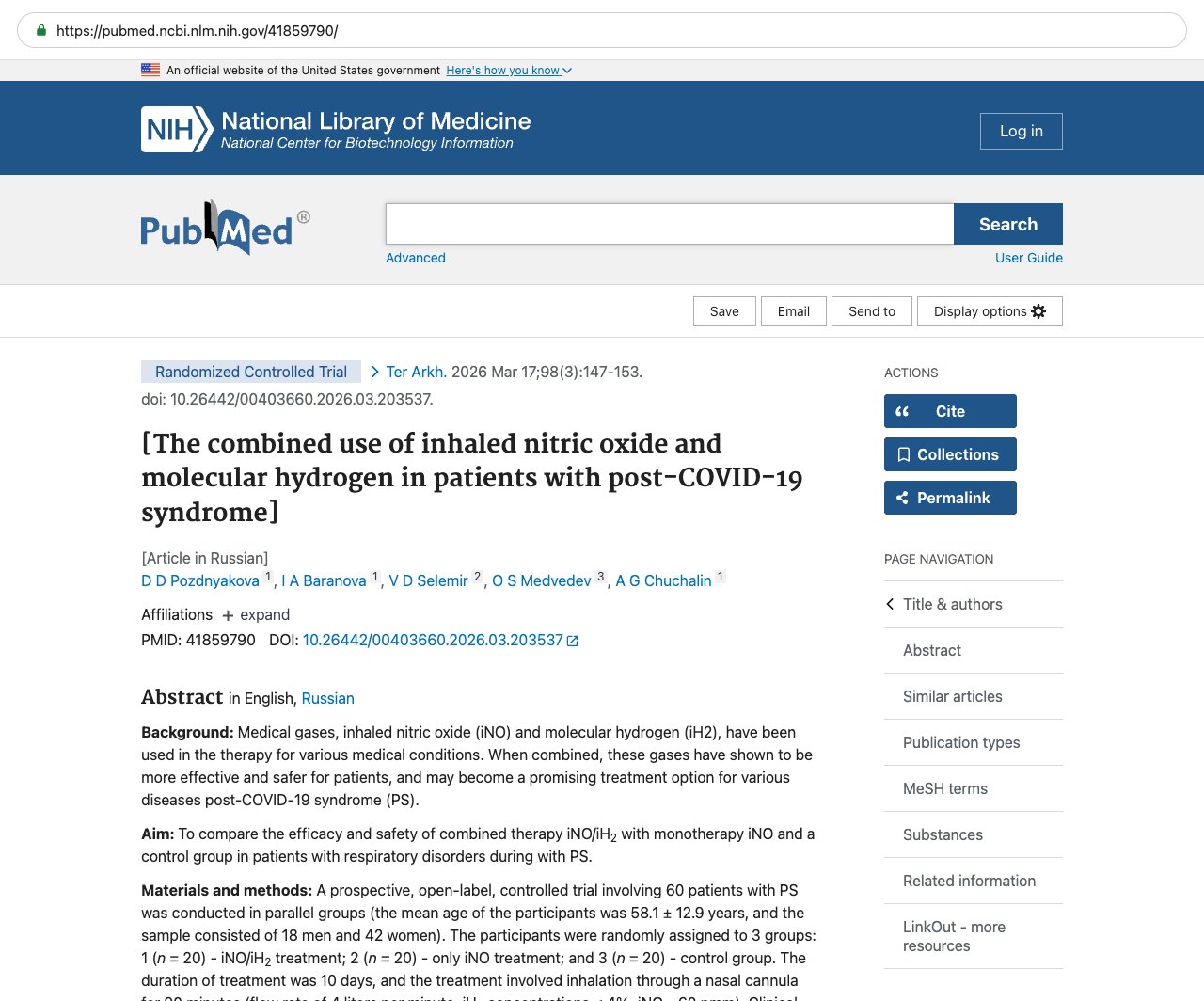
This page mirrors the published abstract (© the authors / publisher) for reference and citation. The canonical source is the PubMed record linked above. This is not medical advice.