2014 · Bazaka et al. — Polymer encapsulation of magnesium to control biodegradability and biocompatibility.
Super-Abstract
This animal and cell study investigated plasma-polymerised coatings on biodegradable magnesium implants — where hydrogen gas appears as an unwanted by-product of magnesium corrosion, not as a therapeutic agent. The polymer coating successfully slowed magnesium degradation and improved cell viability compared to uncoated samples.
Commentary
Biodegradable magnesium implants are an emerging area of orthopaedic and surgical research: they dissolve over time, eliminating the need for implant removal surgery. Their main drawback is a high corrosion rate that causes mechanical failure, local alkalisation, and accumulation of hydrogen gas around the implant. This study addresses the engineering problem — not the biology of therapeutic H₂. Plasma polymer coatings derived from a monoterpene alcohol reduced corrosion in simulated body fluid and improved cytocompatibility of THP-1 and mouse macrophage cells. H₂ appears here solely as an engineering nuisance to be minimised, not as a substance with therapeutic intent.
Key quotes
- „Their high corrosion rate leads to loss of mechanical integrity, peri-implant alkalization and localised accumulation of hydrogen gas.“ — H₂ as a problem to be controlled, not a therapeutic agent
- „The viability of THP-1 cells was significantly improved when in contact with polymer encapsulated magnesium compared to unmodified samples.“ — biocompatibility improvement from polymer coating
- „plasma enhanced polymer encapsulation of magnesium as a suitable method to control degradation kinetics of this biomaterial.“ — the engineering solution proposed
Our assessment
This is a preclinical material science/animal study. Hydrogen gas is a corrosion by-product here — not a bioactive intervention. The findings are relevant to biodegradable implant engineering but have no bearing on molecular hydrogen as a health supplement or therapy. Results are from in-vitro cell models and rat-tissue simulated body fluid, not from a therapeutic H₂ study.
Study design
- Type: preclinical animal + in-vitro study · Model: THP-1 human monocytes, mouse macrophage cells, simulated body fluid (magnesium degradation) · H₂ role: unwanted corrosion by-product of magnesium implants (not therapeutic)
- Result: polymer coating reduced magnesium corrosion rate; THP-1 cell viability significantly improved vs. uncoated magnesium; no therapeutic H₂ endpoints
Abstract
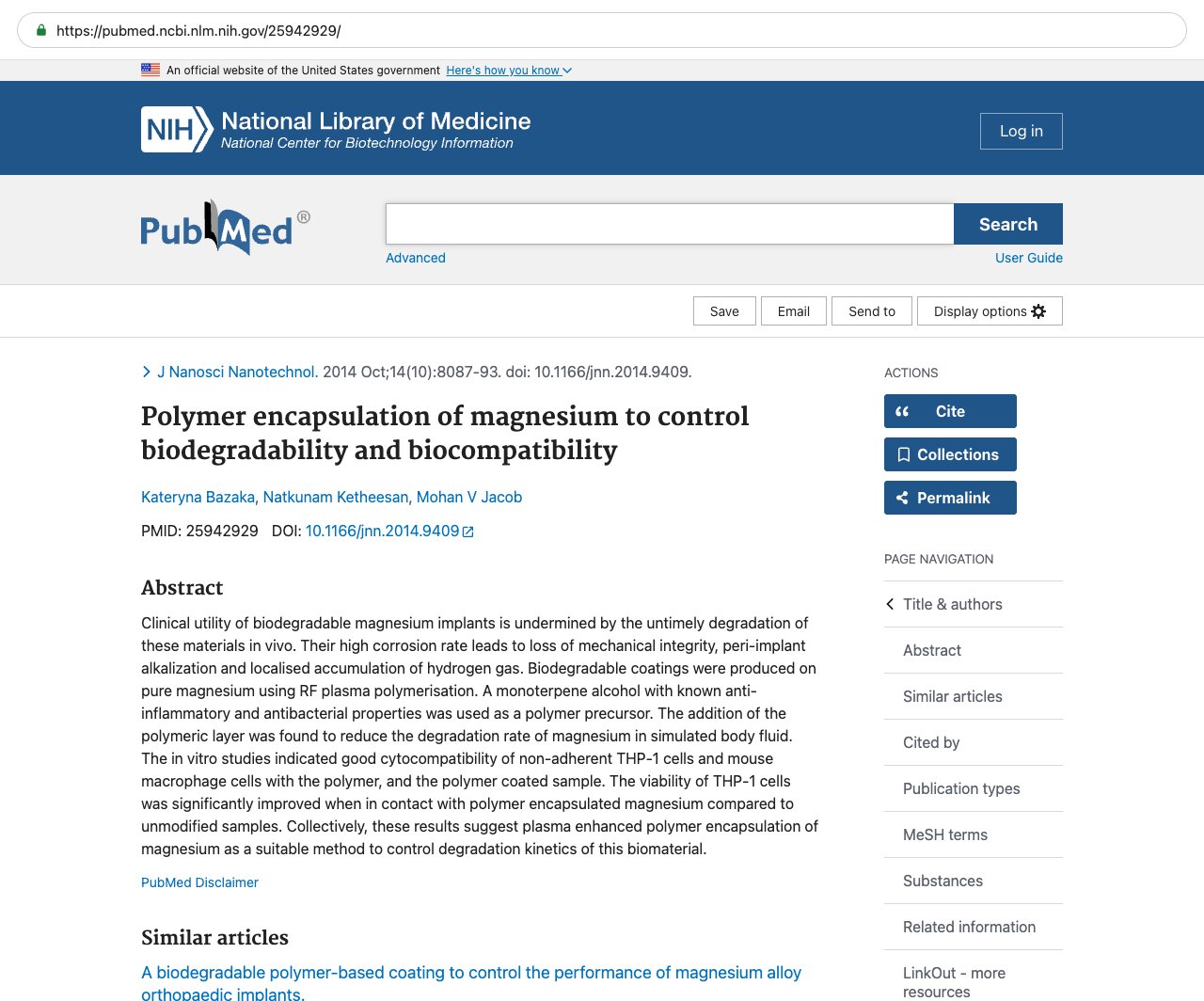
Clinical utility of biodegradable magnesium implants is undermined by the untimely degradation of these materials in vivo. Their high corrosion rate leads to loss of mechanical integrity, peri-implant alkalization and localised accumulation of hydrogen gas. Biodegradable coatings were produced on pure magnesium using RF plasma polymerisation. A monoterpene alcohol with known anti-inflammatory and antibacterial properties was used as a polymer precursor. The addition of the polymeric layer was found to reduce the degradation rate of magnesium in simulated body fluid. The in vitro studies indicated good cytocompatibility of non-adherent THP-1 cells and mouse macrophage cells with the polymer, and the polymer coated sample. The viability of THP-1 cells was significantly improved when in contact with polymer encapsulated magnesium compared to unmodified samples. Collectively, these results suggest plasma enhanced polymer encapsulation of magnesium as a suitable method to control degradation kinetics of this biomaterial.
Source & links
Screenshot of the PubMed page
This page mirrors the published abstract (© the authors / publisher) for reference and citation. The canonical source is the PubMed record linked above. This is not medical advice.