2023 · Bellucci et al. — Novel Therapeutic Approaches Based on the Pathological Role of Gut Dysbiosis on the Link Between Non-Alcoholic Fatty Liver Disease and Insulin Resistance
Super-Abstract
This review examines the interplay between gut dysbiosis, insulin resistance, and non-alcoholic fatty liver disease (NAFLD) — the most common chronic liver disease in the Western world — and surveys a broad range of therapeutic strategies including probiotics, prebiotics, fecal microbiota transplant, Chinese herbal medicine, dietary approaches, and minor therapies such as hydrogen-rich water. Hydrogen-rich water is mentioned as one of several experimental approaches showing potential to improve NAFLD's phenotypic pattern. This is a literature review, not a clinical study of H₂ therapy.
Commentary
NAFLD affects hundreds of millions of people globally and its intersection with insulin resistance and gut dysbiosis represents one of metabolic medicine's most complex feedback loops. This review takes a broad therapeutic panorama, listing hydrogen-rich water among „minor therapies“ alongside carbon nanoparticles and an MCJ protein — not as a primary focus but as an emerging possibility. The H₂ mention in this context reflects a growing recognition that gut-derived molecular hydrogen (from bacterial fermentation) may have systemic antioxidant effects relevant to NAFLD pathophysiology. However, the specific H₂ evidence base within the context of NAFLD and insulin resistance is thin, and the review does not conduct a systematic quality assessment of the hydrogen evidence. It is more useful as a general map of the NAFLD therapeutic landscape than as a H₂-specific resource.
Key quotes
- „The use of probiotics, prebiotics, symbiotics, postbiotics, fecal microbiota transplant (FMT), Chinese herbal medicine, antibiotics, diet (polyphenols and fasting diets), and minor therapies such as carbon nanoparticles, the MCJ protein, water rich in molecular hydrogen, seems to be able to improve the phenotypic pattern in NAFLD patients.“ — hydrogen-rich water listed as one of many candidate therapeutic approaches — context is exploratory, not established
- „In the last few years, a rising number of studies conducted both on animal and human models have shown the existence of a close association between insulin resistance (IR), dysbiosis, and steatosis.“ — the trifecta the review investigates: IR, dysbiosis, and NAFLD are tightly linked
Our assessment
This paper is primarily a review of NAFLD and gut dysbiosis, in which hydrogen-rich water appears as one item in a long list of candidate interventions. It is not a H₂-focused review, and its coverage of the hydrogen evidence is minimal. As a review article, it produces no new experimental data. For those specifically interested in H₂ and NAFLD, this paper provides limited dedicated insight — it situates H₂ as a „minor therapy“ worth exploring, no more. More targeted H₂ NAFLD research would be needed to draw meaningful conclusions.
Study design
- Type: narrative review · n: n/a (literature synthesis) · H₂ delivery: hydrogen-rich water mentioned briefly among other interventions
- Primary focus: gut dysbiosis → insulin resistance → NAFLD pathophysiology and therapeutic strategies · H₂ is one of many candidate approaches discussed, not the primary subject
Abstract
The growing global epidemic of obesity and type 2 diabetes mellitus has determined an increased prevalence of NAFLD (non-alcoholic fatty liver disease), making it the most common chronic liver disease in the Western world and a leading cause of liver transplantation. In the last few years, a rising number of studies conducted both on animal and human models have shown the existence of a close association between insulin resistance (IR), dysbiosis, and steatosis. However, all the mechanisms that lead to impaired permeability, inflammation, and fibrosis have not been fully clarified. Recently, new possible treatment modalities have received much attention. To reach the review purpose, a broad-ranging literature search on multidisciplinary research databases was performed using the following terms alone or in combination: "NAFLD", "gut dysbiosis", "insulin resistance", "inflammation", "probiotics", "Chinese herbs". The use of probiotics, prebiotics, symbiotics, postbiotics, fecal microbiota transplant (FMT), Chinese herbal medicine, antibiotics, diet (polyphenols and fasting diets), and minor therapies such as carbon nanoparticles, the MCJ protein, water rich in molecular hydrogen, seems to be able to improve the phenotypic pattern in NAFLD patients. In this review, we provide an overview of how IR and dysbiosis contribute to the development and progression of NAFLD, as well as the therapeutic strategies currently in use.
Source & links
Screenshot of the PubMed page
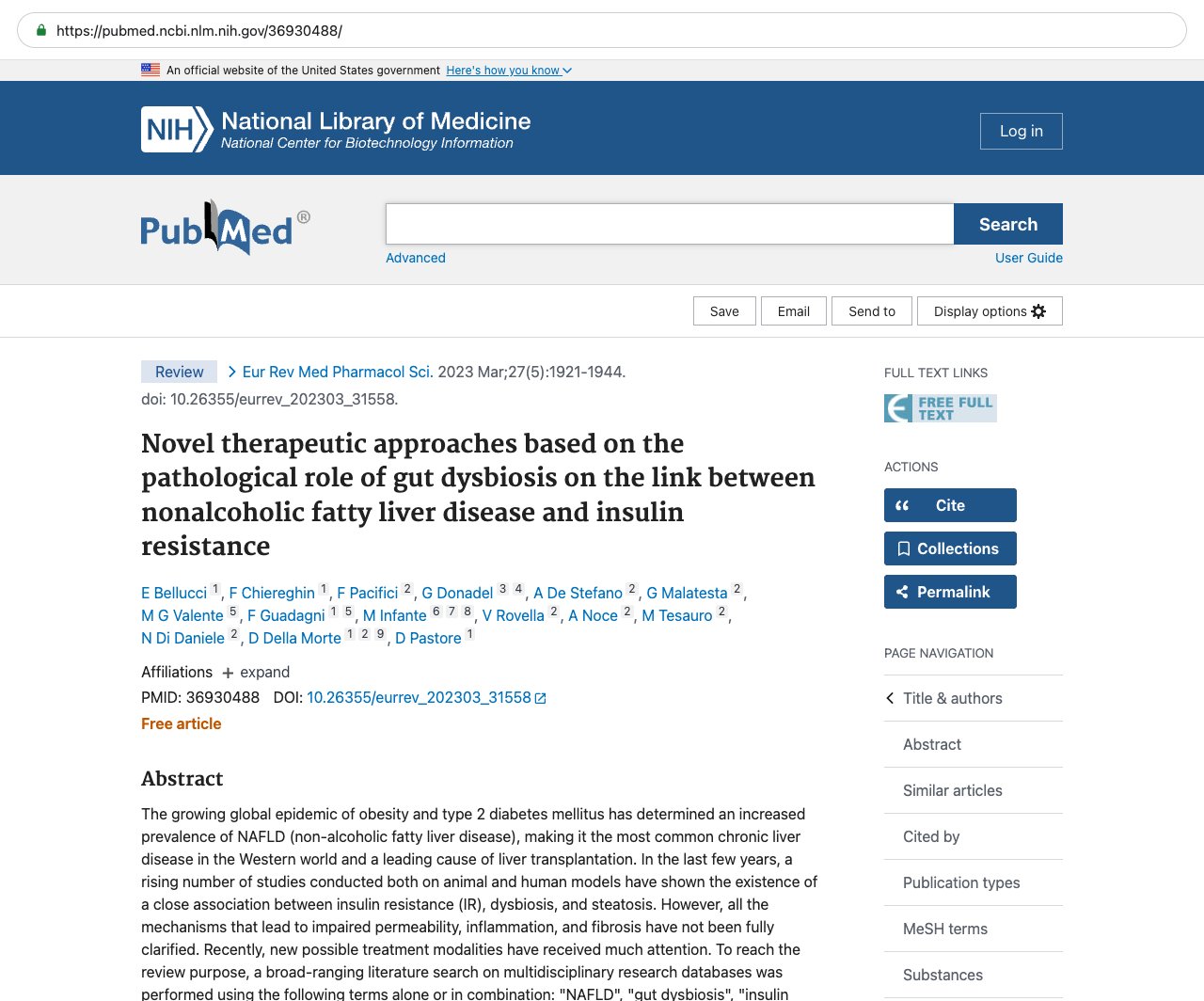
This page mirrors the published abstract (© the authors / publisher) for reference and citation. The canonical source is the PubMed record linked above. This is not medical advice.