2018 Cellular physiology and biochemistry : international journal of experimental cellular physiology, biochemistry, and pharmacology Review / Meta-analysis Unspecified
2018 · Zhang — Hydrogen Therapy in Cardiovascular and Metabolic Diseases: from Bench to Bedside
Super-Abstract
This review summarises a decade of H₂ research in cardiovascular and metabolic diseases — from animal models to early clinical trials. Areas covered include atherosclerosis, cardiac ischaemia, hypertrophic remodelling, heart transplantation injury, obesity, and diabetes. The authors conclude that H₂-based therapies show broad potential in cardiometabolic disease, though most mechanistic work remains preclinical. (Cellular Physiology and Biochemistry, 2018.)
Commentary
Zhang and colleagues provide a useful orientation review for anyone entering the H₂-cardiovascular field. The paper catalogues delivery routes (inhalation, hydrogen-rich water, saline), describes proposed molecular mechanisms — selective scavenging of hydroxyl radicals and peroxynitrite, modulation of Nrf2 and NF-κB pathways — and maps the evidence landscape from cell culture through animal models to a handful of human trials. The review is frank that most clinical data come from small, often uncontrolled pilots, and that mechanistic understanding still has significant gaps. As a 2018 overview it represents the state of knowledge at an early but active period in the field.
Key quotes
- „Delivery of H2 by various strategies improves cardiometabolic diseases, including atherosclerosis, vascular injury, ischemic or hypertrophic ventricular remodeling, intermittent hypoxia- or heart transplantation-induced heart injury, obesity and diabetes in animal models or in clinical trials.“ — scope of the review across disease areas
- „The purpose of this review is to summarize the physical and chemical properties of H2, and then, the functions of H2 with an emphasis on the therapeutic potential and molecular mechanisms involved in the diseases above.“ — stated objective of the paper
- „We hope this review will provide the future outlook of H2-based therapies for cardiometabolic disease.“ — forward-looking conclusion
Our assessment
This is a narrative review, not a meta-analysis or clinical trial. Its value lies in breadth: it assembles diverse preclinical and a few clinical signals into one readable map. Limitations: no quantitative pooling of effects, publication bias likely, many cited studies are small animal experiments whose translational relevance to humans is unproven. The review does not perform a systematic literature search, so coverage may be selective. It is a good entry point but should not be read as definitive proof of clinical efficacy in any of the listed conditions.
Study design
- Type: narrative review · n: n/a (literature analysis) · H₂ delivery: multiple routes reviewed (inhalation, hydrogen-rich water, hydrogen-rich saline)
- Result: descriptive synthesis across multiple disease models; evidence ranges from in-vitro to small clinical pilots; no pooled effect sizes reported
Abstract
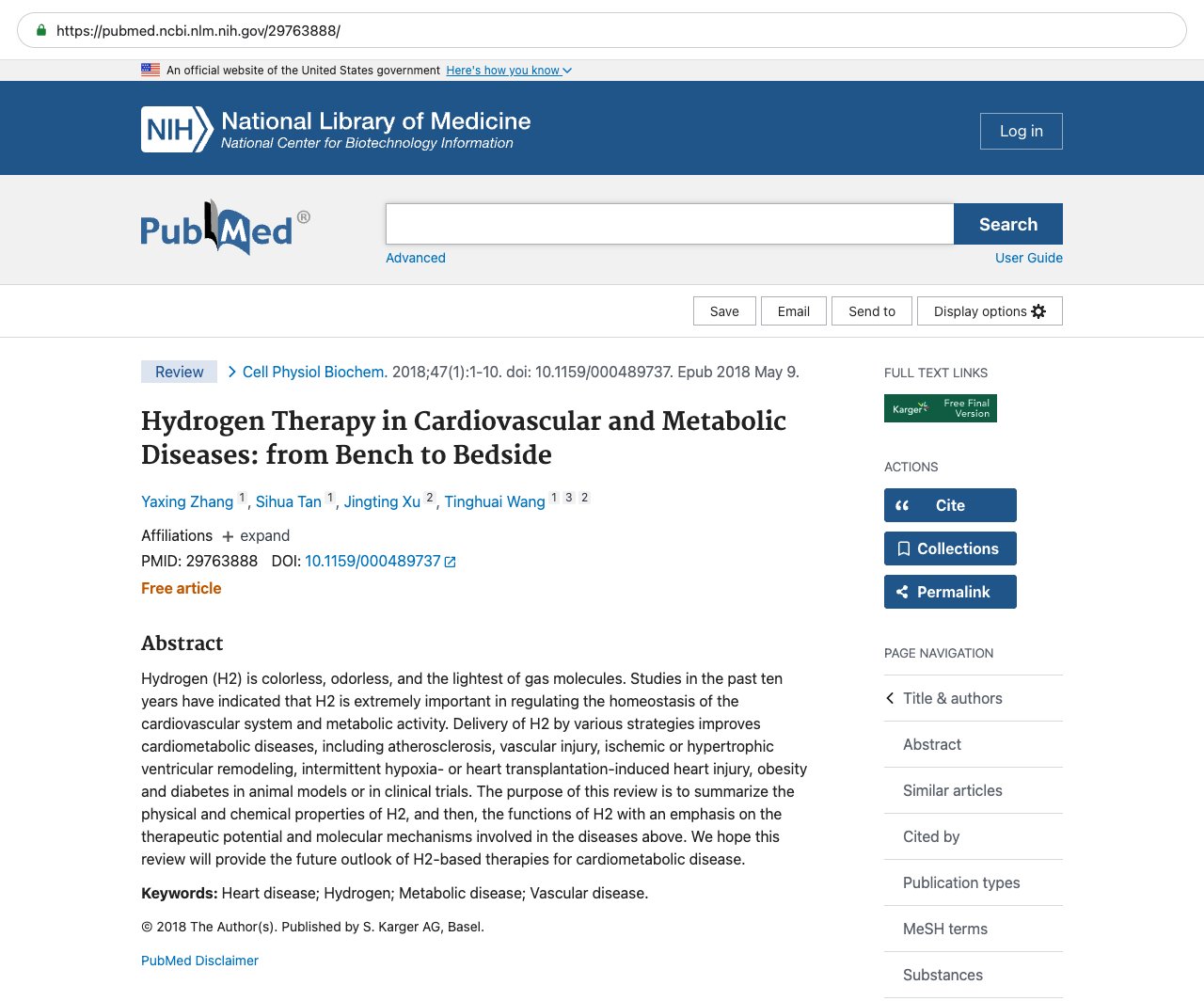
Hydrogen (H2) is colorless, odorless, and the lightest of gas molecules. Studies in the past ten years have indicated that H2 is extremely important in regulating the homeostasis of the cardiovascular system and metabolic activity. Delivery of H2 by various strategies improves cardiometabolic diseases, including atherosclerosis, vascular injury, ischemic or hypertrophic ventricular remodeling, intermittent hypoxia- or heart transplantation-induced heart injury, obesity and diabetes in animal models or in clinical trials. The purpose of this review is to summarize the physical and chemical properties of H2, and then, the functions of H2 with an emphasis on the therapeutic potential and molecular mechanisms involved in the diseases above. We hope this review will provide the future outlook of H2-based therapies for cardiometabolic disease.
Source & links
Screenshot of the PubMed page
This page mirrors the published abstract (© the authors / publisher) for reference and citation. The canonical source is the PubMed record linked above. This is not medical advice.