2025 · Huang — Magnesium hydride-induced hydrogen therapy for enhanced sonodynamic therapy.
Super-Abstract
Combining molecular hydrogen (H₂) released from magnesium hydride with ultrasound-activated cancer therapy (sonodynamic therapy, SDT) significantly improves anti-tumour efficacy and enhances the response to immune checkpoint inhibitors in mice. The H₂ amplifies tumour cell destruction and — through its alkaline by-products — neutralises the acidic tumour environment that normally suppresses immune responses. This is an animal study; no human data are available. (Materials Horizons, 2025.)
Commentary
Sonodynamic therapy (SDT) uses ultrasound to activate a sensitiser compound and generate cytotoxic reactive oxygen species inside tumours — it is a non-invasive, local approach with growing research interest. This paper adds MgH₂ microspheres to SDT: the MgH₂ reacts with water to produce H₂ (which amplifies ROS cytotoxicity and induces immunogenic cell death) and also generates OH⁻ and Mg²⁺ ions that neutralise the acidic tumour microenvironment (TME). An acidic TME suppresses T-cell function, so neutralisation helps immune checkpoint therapy (anti-PD-1). The study further shows MgH₂ upregulates PD-1 on T cells, sensitising tumours to anti-PD-1. This is a well-designed multimodal strategy with sound mechanistic rationale. However, the CT26 colorectal cancer murine model used here has known limitations in predicting human immunotherapy response. No human trials exist; clinical translation requires proof that this three-way combination (H₂ + SDT + anti-PD-1) is safe and feasible in patients.
Key quotes
- „the sustained release of H₂ from MgH2 microspheres amplifies tumor cell destruction, thereby promoting immune cell recruitment to the tumor site.“ — the dual role of H₂: cytotoxic amplifier and immune recruiter
- „the hydroxide ions (OH-) and magnesium ions (Mg2+) generated by MgH2 alleviate the acidic TME, reversing immune suppression and enhancing T-cell-mediated antitumor responses.“ — alkaline by-products remodel the immune-suppressive tumour microenvironment
- „MgH2 upregulates PD-1 expression in T cells, markedly improving the sensitivity of tumors to aPD-1 therapy.“ — unexpected finding: MgH₂ makes tumours more responsive to anti-PD-1 checkpoint therapy
Our assessment
A mechanistically rich preclinical study combining three modalities (H₂, SDT, anti-PD-1) with sound scientific rationale and promising murine efficacy data. The mechanistic logic — H₂ amplifies SDT, MgH₂ by-products reverse TME acidity, PD-1 upregulation enhances checkpoint therapy — is internally consistent. Critical limitation: this is an animal study only — results cannot be directly extrapolated to humans. SDT itself is not yet standard clinical practice, and adding two further agents (H₂ and anti-PD-1) multiplies the translational complexity. The paper claims broad potential as a „generalizable approach“ — appropriate as a research direction but not as a clinical claim. No human data exist.
Study design
- Type: animal study (preclinical) · Model: CT26 colorectal cancer murine model · H₂ delivery: MgH₂ microspheres — sustained H₂ release via Mg-water reaction; co-generates OH⁻ and Mg²⁺
- Combination: barium titanate (BTO)-mediated SDT (ultrasound-activated) + MgH₂ + anti-PD-1 antibody (aPD-1)
- Result: synergistic tumour suppression vs. BTO-SDT alone; prolonged murine survival; MgH₂ upregulates PD-1 on T cells, improving anti-PD-1 sensitivity; TME acidity neutralised
Abstract
The tumor microenvironment (TME) is typically immunosuppressive, playing a crucial role in tumor progression, immune evasion, and therapeutic resistance, all of which significantly impede the efficacy of cancer therapies1. Herein, we propose that magnesium hydride (MgH2)-induced hydrogen (H2) therapy can synergistically enhance barium titanate (BTO)-mediated sonodynamic therapy (SDT) while modulating the TME to improve the efficacy of immune checkpoint inhibitors (aPD-1). Specifically, ultrasound (US) activated BTO to trigger SDT and induce immunogenic cell death (ICD), while the sustained release of H2 from MgH2 microspheres amplifies tumor cell destruction, thereby promoting immune cell recruitment to the tumor site. Meanwhile, the hydroxide ions (OH-) and magnesium ions (Mg2+) generated by MgH2 alleviate the acidic TME, reversing immune suppression and enhancing T-cell-mediated antitumor responses. In the CT26 tumor model, the synergistic combination of SDT and MgH2 therapy significantly enhances the anti-tumor efficacy of SDT compared to that of BTO alone, leading to prolonged survival of treated mice. Moreover, MgH2 upregulates PD-1 expression in T cells, markedly improving the sensitivity of tumors to aPD-1 therapy. This strategy provides a generalizable approach for enhancing SDT, demonstrating its broad potential in anti-tumor treatment and presenting a promising avenue for overcoming resistance to immune checkpoint inhibitors.
Source & links
Screenshot of the PubMed page
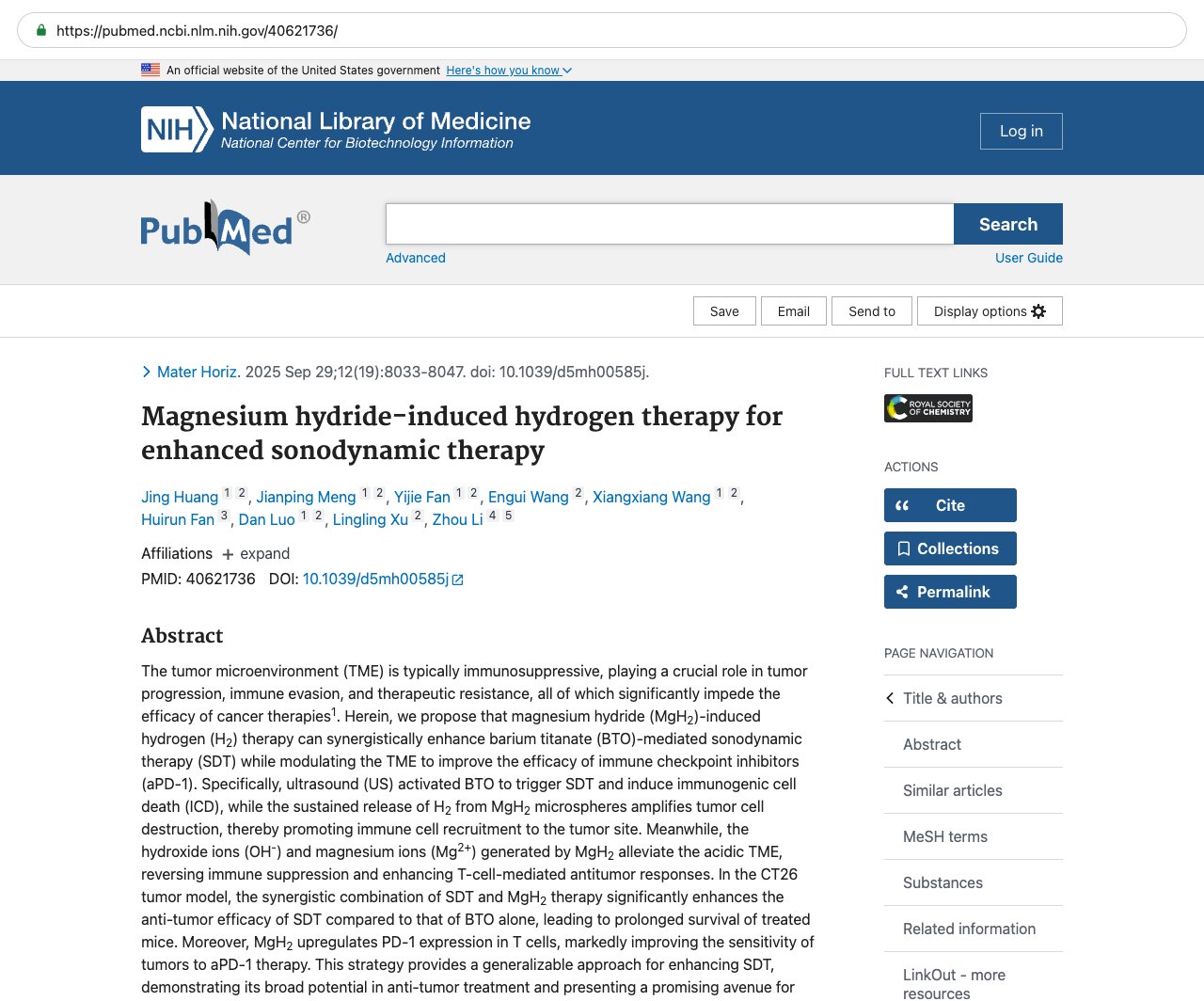
This page mirrors the published abstract (© the authors / publisher) for reference and citation. The canonical source is the PubMed record linked above. This is not medical advice.