2022 · Botek — Hydrogen Rich Water Consumption Positively Affects Muscle Performance, Lactate Response, and Alleviates Delayed Onset of Muscle Soreness After Resistance Training
Super-Abstract
Hydrogen-rich water improves muscle performance, lowers the lactate response and alleviates muscle soreness after resistance training. In a randomized double-blind crossover (12 men), muscle soreness after 24 hours was markedly lower (26 vs. 41 mm, p = 0.002). (J Strength Cond Res, 2022.)
Commentary
This study extends the H₂ sports benefit from endurance to resistance training — where the evidence was previously thin. The design is randomized, double-blind, placebo-controlled crossover with 12 men (about 24 years), who completed a tough leg programme once after H₂ water (1,260 ml in total) and once after placebo: squats, leg curls and leg extensions at 70 % of the maximum weight plus lunges. The results: the lunges were performed faster with H₂ water (p < 0.001), lactate was lower both during and immediately after exertion (e.g. 5.1 vs. 6.3 mmol/L, p ≤ 0.008), and the decisive point for anyone who trains: muscle soreness 24 hours later was markedly lower on the visual pain scale — 26 versus 41 mm (p = 0.002). This suggests better and faster recovery. To be honest: the sample is very small (n = 12) and all male, and it is an acute single hydration, not a long-term study.
Key quotes
- „Visual analog scale ratings were significantly lower with HRW (26 ± 11 vs. 41 ± 20 mm, p = 0.002) after 24 hours of recovery.“ — the clearly measurable effect: less muscle soreness the next day
- „Hydrogen rich water reduced lactate at mid-way and immediately after the exercise (HRW: 5.3 ± 2.1 and 5.1 ± 2.2, placebo: 6.5 ± 1.8 and 6.3 ± 2.2 mmol·L -1 , p ≤ 0.008).“ — lower lactate response under exertion
- „an acute intermittent HRW hydration improved muscle function, reduced the lactate response, and alleviated delayed onset of muscle soreness.“ — the authors' summarising conclusion
Our assessment
Directly relevant to recovery from strength and fitness training, because the endpoint „delayed-onset muscle soreness“ (DOMS) is very tangible in everyday practice. The double-blind crossover design largely excludes placebo effects — each subject is their own control. Mechanistically, the lower lactate and soreness findings fit the antioxidant, inflammation-modulating profile of H₂. Limitation, stated honestly: very small sample (n = 12), only men, acute single dose — no statement about chronic intake or training adaptation over weeks.
Study design
- Type: RCT, randomized/double-blind/placebo-controlled/crossover · n: 12 (men, ~23.8 years) · Duration: acute, measurement up to 24 h recovery · H₂ delivery: 1,260 ml hydrogen-rich water (HRW)
- Result: lunges faster (p < 0.001); lactate 5.3/5.1 vs. 6.5/6.3 mmol/L (p ≤ 0.008); muscle-soreness VAS 26 vs. 41 mm after 24 h (p = 0.002)
Abstract
Botek, M, Krejčí, J, McKune, A, Valenta, M, and Sládečková, B. Hydrogen rich water consumption positively affects muscle performance, lactate response, and alleviates delayed onset of muscle soreness after resistance training. J Strength Cond Res 36(10): 2792-2799, 2022-Positive outcomes of hydrogen rich water (HRW) supplementation on endurance performance have been shown, but the effects of HRW in resistance training are unclear. The aim of this study was to assess the effects of 1,260 ml of HRW intake on physiological, perceptual, and performance responses to a resistance training and after 24 hours of recovery. This randomized, double-blinded placebo-controlled cross-over study included 12 men aged 23.8 ± 1.9 years. Subjects performed a half squat, knee flexion, and extension exercises with the load set at 70% of 1 repetition maximum for 3 sets (10 reps/set). Lunges were performed with a load of 30% of body mass for 3 sets (20 reps/set). Time of each set, lactate, and ratings of perceived exertion were assessed mid-way through exercise and immediately after the exercise. Creatine kinase, muscle soreness visual analog scale ratings, countermovement jump, and heart rate variability were evaluated before the training and at 30 minutes, 6, and 24 hours of recovery. Lunges were performed faster with HRW compared with placebo ( p < 0.001). Hydrogen rich water reduced lactate at mid-way and immediately after the exercise (HRW: 5.3 ± 2.1 and 5.1 ± 2.2, placebo: 6.5 ± 1.8 and 6.3 ± 2.2 mmol·L -1 , p ≤ 0.008). Visual analog scale ratings were significantly lower with HRW (26 ± 11 vs. 41 ± 20 mm, p = 0.002) after 24 hours of recovery. In conclusion, an acute intermittent HRW hydration improved muscle function, reduced the lactate response, and alleviated delayed onset of muscle soreness.
Source & links
Screenshot of the PubMed page
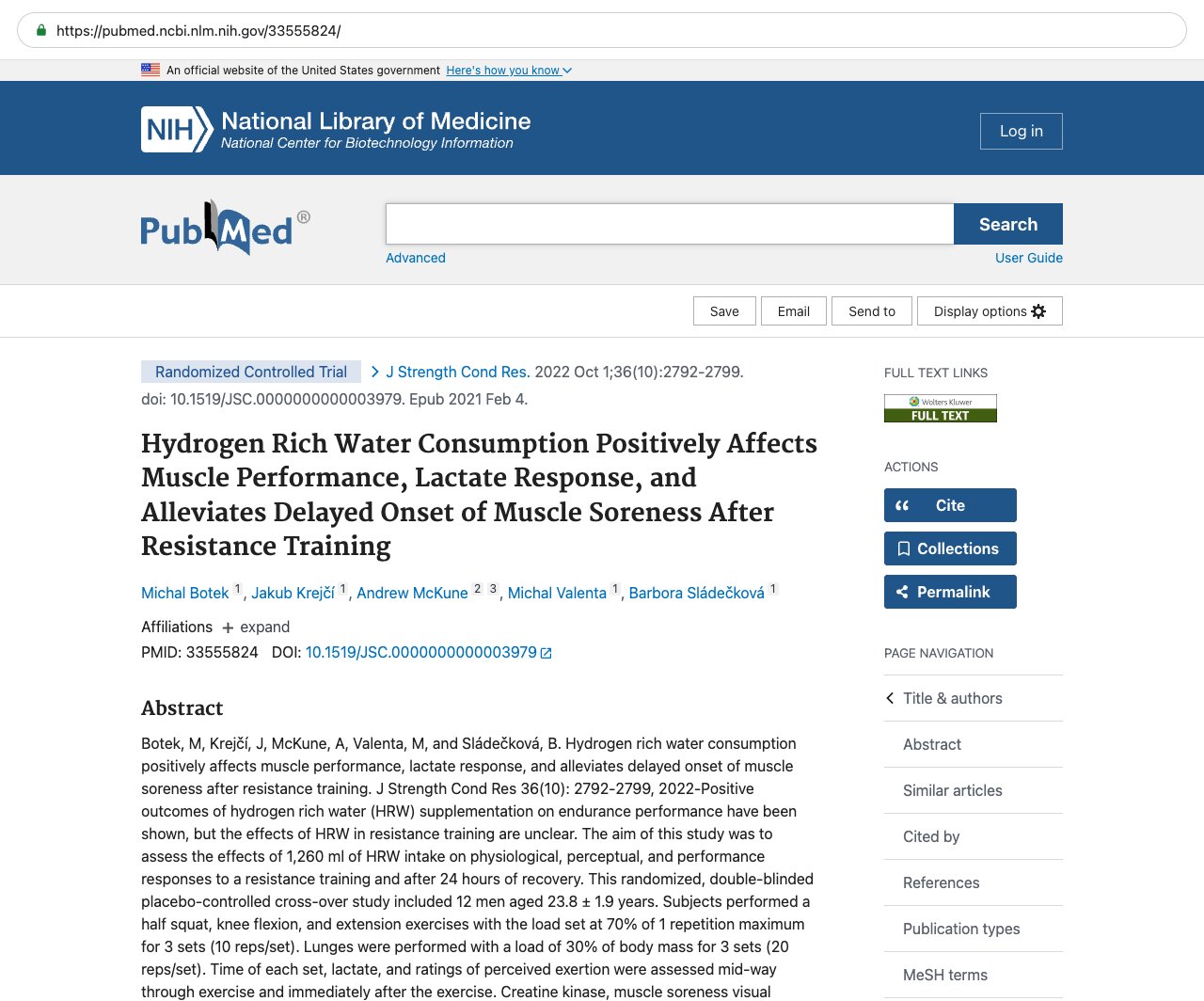
This page mirrors the published abstract (© the authors / publisher) for reference and citation. The canonical source is the PubMed record linked above. This is not medical advice.