2022 · Botek — Molecular Hydrogen Mitigates Performance Decrement during Repeated Sprints in Professional Soccer Players
Super-Abstract
Hydrogen-rich water curbs performance decline during repeated sprints. In a randomized, double-blind crossover trial with 16 professional soccer players, the final sprints after H₂ water were measurably faster — up to 3.4 % faster over 15 m in the 14th and 15th sprints. (Nutrients, 2022.)
Commentary
This study tests hydrogen in sport exactly where it should theoretically work: during intense, repeated exertion with high fatigue. The design is clean — randomized, double-blind, placebo-controlled, crossover — with 16 male professional soccer players (about 19 years old). Each player completed a protocol of 15 sprints over 30 m twice, separated by just 20 seconds of recovery, once after H₂ water, once after placebo, with a one-week washout period in between. The result: after H₂ water, sprint times in the final phase were significantly faster — over 15 m in the 14th and 15th sprints by 3.4 % and 2.7 % respectively, and over 30 m in the last sprint by 1.9 %. That is exactly the fatigue window that counts in a real game. To be honest: lactate and the subjective rating of perceived exertion (RPE) did not differ significantly — so the effect shows in the hard performance, not in these accompanying markers. The sample is small (n = 16) and all male.
Key quotes
- „There were significantly faster sprint times after HRW consumption compared with placebo at 15 m for the 14th and 15th sprints, representing improvements in time of 3.4% and 2.7%, respectively.“ — the central finding: less performance decline in the final phase
- „Sprint time at 30 m also significantly improved by 1.9% in the HRW group in the last sprint.“ — the effect also shows over the full distance
- „neither lactate concentrations nor ratings of perceived exertion were significantly different between HRW and placebo.“ — honest: no effect on lactate and perceived exertion
Our assessment
Directly relevant to repeated-sprint performance under fatigue: the crossover design (each athlete is their own control) and the double-blinding strongly reduce placebo and expectation effects — a frequent weakness in supplement studies. The finding fits mechanistically the antioxidant profile of H₂: less fatigue-related performance decline under high ROS load. Limitation, stated honestly: small sample (n = 16), only young male professionals, acute single dose before the test (no long-term effect studied). The fact that lactate and RPE remained unchanged leaves the precise mechanism open.
Study design
- Type: RCT, randomized/double-blind/placebo-controlled/crossover · n: 16 (male professional soccer players, ~18.8 years) · Duration: acute pre-exercise dose, 1 week washout · H₂ delivery: hydrogen-rich water (HRW) before the test
- Result: sprint time 15 m in the 14th/15th sprint −3.4 %/−2.7 % (significant); 30 m in the last sprint −1.9 % (significant); lactate and RPE with no significant difference
Abstract
Hydrogen-rich water (HRW) supplementation has been shown to have an antifatigue effect across different modes of exercise. However, its effect on repeated sprint performance is unknown. The aim of this study was to assess the effect of pre-exercise HRW consumption on repeated sprint performance, lactate, and perceptual responses using a repeated sprint protocol. This randomized, double blinded, placebo controlled, crossover study included 16 professional, male soccer players aged 18.8 ± 1.2 years. Athletes performed two indoor tests, particularly 15 × 30 m track sprints interspersed by 20 s of recovery, separated by a 1-week washout period. Sprint time was measured at 15 m and 30 m. Ratings of perceived exertion were assessed immediately after each sprint, and post-exercise blood lactate concentration was measured after the last sprint. There were significantly faster sprint times after HRW consumption compared with placebo at 15 m for the 14th and 15th sprints, representing improvements in time of 3.4% and 2.7%, respectively. Sprint time at 30 m also significantly improved by 1.9% in the HRW group in the last sprint. However, neither lactate concentrations nor ratings of perceived exertion were significantly different between HRW and placebo. Pre-exercise HRW supplementation is associated with an increased ability to reduce fatigue, especially during the later stages of repeated sprint exercise.
Source & links
Screenshot of the PubMed page
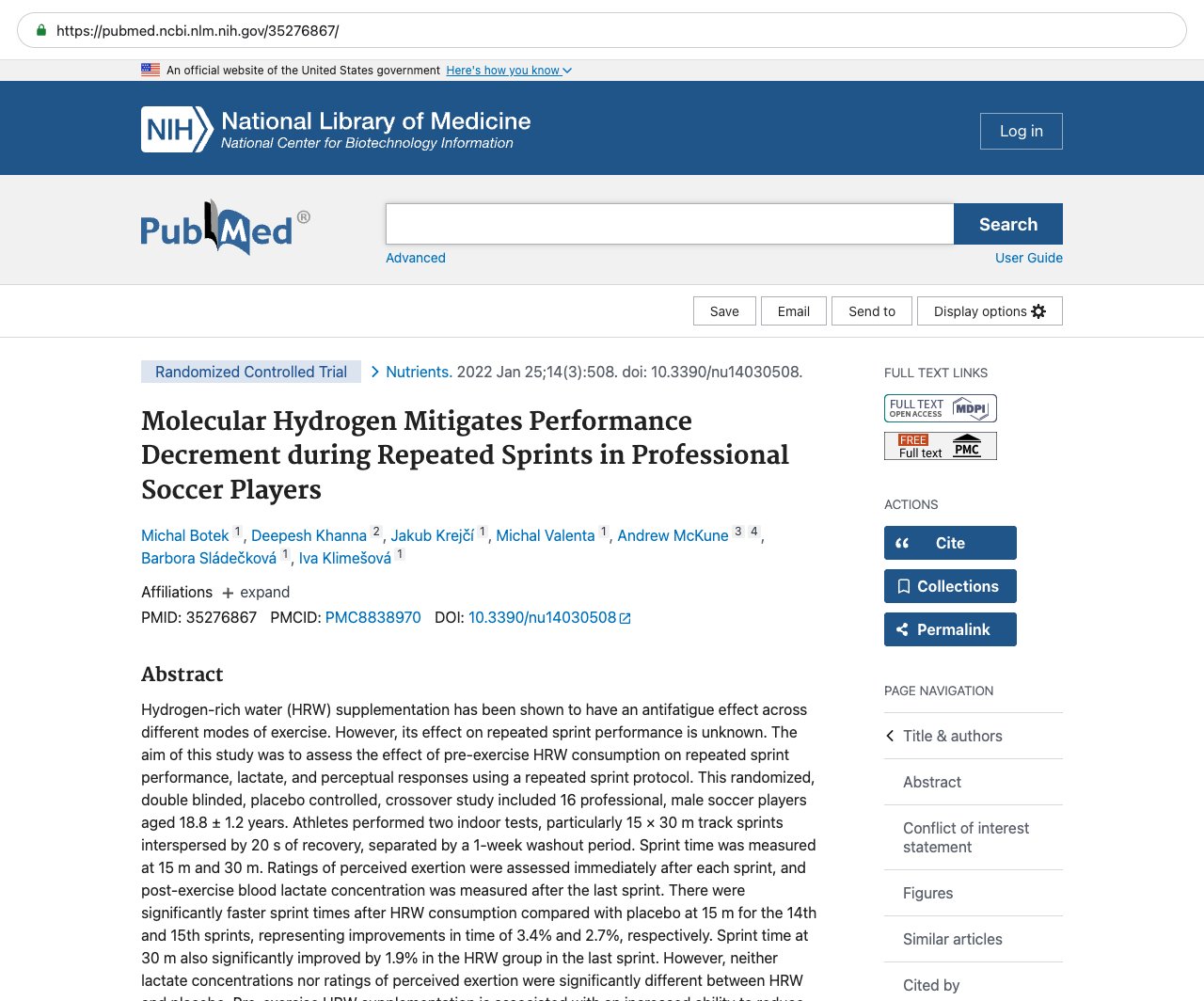
This page mirrors the published abstract (© the authors / publisher) for reference and citation. The canonical source is the PubMed record linked above. This is not medical advice.