2024 · Chair — The impact of hydrogen inhalation therapy on blood reactive oxygen species levels: A randomized controlled study
Super-Abstract
Inhaling hydrogen measurably lowers free oxygen radicals in the blood. In a controlled study of people with elevated ROS levels (d-ROMs > 350 U.CARR), a single session of hydrogen inhalation significantly reduced the blood ROS level — right after treatment. (Free Radical Biology & Medicine, 2024.)
Commentary
This study directly measures what H₂ is theorized to do: lower oxidative stress. It is a randomized, controlled study of 37 people who had an important inclusion criterion — already elevated levels of free oxygen radicals (measured as d-ROMs above 350 U.CARR). That is smart, because in someone with already low oxidative stress there would be little room for improvement. Participants were split into a test and a control group. The test group received hydrogen inhalation therapy, then blood ROS levels were measured immediately after treatment and after 24 hours and compared with the control group. The result: the test group showed a significant reduction in blood ROS levels after treatment. What it means: H₂ inhalation can actually lower oxidative stress in the blood — direct evidence measured in humans for the antioxidant principle. Honestly: a small sample (n = 37), the abstract gives no concrete values or p-values, and it concerns a surrogate marker (ROS), not a clinical endpoint.
Key quotes
- „Due to its unique attributes, including distinguished permeability and selective antioxidant capability, molecular hydrogen (H2) has become an essential therapeutic agent.“ — framing H₂ as a selective antioxidant (cf. Ohsawa 2007)
- „37 participants with elevated ROS levels (d-ROMs value > 350 U.CARR) were enrolled in the study.“ — targeted selection of people with elevated oxidative stress
- „The test group demonstrated a significant reduction in blood ROS levels after the treatment. These findings suggested the efficacy of HIT in reducing oxidative stress.“ — the central finding in humans
Our assessment
Valuable as direct human evidence for the antioxidant core promise of H₂: it measures oxidative stress (ROS) in the blood and shows a significant reduction after H₂ inhalation. It thus bridges from preclinical mechanism (Ohsawa 2007) to clinical measurement. Relevant for H₂ inhalation applications. Limitation, stated honestly: a small sample (n = 37), the abstract provides no concrete effect sizes, means or p-values, and the measured endpoint is a biomarker (d-ROMs), not a symptom or clinical outcome. Published in a relevant specialist journal (Free Radical Biology & Medicine).
Study design
- Type: RCT (randomized, controlled) · n: 37 (people with d-ROMs > 350 U.CARR) · Duration: single session, measurement post-treatment and after 24 h · H₂ delivery: Hydrogen Inhalation Therapy (HIT)
- Result metrics: significant reduction of blood ROS level in the test group vs. control (abstract gives no values/p-values)
Abstract
Reactive Oxygen Species (ROS) play a key role in physiological processes. However, the imbalance between ROS and antioxidants in favor of the former causes oxidative stress linked to numerous pathologies. Due to its unique attributes, including distinguished permeability and selective antioxidant capability, molecular hydrogen (H2) has become an essential therapeutic agent. Hydrogen Inhalation Therapy (HIT) has come to light as a promising strategy to counteract oxidative stress. In this randomized controlled study, we aimed to evaluate the effectiveness of HIT in reducing blood ROS levels. 37 participants with elevated ROS levels (d-ROMs value > 350 U.CARR) were enrolled in the study. Participants were divided into test and control groups. The test group participants received HIT, and then their blood ROS levels were measured immediately post-treatment and after 24 h. Their results were compared to those of the control group participants who did not undergo HIT. The test group demonstrated a significant reduction in blood ROS levels after the treatment. These findings suggested the efficacy of HIT in reducing oxidative stress.
Source & links
Screenshot of the PubMed page
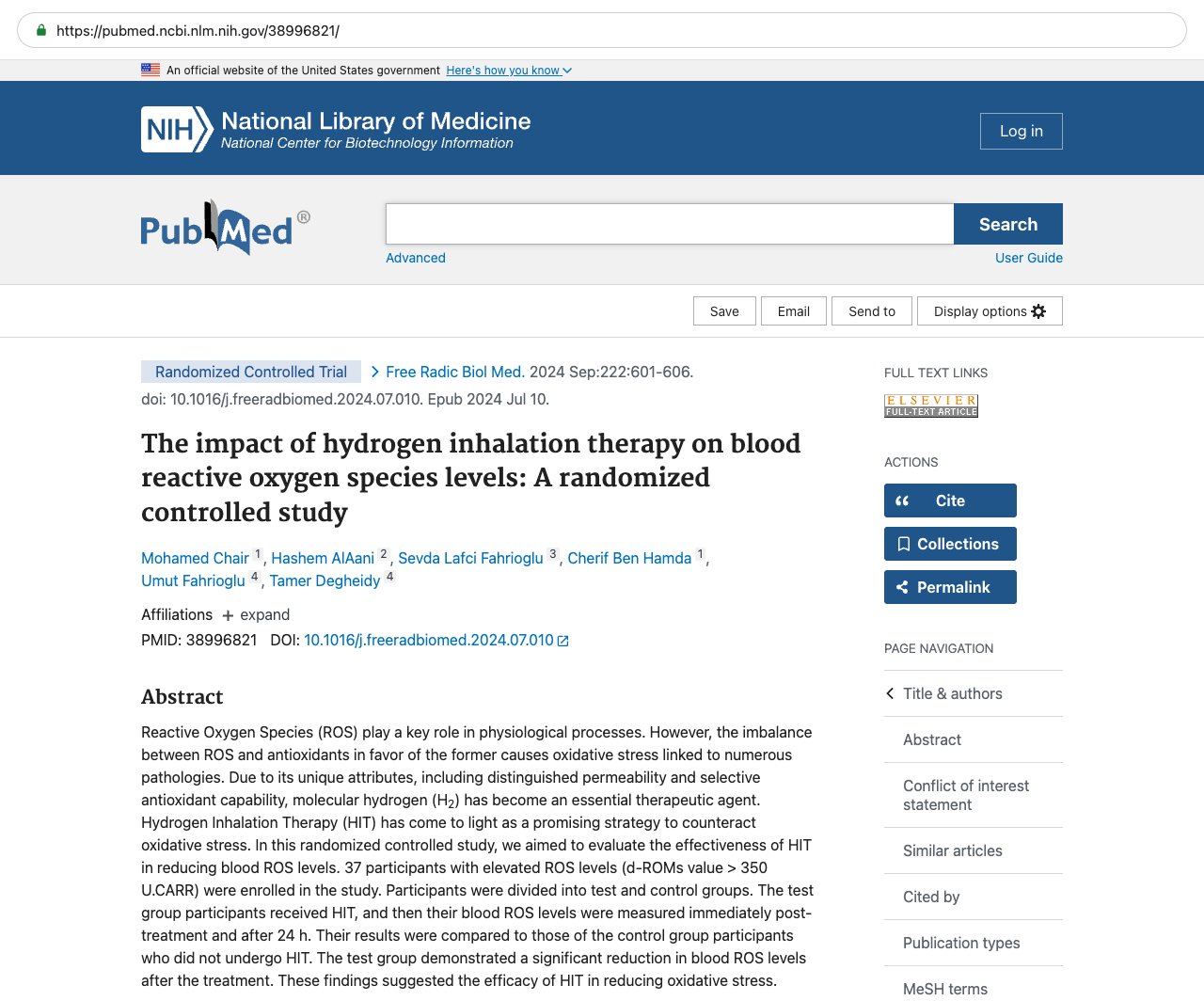
This page mirrors the published abstract (© the authors / publisher) for reference and citation. The canonical source is the PubMed record linked above. This is not medical advice.