2024 · Wang — Natural hydrogen gas and engineered microalgae prevent acute lung injury in sepsis
Super-Abstract
Inhaled hydrogen gas protects the lung in sepsis — and a novel nanosystem of H₂-releasing particles plus microalgae (DQB@C) amplifies this protection in a mouse model by curbing inflammation, oxidative stress and „ferroptosis“ (iron-dependent cell death). (Materials Today Bio, 2024 — preclinical mechanistic study.)
Commentary
This work is highly technical, but the core story is easy to tell. In sepsis, acute lung injury can become life-threatening. The team used an established mouse sepsis model (cecum ligation and puncture, CLP) and had the animals inhale hydrogen gas. Using modern omics analyses (phosphoproteomics, metabolomics, proteomics), they found that H₂ in the lung specifically affects two key proteins (Esam and ZO-1, both important for vascular tightness) as well as the ferroptosis and glutathione metabolism pathways. Because pure H₂ gas is hard to dose in the clinic, they built a clever nanosystem: H₂-releasing particles (with ammonia borane as the H₂ source), combined with the antioxidant dihydroquercetin and the microalga Chlorella vulgaris as a carrier — named DQB@C (307 nm in size). This system releases hydrogen precisely where an infection is, lowered oxidative stress and inflammatory markers and protected the lung and other organs. To be honest: this is a pure animal and cell study — a fascinating mechanism and elegant drug delivery, but still far from humans.
Key quotes
- „We aimed to integrate hydrogen gas and biology nano microalgae together to expand the treatment options in sepsis.“ — the goal: H₂ + microalgae nanosystem against sepsis
- „we identified Esam and Zo-1 were target phosphorylation proteins for molecular hydrogen treatment in lung. Ferroptosis and glutathione metabolism were two target pathways.“ — the molecular targets of H₂ in the lung
- „DQB@C played lung and multi organ protection and anti-inflammation roles on CLP mice.“ — the result in the animal model: lung and multi-organ protection
Our assessment
Interesting as evidence that H₂ research in 2024 goes far beyond „drinking water“ — here molecular hydrogen is characterised down to the level of individual phosphorylated proteins (Esam, ZO-1) and linked to highly topical cell-death mechanisms (ferroptosis). This supports the general plausibility of anti-inflammatory and anti-oxidative H₂ effects. Limitations, honestly and clearly: this is a preclinical study in mice and cells — no human evidence at all. Moreover, the actual main finding is a technical drug-carrier system (DQB@C nanoparticles with ammonia borane as a chemical H₂ source) that shares only the active agent with classic applications (H₂ water, inhalation), not the mode of use. It works as a „look into the research pipeline“, not as a promise of efficacy. Note: the DOI in the source dataset was erroneous (pointed to a different journal) — therefore omitted; the canonical reference is the PubMed link.
Study design
- Type: preclinical (mouse sepsis model CLP + in-vitro) · n: n/a (animal/cell experiments, no case number in the abstract) · Duration: n/a · H₂ delivery: inhalation of hydrogen gas; additionally H₂-releasing nanosystem DQB@C (ammonia borane as H₂ source)
- Result: H₂ target proteins in lung: Esam, ZO-1; target pathways: ferroptosis & glutathione metabolism (via Slc7a11/xCT ↑ and Cox2 ↓); DQB@C particles: size 307.3 nm, zeta potential −22 mV; effect: ↓ oxidative stress + inflammatory factors, lung and multi-organ protection in CLP mice
Abstract
Hydrogen gas and microalgae both exist in the natural environment. We aimed to integrate hydrogen gas and biology nano microalgae together to expand the treatment options in sepsis. Phosphoproteomics, metabolomics and proteomics data were obtained from mice undergoing cecum ligation and puncture (CLP) and inhalation of hydrogen gas. All omics analysis procedure were accordance with standards. Multi R packages were used in single cell and spatial transcriptomics analysis to identify primary cells expressing targeted genes, and the genes' co-expression relationships in sepsis related lung landscape. Then, network pharmacology method was used to identify candidate drugs. We used hydrophobic-force-driving self-assembly method to construct dihydroquercetin (DQ) nanoparticle. To cooperate with molecular hydrogen, ammonia borane (B) was added to DQ surface. Then, Chlorella vulgaris (C) was used as biological carrier to improve self-assembly nanoparticle. Vivo and vitro experiments were both conducted to evaluate anti-inflammation, anti-ferroptosis, anti-infection and organ protection capability. As a result, we identified Esam and Zo-1 were target phosphorylation proteins for molecular hydrogen treatment in lung. Ferroptosis and glutathione metabolism were two target pathways. Chlorella vulgaris improved the dispersion of DQB and reconstructed morphological features of DQB, formed DQB@C nano-system (size = 307.3 nm, zeta potential = -22mv), with well infection-responsive hydrogen release capability and biosafety. In addition, DQB@C was able to decrease oxidative stress and inflammation factors accumulation in lung cells. Through increasing expression level of Slc7a11/xCT and decreasing Cox2 level to participate with the regulation of ferroptosis. Also, DQB@C played lung and multi organ protection and anti-inflammation roles on CLP mice. Our research proposed DQB@C as a novel biology nano-system with enormous potential on treatment for sepsis related acute lung injury to solve the limitation of hydrogen gas utilization in clinics.
Source & links
Screenshot of the PubMed page
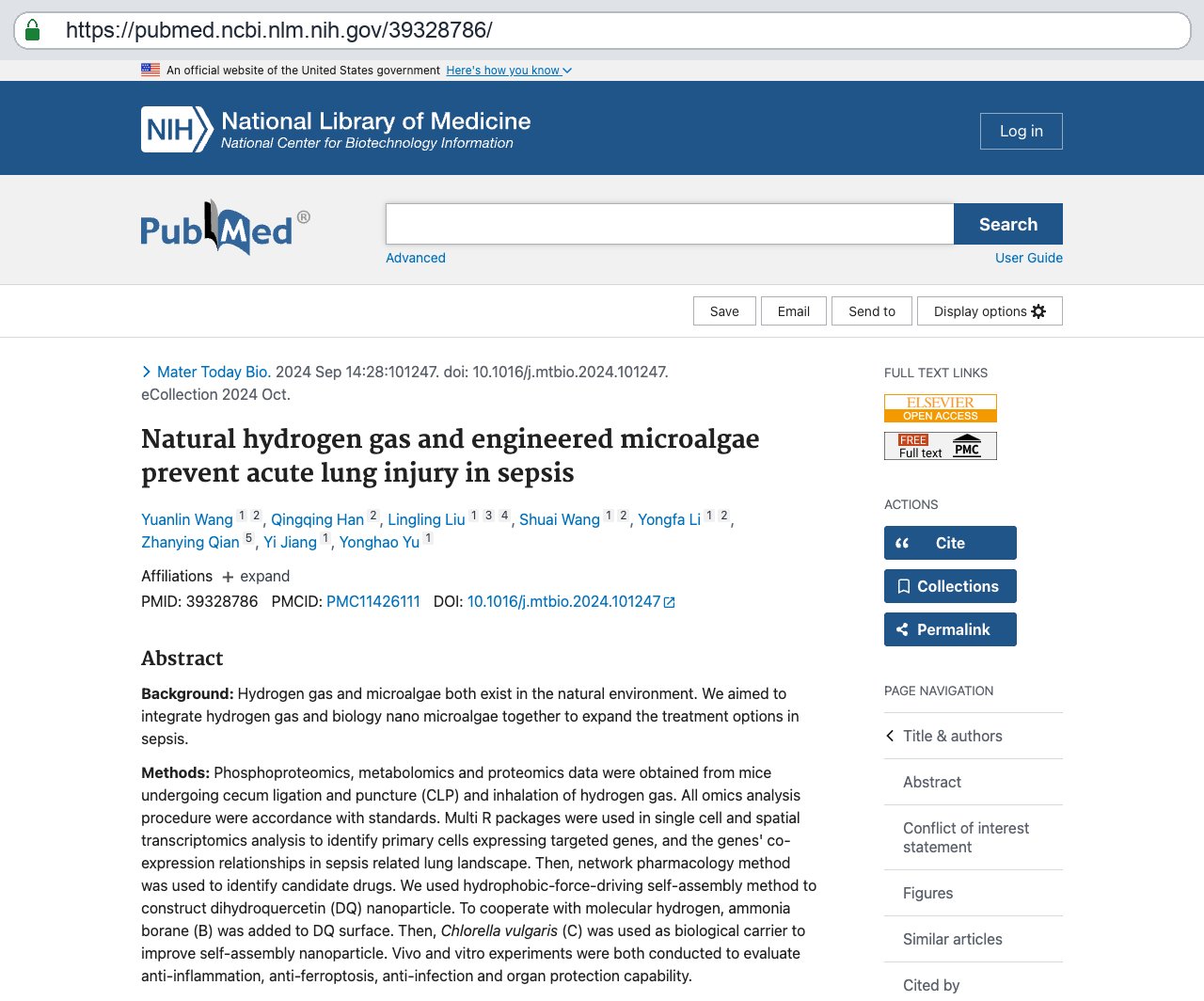
This page mirrors the published abstract (© the authors / publisher) for reference and citation. The canonical source is the PubMed record linked above. This is not medical advice.