2012 · Chang et al. — Inhibition of hepatitis C virus NS5A by fluoro-olefin based γ-turn mimetics.
Super-Abstract
This study develops a new class of antiviral compounds targeting the NS5A protein of hepatitis C virus (HCV) — using a fluoro-olefin chemical scaffold to mimic the three-dimensional structure of natural peptide inhibitors. The lead compound showed picomolar potency against HCV in cell-based assays. This is a pure medicinal chemistry / drug discovery study. The connection to hydrogen, if any, is through intramolecular hydrogen bonding as a structural feature in the inhibitor molecules — not molecular H₂ as a health-relevant gas.
Commentary
This paper is a drug discovery study from medicinal chemistry, not a molecular hydrogen biology study. The relevance of „hydrogen" here is limited to intramolecular hydrogen bonds (H-bonds) that stabilize the three-dimensional γ-turn structure of peptide-based HCV inhibitors — a standard concept in structural chemistry. The fluoro-olefin isostere was designed to mimic these H-bonds without the metabolic liabilities of natural peptides. The NS5A protein is a validated drug target (several approved NS5A inhibitors exist in clinical practice), and the picomolar potency achieved here is impressive from a drug development standpoint. However, this research has no bearing on H₂ gas therapy, antioxidant properties of molecular hydrogen, or any health application of dissolved H₂.
Key quotes
- „strong intra-molecular hydrogen bonds were found to be a common structural moiety within known NS5A inhibitors that have low pico-molar replicon potency.“ — the structural chemical role of hydrogen bonds — not H₂ gas
- „This fluoro-olefin containing inhibitor exhibited picomolar activity (EC(50)=79 pM) against HCV genotype 1b replicon without measurable cytotoxicity.“ — the potency of the new compound in cell assays
- „a peptidomimetic approach can serve as a useful strategy to produce potent and structurally unique inhibitors of HCV NS5A.“ — the drug design conclusion
Our assessment
This paper is not relevant to molecular hydrogen (H₂) therapy or H₂ biology. It is a medicinal chemistry study on antiviral drug design. The word „hydrogen" in the abstract refers to intramolecular hydrogen bonds in drug molecules — a structural chemistry concept entirely unrelated to dissolved H₂ gas. No conclusions about H₂ health effects can be drawn from this study. It appears in H₂-related literature databases as an indexing artifact.
Study design
- Type: in-vitro medicinal chemistry / drug discovery study · n: HCV genotype 1b replicon cell assay · H₂ relevance: none — „hydrogen" refers to intramolecular H-bonds in drug structure
- Result: fluoro-olefin NS5A inhibitor achieved EC₅₀ = 79 pM against HCV replicon; no cytotoxicity detected; activity comparable to clinical-stage peptide inhibitors
Abstract
The HCV non-structural protein NS5A has been established as a viable target for the development of direct acting antiviral therapy. From computational modeling studies strong intra-molecular hydrogen bonds were found to be a common structural moiety within known NS5A inhibitors that have low pico-molar replicon potency. Efforts to reproduce these γ-turn-like substructures provided a novel NS5A inhibitor based on a fluoro-olefin isostere. This fluoro-olefin containing inhibitor exhibited picomolar activity (EC(50)=79 pM) against HCV genotype 1b replicon without measurable cytotoxicity. This level of activity is comparable to the natural peptide-based inhibitors currently under clinic evaluation, and demonstrates that a peptidomimetic approach can serve as a useful strategy to produce potent and structurally unique inhibitors of HCV NS5A.
Source & links
Screenshot of the PubMed page
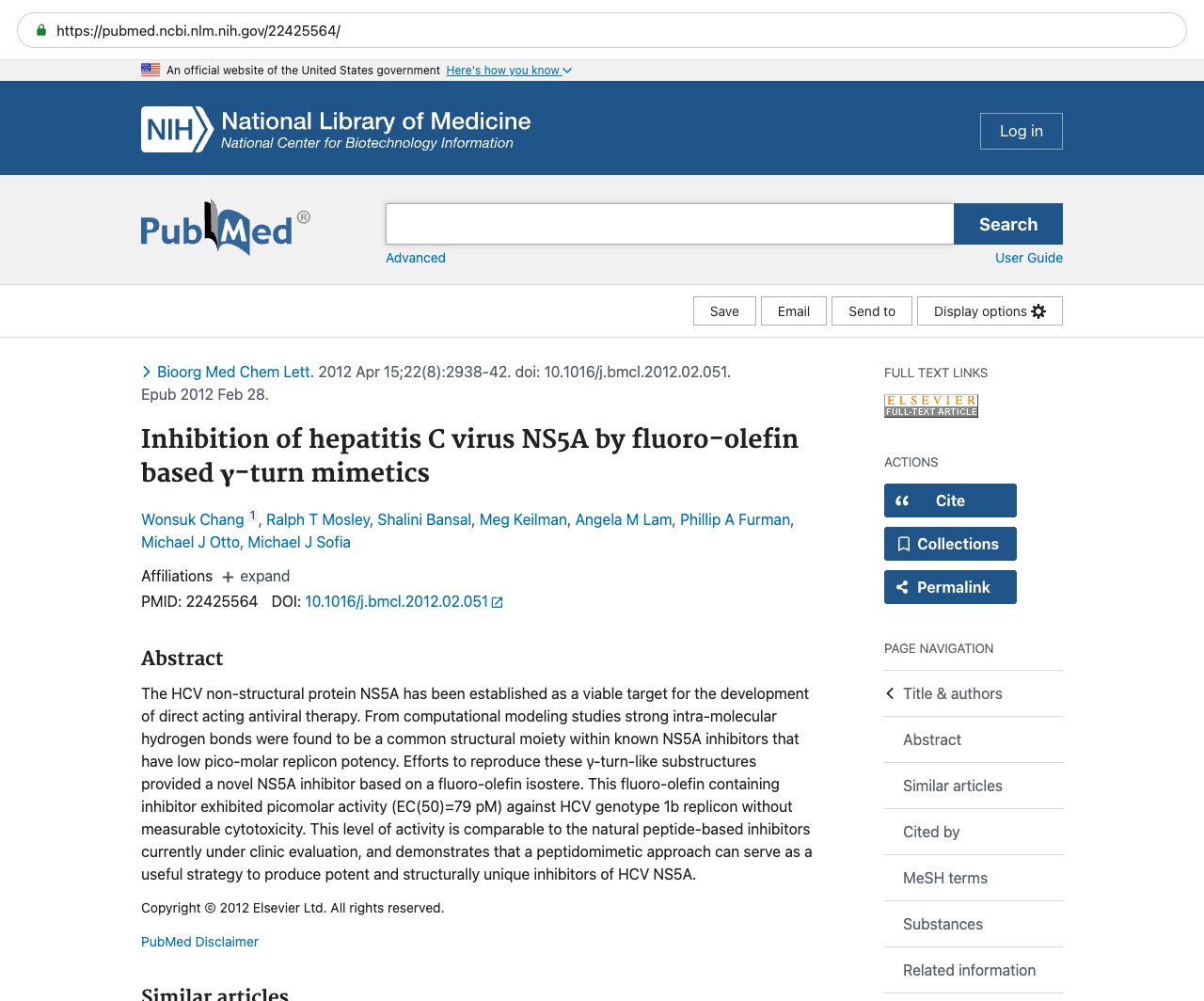
This page mirrors the published abstract (© the authors / publisher) for reference and citation. The canonical source is the PubMed record linked above. This is not medical advice.