2015 · Chen et al. — Molecular hydrogen protects mice against polymicrobial sepsis by ameliorating endothelial dysfunction via an Nrf2/HO-1 signaling pathway.
Super-Abstract
In a mouse sepsis model, molecular hydrogen suppressed the inflammatory cascade and endothelial injury — both in cell culture and in live animals — by activating the Nrf2/HO-1 antioxidant pathway. This is a preclinical study combining in-vitro and animal experiments; results cannot be directly applied to human sepsis treatment. (International Immunopharmacology, 2015.)
Commentary
Chen and colleagues used two complementary systems: LPS-stimulated human umbilical vein endothelial cells (HUVECs) in culture and a cecal ligation and puncture (CLP) mouse model — a well-established model for polymicrobial sepsis. H₂ treatment (via H₂-saturated medium for cells and an unspecified route for mice) consistently reduced levels of pro-inflammatory cytokines (TNF-α, IL-1β, HMGB1) and adhesion molecules (VCAM-1, ICAM-1) while elevating the anti-inflammatory cytokine IL-10. The central mechanism identified was Nrf2-mediated HO-1 activation — confirmed by showing that HO-1 inhibition reversed H₂'s protective effects, and that Nrf2 knockout mice lost protection. This is rigorous mechanistic work, but the sepsis mouse model has historically poor predictive value for human clinical trials.
Key quotes
- „H2 could suppress the release of cell adhesion molecules, such as vascular cell adhesion molecule-1 (VCAM-1) and intercellular cell adhesion molecule-1 (ICAM-1), and pro-inflammatory cytokines, such as tumor necrosis factor (TNF)-α, interleukin (IL)-1β and high-mobility group box 1 protein (HMGB1).“ — specific inflammatory mediators reduced by H₂ in both cell and animal systems
- „H2 regulated endothelial injury and the inflammatory response via Nrf2-mediated HO-1 levels.“ — the confirmed mechanistic pathway — genetic knockout experiments validate this link
- „These results suggest that H2 could suppress excessive inflammatory responses and endothelial injury via an Nrf2/HO-1 pathway.“ — the authors' summary — carefully stated as a suggestion, not a clinical recommendation
Our assessment
A well-designed preclinical study with both in-vitro and animal components, providing mechanistic evidence that H₂ can reduce sepsis-associated endothelial injury via the Nrf2/HO-1 pathway. The use of Nrf2 knockout mice to confirm the pathway is a strength. However, this is a mouse study — results cannot be directly translated to human sepsis management. The CLP sepsis model has repeatedly shown poor translation to human outcomes in drug development. The findings are hypothesis-generating for future clinical investigation, not a basis for treatment decisions.
Study design
- Type: combined in-vitro and animal study · Model: LPS-stimulated HUVECs (in vitro) + cecal ligation and puncture (CLP) mice (in vivo), including Nrf2-knockout mice · H₂ delivery: H₂-saturated medium (0.3–0.6 mmol/L) for cell experiments; route not specified for animal experiments
- Result: H₂ reduced VCAM-1, ICAM-1, TNF-α, IL-1β, HMGB1 and increased IL-10; enhanced HO-1 expression via Nrf2; HO-1 inhibition reversed effects; Nrf2-knockout abolished protection — confirming Nrf2/HO-1 as the operative pathway
Abstract
Endothelial injury is a primary cause of sepsis and sepsis-induced organ damage. Heme oxygenase-1 (HO-1) plays an essential role in endothelial cellular defenses against inflammation by activating nuclear factor E2-related factor-2 (Nrf2). We found that molecular hydrogen (H2) exerts an anti-inflammatory effect. Here, we hypothesized that H2 attenuates endothelial injury and inflammation via an Nrf2-mediated HO-1 pathway during sepsis. First, we detected the effects of H2 on cell viability and cell apoptosis in human umbilical vein endothelial cells (HUVECs) stimulated by LPS. Then, we measured cell adhesion molecules and inflammatory factors in HUVECs stimulated by LPS and in a cecal ligation and puncture (CLP)-induced sepsis mouse model. Next, the role of Nrf2/HO-1 was investigated in activated HUVECs, as well as in wild-type and Nrf(-/-) mice with sepsis. We found that both 0.3 mmol/L and 0.6 mmol/L (i.e., saturated) H2-rich media improved cell viability and cell apoptosis in LPS-activated HUVECs and that 0.6mmol/L (i.e., saturated) H2-rich medium exerted an optimal effect. H2 could suppress the release of cell adhesion molecules, such as vascular cell adhesion molecule-1 (VCAM-1) and intercellular cell adhesion molecule-1 (ICAM-1), and pro-inflammatory cytokines, such as tumor necrosis factor (TNF)-α, interleukin (IL)-1β and high-mobility group box 1 protein (HMGB1). Furthermore, H2 could elevate anti-inflammatory cytokine IL-10 levels in LPS-stimulated HUVECs and in lung tissue from CLP mice. H2 enhanced HO-1 expression and activity in vitro and in vivo. HO-1 inhibition reversed the regulatory effects of H2 on cell adhesion molecules and inflammatory factors. H2 regulated endothelial injury and the inflammatory response via Nrf2-mediated HO-1 levels. These results suggest that H2 could suppress excessive inflammatory responses and endothelial injury via an Nrf2/HO-1 pathway.
Source & links
Screenshot of the PubMed page
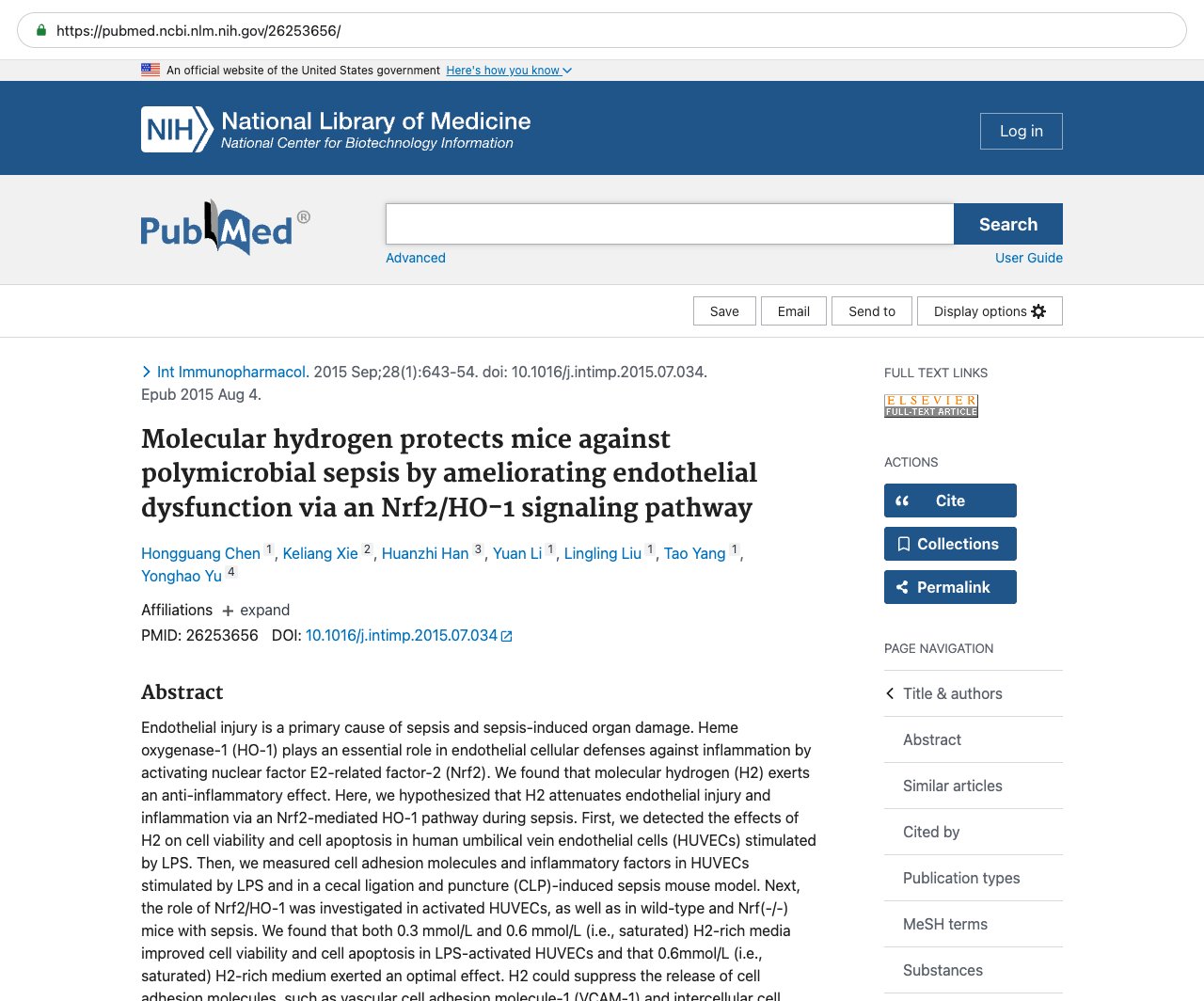
This page mirrors the published abstract (© the authors / publisher) for reference and citation. The canonical source is the PubMed record linked above. This is not medical advice.