2025 · Tu et al. — Molecular Hydrogen Therapy for SLE-PAH: Case Report on Immune Marker Modulation
Super-Abstract
SLE-associated pulmonary arterial hypertension (SLE-PAH) is one of the most life-threatening complications of lupus, and standard vasodilator treatments often fail to adequately control progression. This case report documents a 51-year-old woman with SLE-PAH who had worsening disease since 2018 — including severe dyspnea and oxygen desaturation following sepsis — and showed clinical stabilization after molecular hydrogen therapy was introduced in 2024. (In Vivo, 2025.)
Commentary
SLE-PAH is a vascular complication driven by autoimmune-mediated endothelial injury and inflammatory remodeling of pulmonary arteries. Current treatments target vasoconstriction (prostacyclin analogues, endothelin antagonists, PDE5 inhibitors) but do not address the underlying immunopathology. The hypothesis that H₂'s antioxidant and immunomodulatory properties might benefit SLE-PAH is mechanistically plausible — oxidative stress is a key driver of pulmonary vascular remodeling. The immune changes documented here — increased Tr1 cells, decreased Treg subsets, B cell subset changes — suggest a nuanced immune recalibration rather than broad immunosuppression. Clinical symptoms stabilized and the patient tolerated therapy without adverse effects. However, this is a single patient over a short observation window, and PAH has known phases of relative stability that can occur without intervention.
Key quotes
- „The patient received daily hydrogen capsules, which resulted in an increased percentage of Tr1 cells, and a decreased percentage of Treg cell subsets, B cell subsets, marginal cell, and plasma cell.“ — specific immune shifts — Tr1 increase vs. Treg decrease, a nuanced pattern
- „Her clinical symptoms stabilized, and no adverse effects or complications were observed.“ — safety and stability — primary clinical outcome
- „Further research is needed to confirm its therapeutic benefits, particularly its ability to modulate immune markers and improve clinical outcomes.“ — authors acknowledge the need for controlled evidence
Our assessment
This is a single case report in an extremely rare and severe condition. The clinical „stabilization“ observed may reflect natural disease fluctuation in PAH rather than a H₂ effect — PAH severity can vary over weeks to months without treatment changes. The immune phenotyping is detailed but cannot establish causality at n=1. The Tr1/Treg ratio change is biologically interesting — Tr1 cells (IL-10 secreting, anti-inflammatory) increasing while Tregs decrease could suggest a shift in immune regulatory balance, but this requires mechanistic follow-up. No hemodynamic data (right heart catheterization, echocardiographic measurements) are reported, which are the gold standard for PAH assessment. Safety signal is reassuring; efficacy remains unproven.
Study design
- Type: single case report · n: 1 (51-year-old female, SLE-PAH with decompensated right heart failure, diagnosed 2012) · H₂ delivery: hydrogen capsules (dose not specified), daily from March 2024
- Endpoints: clinical symptom stability, flow cytometry of T and B cell subsets (Tr1, Treg, B subsets, marginal cells, plasma cells)
- Result: increased Tr1 cells, decreased Treg and B cell subsets; clinical stabilization; no adverse effects; no hemodynamic measurements reported
Abstract
BACKGROUND/AIM: Systemic lupus erythematosus-associated pulmonary arterial hypertension (SLE-PAH) is a severe complication marked by elevated pulmonary artery pressure, leading to exertional dyspnea and right-sided heart failure. Standard treatments frequently fall short in effectively controlling symptoms, highlighting the need for innovative therapeutic approaches. This aim of this study was to investigate the efficacy of molecular hydrogen therapy in a patient with SLE-PAH with decompensated right-side heart failure. CASE REPORT: We present the case of a 51-year-old female diagnosed with SLE-PAH in 2012. Despite treatment with vasodilator agents, her condition worsened following an episode of sepsis, leading to severe dyspnea and oxygen desaturation since 2018. In March 2024, molecular hydrogen therapy was introduced as an adjuvant treatment. The patient received daily hydrogen capsules, which resulted in an increased percentage of Tr1 cells, and a decreased percentage of Treg cell subsets, B cell subsets, marginal cell, and plasma cell. Her clinical symptoms stabilized, and no adverse effects or complications were observed. CONCLUSION: This case study highlights the potential efficacy of molecular hydrogen therapy in a patient with SLE-PAD and decompensated right-sided heart failure precipitated by sepsis. Further research is needed to confirm its therapeutic benefits, particularly its ability to modulate immune markers and improve clinical outcomes.
Source & links
Screenshot of the PubMed page
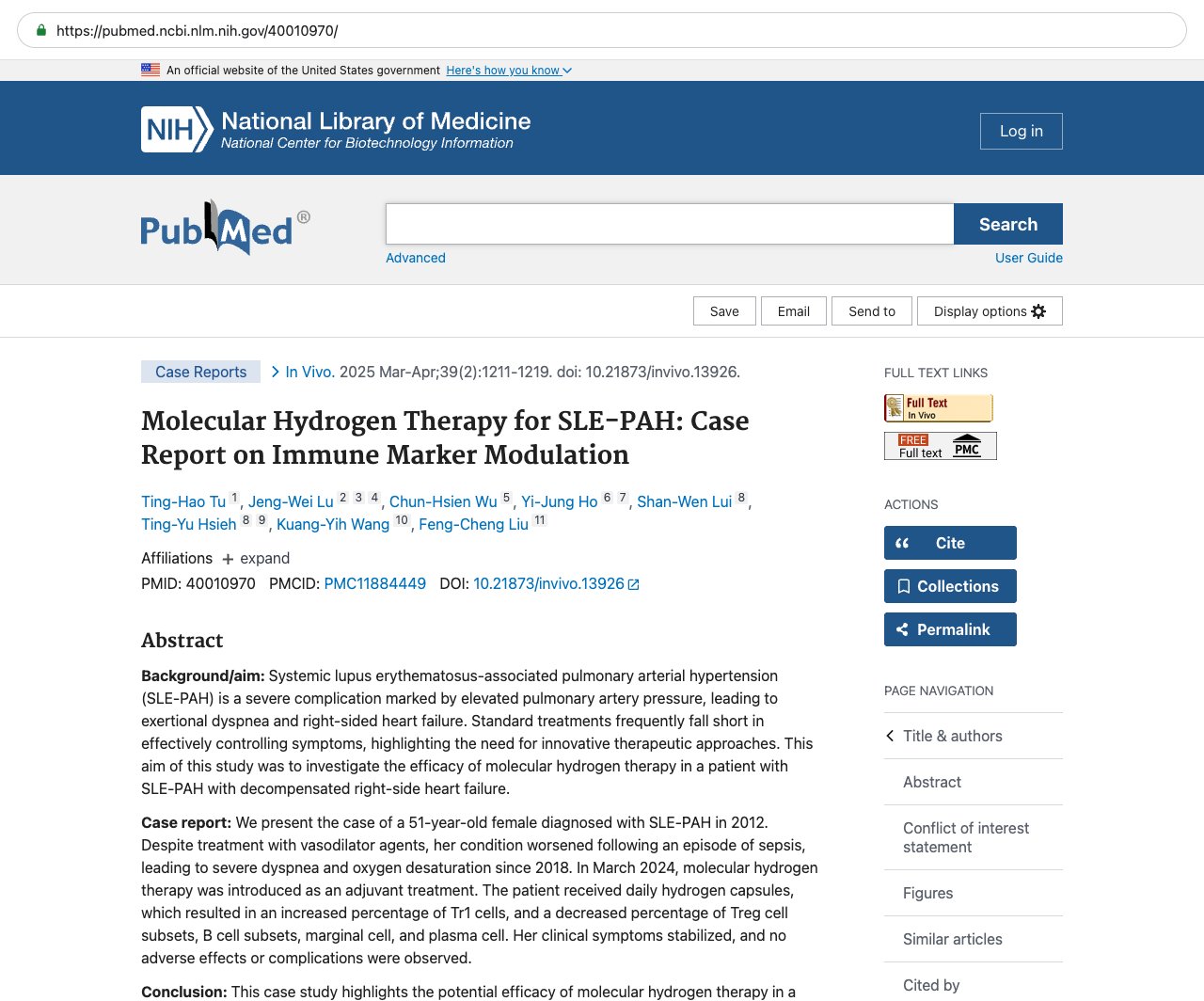
This page mirrors the published abstract (© the authors / publisher) for reference and citation. The canonical source is the PubMed record linked above. This is not medical advice.