2016 · Wang — Hydrogen Metabolism in Helicobacter pylori Plays a Role in Gastric Carcinogenesis through Facilitating CagA Translocation
Super-Abstract
This animal and cell study shows that the bacterium Helicobacter pylori uses molecular hydrogen — produced by the gut microbiome — as an energy source to power delivery of its cancer-causing toxin CagA into stomach cells, promoting gastric cancer development in a gerbil model. Crucially, this concerns bacterial hydrogen metabolism, not therapeutic hydrogen intake by humans; the findings relate to a pathogen, not to H₂ supplementation. (mBio, 2016.)
Commentary
This paper investigates a completely different dimension of hydrogen biology: not H₂ as a therapeutic agent, but H₂ as a fuel source exploited by a pathogen. Helicobacter pylori, the primary known cause of gastric ulcer and a major risk factor for gastric cancer, encodes a hydrogenase enzyme that oxidises molecular hydrogen (derived from host gut fermentation) to generate a transmembrane proton gradient. This gradient powers the Type IV secretion system used to inject the virulence protein CagA into gastric epithelial cells — the key step in H. pylori-related carcinogenesis. The study demonstrates elegantly that hydrogenase-deficient (Δhyd) H. pylori strains are markedly less effective at CagA translocation, less inflammatory in gerbils, and caused zero gastric cancers compared to 50% in gerbils infected with the wild-type strain. Clinical strains isolated from cancer patients also showed significantly higher hydrogenase activity than strains from gastritis patients. This is an important mechanistic finding about pathogen biology. It is entirely distinct from — and should not be conflated with — research on oral H₂ supplementation for health purposes.
Key quotes
- „Gastric cancer developed in 50% of gerbils infected with the wild-type strain 7.13 but in none of the animals infected with the Δhyd strain.“ — striking animal result: hydrogenase deletion eliminated cancer in this model
- „Strains isolated from cancer patients (n=6) have a significantly higher hydrogenase (H2/O2) activity than the strains isolated from gastritis patients (n=6).“ — clinical correlation: higher bacterial hydrogenase activity associates with cancer risk
- „This work extends the roles of H2 oxidation to include transport of a carcinogenic toxin. The work provides a new avenue for exploratory treatment of some cancers via microflora alterations.“ — the authors' proposed implication: targeting H. pylori hydrogenase as a therapeutic strategy
Our assessment
This is a preclinical animal and cell study about the pathogen Helicobacter pylori — not about H₂ supplementation or hydrogen therapy. The finding that H. pylori exploits host-derived H₂ to power toxin delivery is scientifically significant for understanding gastric carcinogenesis and may open new treatment avenues. However, this paper has no bearing whatsoever on the safety or efficacy of molecular hydrogen consumed as a supplement — a completely different biological context. Results come from a gerbil model and a small number of clinical isolates (n=6 per group).
Study design
- Type: animal + in-vitro microbiology study · Model: Mongolian gerbil infection model (H. pylori 7.13 vs. Δhyd mutant); AGS gastric epithelial cell line; clinical H. pylori isolates (n=12) · H₂ context: endogenous gut-fermentation H₂ used by H. pylori hydrogenase — not exogenous H₂ administration
- Result: Δhyd mutant: severely impaired CagA translocation; reduced inflammation in gerbils at 12 weeks; 0% gastric cancer vs. 50% with wild-type strain; clinical cancer isolates had significantly higher hydrogenase activity than gastritis isolates
Abstract
UNLABELLED: A known virulence factor of Helicobacter pylori that augments gastric cancer risk is the CagA cytotoxin. A carcinogenic derivative strain, 7.13, that has a greater ability to translocate CagA exhibits much higher hydrogenase activity than its parent noncarcinogenic strain, B128. A Δhyd mutant strain with deletion of hydrogenase genes was ineffective in CagA translocation into human gastric epithelial AGS cells, while no significant attenuation of cell adhesion was observed. The quinone reductase inhibitor 2-n-heptyl-4-hydroxyquinoline-N-oxide (HQNO) was used to specifically inhibit the H2-utilizing respiratory chain of outer membrane-permeabilized bacterial cells; that level of inhibitor also greatly attenuated CagA translocation into AGS cells, indicating the H2-generated transmembrane potential is a contributor to toxin translocation. The Δhyd strain showed a decreased frequency of DNA transformation, suggesting that H. pylori hydrogenase is also involved in energizing the DNA uptake apparatus. In a gerbil model of infection, the ability of the Δhyd strain to induce inflammation was significantly attenuated (at 12 weeks postinoculation), while all of the gerbils infected with the parent strain (7.13) exhibited a high level of inflammation. Gastric cancer developed in 50% of gerbils infected with the wild-type strain 7.13 but in none of the animals infected with the Δhyd strain. By examining the hydrogenase activities from well-defined clinical H. pylori isolates, we observed that strains isolated from cancer patients (n = 6) have a significantly higher hydrogenase (H2/O2) activity than the strains isolated from gastritis patients (n = 6), further supporting an association between H. pylori hydrogenase activity and gastric carcinogenesis in humans. IMPORTANCE: Hydrogen-utilizing hydrogenases are known to be important for some respiratory pathogens to colonize hosts. Here a gastric cancer connection is made via a pathogen's (H. pylori) use of molecular hydrogen, a host microbiome-produced gas. Delivery of the known carcinogenic factor CagA into host cells is augmented by the H2-utilizing respiratory chain of the bacterium. The role of hydrogenase in carcinogenesis is demonstrated in an animal model, whereby inflammation markers and cancer development were attenuated in the hydrogenase-null strain. Hydrogenase activity comparisons of clinical strains of the pathogen also support a connection between hydrogen metabolism and gastric cancer risk. While molecular hydrogen use is acknowledged to be an alternative high-energy substrate for some pathogens, this work extends the roles of H2 oxidation to include transport of a carcinogenic toxin. The work provides a new avenue for exploratory treatment of some cancers via microflora alterations.
Source & links
Screenshot of the PubMed page
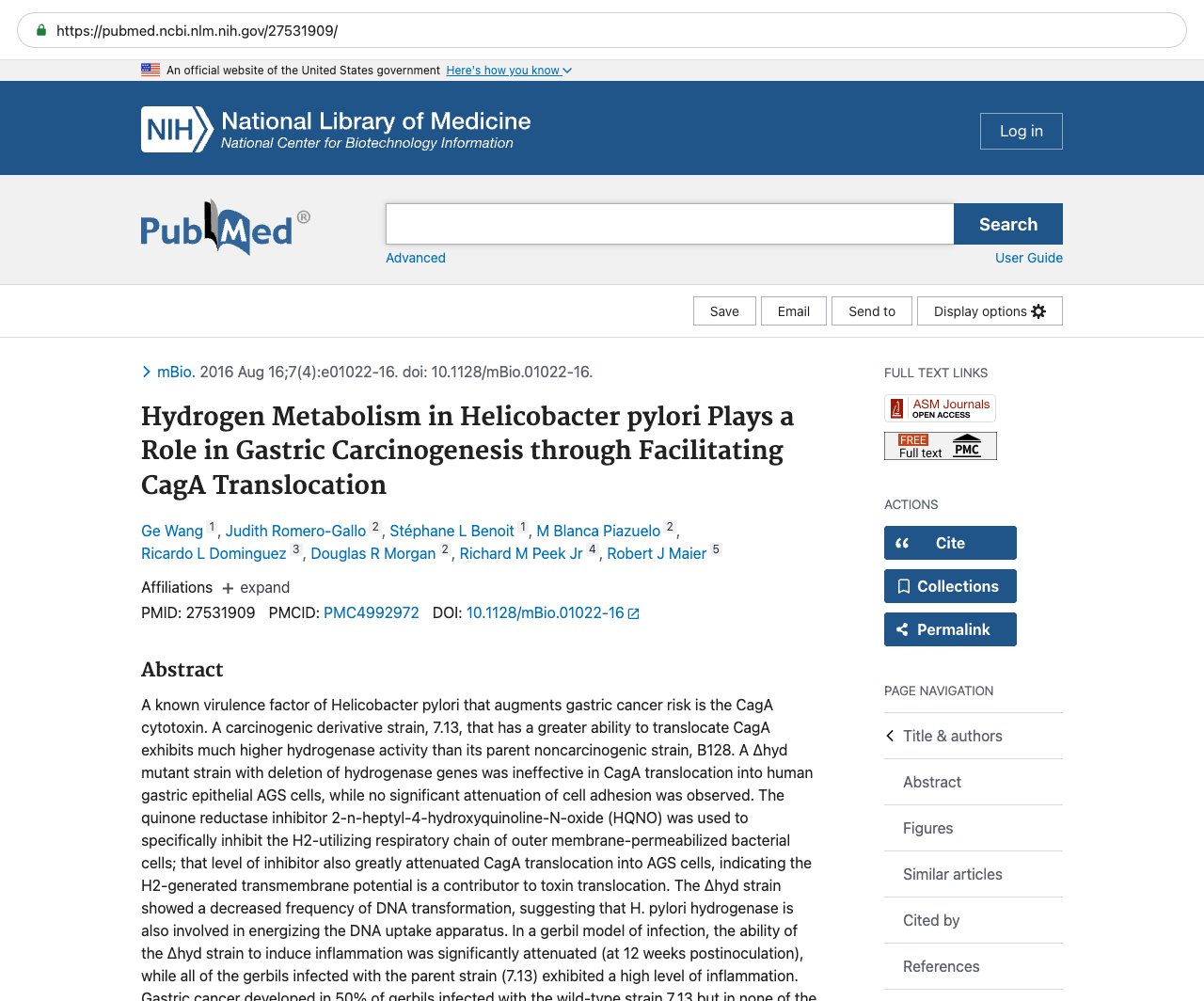
This page mirrors the published abstract (© the authors / publisher) for reference and citation. The canonical source is the PubMed record linked above. This is not medical advice.