2020 · Chen et al. — Hydrogen therapy can be used to control tumor progression and alleviate the adverse events of medications in patients with advanced non-small cell lung cancer.
Super-Abstract
In 58 patients with advanced non-small cell lung cancer (NSCLC), daily H₂ inhalation for up to 5 months — alone or combined with chemotherapy, targeted therapy, or immunotherapy — was associated with symptom improvement, reduced drug adverse events, and longer progression-free and overall survival compared to a non-treated control group. This is an exploratory clinical observation without randomisation across the combined arms, and results must be interpreted with caution. (Medical Gas Research, 2020.)
Commentary
This trial from Fuda Cancer Hospital (Guangzhou) tests H₂ inhalation in a severely ill population where conventional options are limited. The overall design is ambitious: five arms (H₂-only vs. control, plus three combination therapy groups), real-world enrolment, and long follow-up. The headline findings — reduced symptom burden, lower drug toxicity, better disease control — are clinically meaningful if real. However, the study has critical methodological gaps: only the H₂-only vs. control arm was randomised (20 patients total); the three combination arms were assigned based on tumour genetics and drug sensitivity, not random allocation. This means comparing across arms is severely confounded. That said, even within the limitations, the safety profile of H₂ inhalation appears favourable, and the signal of reduced drug adverse events is worth investigating in properly controlled trials.
Key quotes
- „During the first 5 months of treatment, the prevalence of symptoms of the control group increased gradually, whereas that of the four treatment groups decreased gradually.“ — symptom trajectory — H₂ arms consistently improved vs. control
- „progression-free survival of the control group was lower than that of the H2-only group, and significantly lower than that of H2 + chemotherapy, H2 + targeted therapy, and H2 + immunotherapy groups.“ — survival signal — encouraging but not randomised across all arms
- „In the combined-therapy groups, most drug-associated adverse events decreased gradually or even disappeared.“ — reduced drug toxicity — a clinically relevant signal if confirmed
Our assessment
This study is hypothesis-generating, not confirmatory. The partial randomisation (only the H₂-only arm was truly randomised), the uncontrolled combination therapy arms, and the non-standardised oncological backgrounds make cross-arm comparisons unreliable. The safety signal is encouraging: no haematological toxicity and only minor, self-resolving adverse reactions. Limitations: non-random allocation in four of five arms; baseline differences acknowledged (tumour-mutation genes); small numbers in each sub-group; single centre; observational follow-up. The results justify a properly randomised, multi-centre trial — they do not establish efficacy.
Study design
- Type: prospective clinical observation (partially randomised — H₂-only vs. control arm randomised; combination arms allocated by tumour genetics) · n: 58 total (20 randomised; 38 in combination arms) · H₂ delivery: inhalation 4–5 hours/day for up to 5 months
- Groups: H₂-only (n=10), control (n=10), H₂ + chemotherapy (n=10), H₂ + targeted therapy (n=18), H₂ + immunotherapy (n=10)
- Result: symptom burden decreased in H₂ arms; disease control rate 57.5 % overall; better PFS and OS vs. control; most drug adverse events reduced in combination arms; no haematological toxicity observed
Abstract
Chemotherapy, targeted therapy, and immunotherapy are used against advanced non-small cell lung cancer. A clinically efficacious method for relieving the adverse events associated of such therapies is lacking. Fifty-eight adult patients were enrolled in our trial to relieve pulmonary symptoms or the adverse events of drugs. Twenty patients who refused drug treatment were assigned equally and randomly to a hydrogen (H2)-only group and a control group. According to the results of tumor-gene mutations and drug-sensitivity tests, 10, 18, and 10 patients were enrolled into chemotherapy, targeted therapy, and immunotherapy groups in which these therapies were combined with H2-therapy, respectively. Patients underwent H2 inhalation for 4-5 hours per day for 5 months or stopped when cancer recurrence. Before study initiation, the demographics (except for tumor-mutation genes) and pulmonary symptoms (except for moderate cough) of the five groups showed no significant difference. During the first 5 months of treatment, the prevalence of symptoms of the control group increased gradually, whereas that of the four treatment groups decreased gradually. After 16 months of follow-up, progression-free survival of the control group was lower than that of the H2-only group, and significantly lower than that of H2 + chemotherapy, H2 + targeted therapy, and H2 + immunotherapy groups. In the combined-therapy groups, most drug-associated adverse events decreased gradually or even disappeared. H2 inhalation was first discovered in the clinic that can be used to control tumor progression and alleviate the adverse events of medications for patients with advanced non-small cell lung cancer. This study was approved by the Ethics Committee of Fuda Cancer Hospital of Jinan University on December 7, 2018 (approval No. Fuda20181207), and was registered at ClinicalTrials.gov (Identifier: NCT03818347) on January 28, 2019.
Source & links
Screenshot of the PubMed page
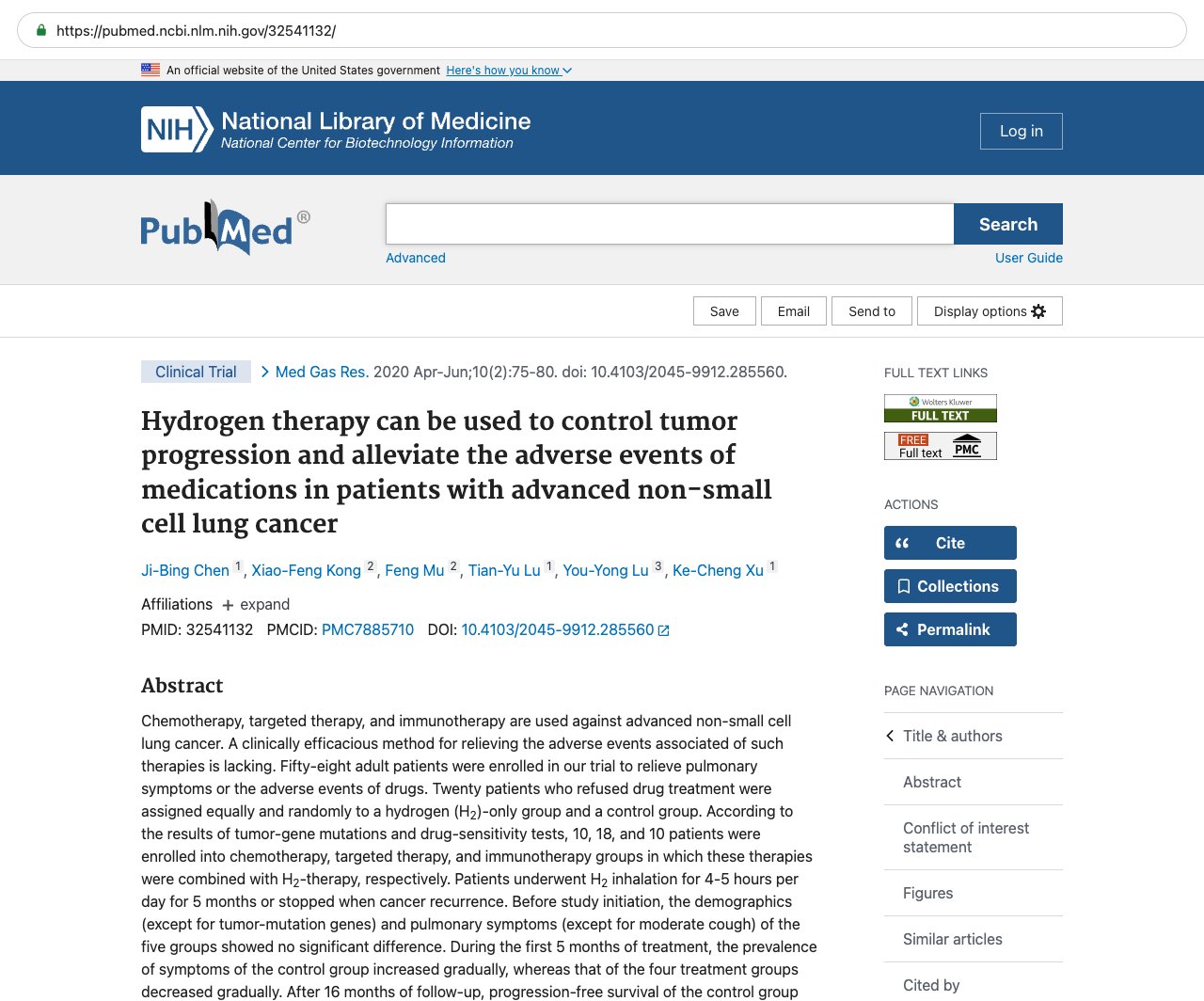
This page mirrors the published abstract (© the authors / publisher) for reference and citation. The canonical source is the PubMed record linked above. This is not medical advice.