2020 · Chen — Two weeks of hydrogen inhalation can significantly reverse adaptive and innate immune system senescence in patients with advanced non-small cell lung cancer: a self-controlled study
Super-Abstract
Two weeks of hydrogen inhalation normalized aging-typical changes of the immune system in patients with advanced lung cancer. Exhausted and aged cytotoxic T cells returned to the normal range, and several weakened immune-cell types recovered. (Medical Gas Research, 2020, self-controlled study, n = 20.)
Commentary
Advanced non-small cell lung cancer goes hand in hand with „immune aging“ — the immune system is exhausted and less able to fight the tumor. This study examined 20 such patients and had them inhale hydrogen gas for two weeks during the waiting period before the actual treatment: a mixture of 66.7 % H₂ and 33.3 % O₂, four hours a day, with no other therapy during this period. It is a self-controlled study, meaning each patient is their own comparison — before/after. Before treatment, the typical aging patterns appeared: too many exhausted and senescent cytotoxic T cells and killer Vδ1 cells, too few functional helper and cytotoxic T cells, Th1, NKT, NK and Vδ2 cells. After two weeks of H₂, the exhausted and aged T cells normalized into the normal range, and the six subsets that were too low likewise rose into the normal range. What it means: H₂ could improve the immunological starting situation before cancer therapy. Honestly and importantly: this is a small, <strong>self-controlled study without a control group</strong> (n = 20), and what was measured were immune-cell markers in the blood — no hard clinical endpoints such as survival or tumor size. No promise of a cure may arise here.
Key quotes
- „After 2 weeks of hydrogen therapy, the number of exhausted and senescent cytotoxic T cells decreased to within the normal range, and there was an increase in killer Vδ1 cells.“ — decline of exhausted/aged T cells into the normal range
- „After 2 weeks of hydrogen therapy, all six cell subsets increased to within the normal range.“ — recovery of the previously too-low immune-cell types
- „2 weeks of hydrogen treatment can significantly improve most of these indexes.“ — the authors' core statement (referring to immune markers)
Our assessment
Thematically strong for investigating H₂ inhalation as a supportive measure in the oncological context — but precisely here maximum caution is required, so as not to create a health-claim overreach. The study shows changes of immune-cell markers in the blood, not that patients live longer or that tumors shrink. Notable as a mechanism/plausibility building block (immunomodulatory profile of H₂), never as a therapy promise in cancer. Limitation, stated honestly: small sample (n = 20), no control group (self-control, before-after), surrogate endpoints instead of clinical outcomes, short duration. Tagged in PubMed as a „Randomized Controlled Trial“, but the title and abstract describe a self-controlled design — hence conservatively classified here as pilot/open-label (evidence level 2).
Study design
- Type: self-controlled pilot study (before-after, without an external control group) · n: 20 (advanced NSCLC) · Duration: 2 weeks (during the waiting period before treatment) · H₂ delivery: inhalation H₂ 66.7 % / O₂ 33.3 %, 3 L/min, 4 h daily
- Result metrics: exhausted/senescent cytotoxic T cells → normal range; killer Vδ1 ↑; six previously lowered subsets (helper/cytotoxic T cells, Th1, NKT, NK, Vδ2) → normal range (abstract gives no numerical p-values)
Abstract
Following standard treatments, the traditional model for enhancing anti-tumor immunity involves performing immune reconstitution (e.g., adoptive immune cell therapies or immunoenhancing drugs) to prevent recurrence. For patients with advanced non-small cell lung cancer, we report here on two objectives, the immunosenescence for advanced non-small cell lung cancer and hydrogen gas inhalation for immune reconstitution. From July 1st to September 25th, 2019, 20 non-small cell lung cancer patients were enrolled to evaluate the immunosenescence of peripheral blood lymphocyte subsets, including T cell, natural killer/natural killer T cell and gamma delta T cell. Two weeks of hydrogen inhalation was performed during the waiting period for treatment-related examination. All patients inhaled a mixture of hydrogen (66.7%) and oxygen (33.3%) with a gas flow rate of 3 L/min for 4 hours each day. None of the patients received any standard treatment during the hydrogen inhalation period. After pretreatment testing, major indexes of immunosenescence were observed. The abnormally higher indexes included exhausted cytotoxic T cells, senescent cytotoxic T cells, and killer Vδ1 cells. After 2 weeks of hydrogen therapy, the number of exhausted and senescent cytotoxic T cells decreased to within the normal range, and there was an increase in killer Vδ1 cells. The abnormally lower indexes included functional helper and cytotoxic T cells, Th1, total natural killer T cells, natural killer, and Vδ2 cells. After 2 weeks of hydrogen therapy, all six cell subsets increased to within the normal range. The current data indicate that the immunosenescence of advanced non-small cell lung cancer involves nearly all lymphocyte subsets, and 2 weeks of hydrogen treatment can significantly improve most of these indexes. The study was approved by the Ethics Committee of Fuda Cancer Hospital, Jinan University in China (approval No. Fuda20181207) on December 7th, 2018, and was registered on ClinicalTrials.gov (ID: NCT03818347) on January 24th, 2019.
Source & links
Screenshot of the PubMed page
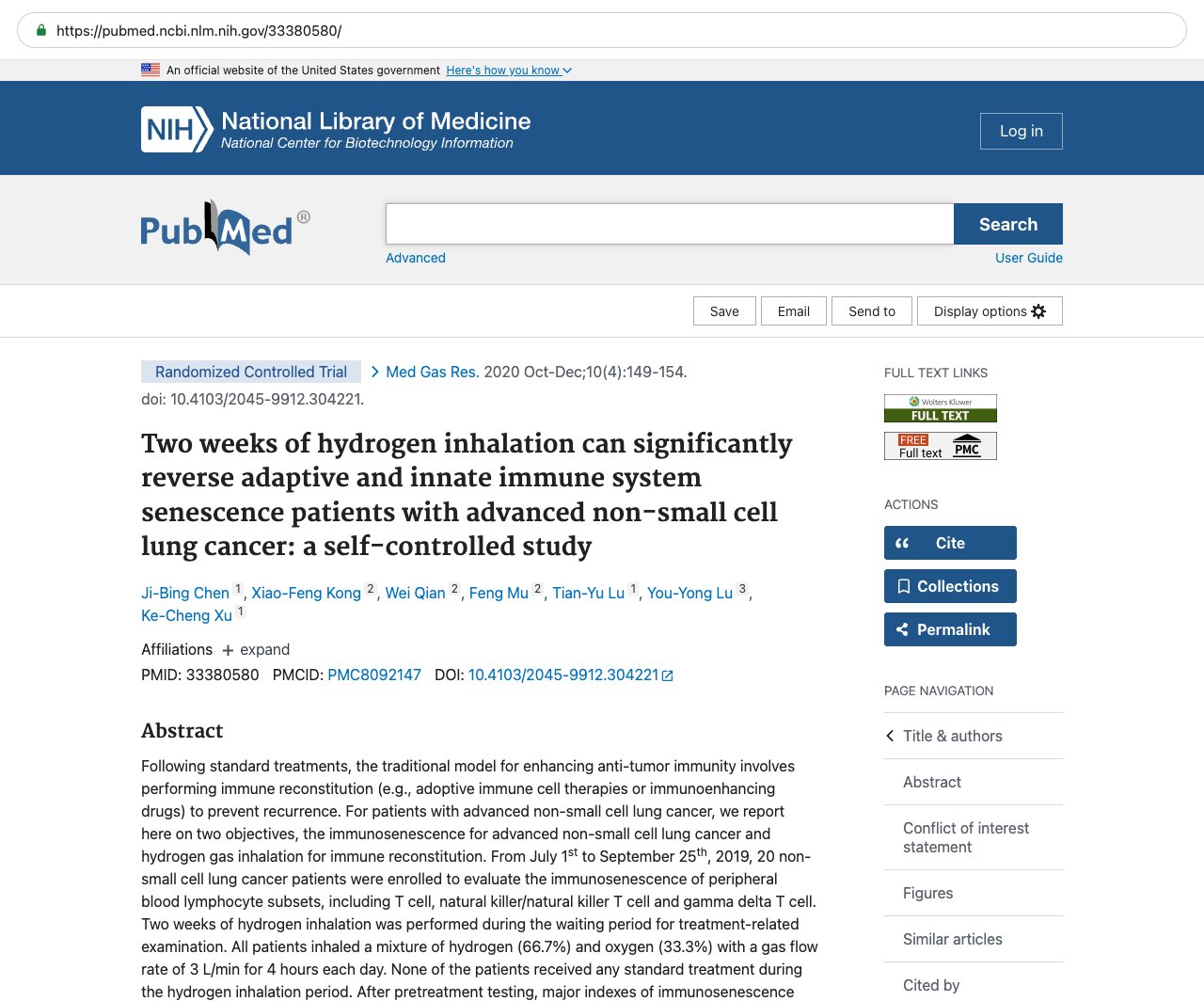
This page mirrors the published abstract (© the authors / publisher) for reference and citation. The canonical source is the PubMed record linked above. This is not medical advice.