2018 · Dong — Protective effects of hydrogen gas against sepsis-induced acute lung injury via regulation of mitochondrial function and dynamics
Super-Abstract
In a mouse model of sepsis-induced acute lung injury (ALI), inhaling 2% hydrogen gas improved lung oxygenation, preserved mitochondrial membrane potential and ATP production, and reduced tissue damage compared to untreated septic animals. H₂ appeared to work by normalising mitochondrial dynamics (fusion vs. fission balance). This is an animal study; results do not directly apply to humans. (International Immunopharmacology, 2018.)
Commentary
Dong and colleagues use the cecal ligation and puncture (CLP) model — a well-established, severe rodent sepsis model — to investigate whether H₂ inhalation protects against ALI. The mechanistic focus on mitochondria is notable: the authors show that sepsis shifts the mitochondrial dynamics towards fission (fragmentation, Drp1 upregulation) and impairs oxidative phosphorylation, and that 2% H₂ partially reverses these changes by reducing Drp1 and raising MFN2 (a fusion protein). The lung-protective effect is backed by multiple converging outcomes: improved PaO₂/FiO₂ ratio, higher ATP, better complex I activity, and lower histological damage scores. The CLP model is clinically relevant but notoriously difficult to translate; human sepsis-ALI is far more heterogeneous and treatment-context-dependent.
Key quotes
- „Therapy with 2% H2 increased PaO2/FiO2 ratios, MMP and ATP levels, RCR, complex I activity and MFN2 expression but decreased histological score and Drp1 levels in the presence of sepsis.“ — summary of multi-parameter improvement across mitochondrial and lung function markers
- „Inhalation of 2% H2 to regulate mitochondrial function and dynamics may be a promising therapeutic strategy for lung injuries induced by severe sepsis.“ — cautious conclusion — “promising”, not proven
- „Mitochondrial dysfunction and dynamics play important roles in sepsis-induced organ damage.“ — the mechanistic rationale for studying H₂ in this context
Our assessment
A mechanistically well-framed animal study with consistent multi-endpoint results. The mitochondrial angle (dynamics, complex I, MFN2/Drp1) adds depth beyond simple antioxidant claims. Limitations inherent to preclinical sepsis research: CLP in inbred mouse strains does not replicate the genetic and immunological diversity of human ICU patients; no long-term survival data are reported; no dose-titration of H₂ concentration; single time-point (24 h post-CLP). Human ALI/ARDS trials with H₂ would be needed to establish clinical relevance. Results are promising for hypothesis generation but cannot be applied to human patients directly.
Study design
- Type: controlled animal experiment · Model: ICR mouse, cecal ligation and puncture (CLP) sepsis · Groups: sham, sham+H₂, CLP, CLP+H₂ (n=4 groups)
- H₂ delivery: 2% H₂ inhalation · Assessment: 24 h post-CLP — histology, TEM, PaO₂/FiO₂, mitochondrial membrane potential, ATP, RCR, complex I/II activity, Western blot (Drp1, MFN2)
- Result: H₂ improved oxygenation index, mitochondrial membrane potential, ATP, complex I activity, MFN2; decreased lung injury score and Drp1; P-values not uniformly specified in abstract
Abstract
BACKGROUND: Lungs are one of the most common target organs of sepsis [1]. Hydrogen gas (H2), which has selective anti-oxidative effects, can be effectively used to treat septic mice. Mitochondrial dysfunction and dynamics play important roles in sepsis-induced organ damage. METHODS: By using cecal ligation and puncture (CLP), a classic septic model, we explored the role of 2% H2 treatment in sepsis-induced acute lung injury (ALI) linked to mitochondrial function and dynamics. We randomized male Institute for Cancer Research (ICR) mice into 4 groups: sham, sham + H2, CLP and CLP + H2. At 24 h after CLP or sham operations, we used histological examination and transmission electron microscopy (TEM) to observe lung slices. We analyzed oxygenation index (PaO2/FiO2), mitochondrial-membrane potential (MMP), adenosine triphosphate (ATP) levels, respiration control ratio (RCR) and mitochondrial-respiration complex activities (I and II) using commercial kits, and dynamin-related protein 1 (Drp1) and mitofusin-2 (MFN2) using Western blot. RESULTS: Therapy with 2% H2 increased PaO2/FiO2 ratios, MMP and ATP levels, RCR, complex I activity and MFN2 expression but decreased histological score and Drp1 levels in the presence of sepsis. These data indicated that inhalation of 2% H2 to regulate mitochondrial function and dynamics may be a promising therapeutic strategy for lung injuries induced by severe sepsis.
Source & links
Screenshot of the PubMed page
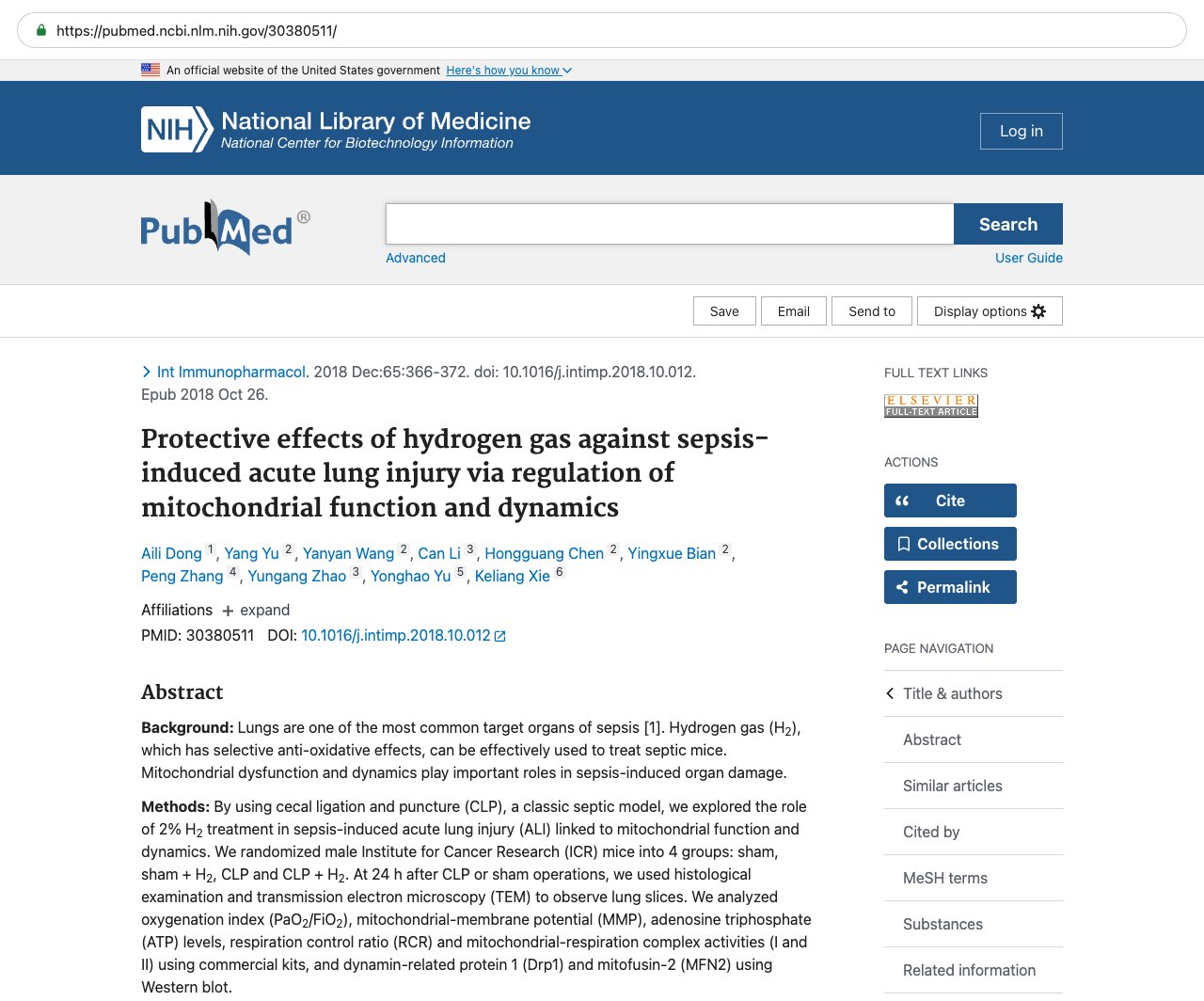
This page mirrors the published abstract (© the authors / publisher) for reference and citation. The canonical source is the PubMed record linked above. This is not medical advice.