2024 · Chen — The Role of Hydrogen in the Prevention and Treatment of Coronary Atherosclerotic Heart Disease
Super-Abstract
Coronary atherosclerotic heart disease (CHD) — the most common cardiovascular disease worldwide — is driven by chronic inflammation and oxidative lipid deposition in arterial walls. This review examines how molecular hydrogen (H₂) could contribute to CHD prevention and treatment by targeting multiple inflammatory and metabolic pathways simultaneously, including NF-κB, Nrf2, PI3K, and AMPK signalling. This is a literature review; no new experimental data are presented.
Commentary
CHD remains the leading cause of death globally, and despite advances in lipid-lowering and anti-inflammatory therapies, residual cardiovascular risk remains high. This review makes the case that H₂'s multi-pathway action — simultaneously targeting inflammation (NF-κB, pyroptosis, mitophagy, ER stress, Nrf2) and glycolipid metabolism (PI3K, AMPK) — gives it a mechanistic profile that single-target drugs cannot replicate. The pathway coverage is notably comprehensive: the paper traces H₂'s effects from LDL oxidation and endothelial dysfunction all the way through plaque development to mitophagy regulation. Being a narrative review, it does not pool clinical data or provide effect estimates. The field of H₂ in CHD has few adequately powered human clinical trials, and this review honestly aims to ‚provide strategies and directions for subsequent studies'.
Key quotes
- „Molecular hydrogen (H2) is an effective anti-inflammatory agent and has potential to ameliorate glycolipid metabolism disorders, which is believed to exert beneficial effects on the prevention and treatment of CHD.“ — core claim: H₂ addresses both inflammatory and metabolic roots of CHD
- „H2 reduces inflammation in CHD by regulating multiple pathways, including NF-κB inflammatory pathway, pyroptosis, mitophagy, endoplasmic reticulum (ER) stress, and Nrf2 antioxidant pathway.“ — multi-pathway anti-inflammatory action in CHD
- „H2 may improve glycolipid metabolism by mediation of PI3K and AMPK signalling pathways, contributing to inhibition of the occurrence and development of CHD.“ — metabolic mechanism: PI3K/AMPK modulation of glycolipid homeostasis
Our assessment
This is a mechanistically detailed narrative review that builds a plausible multi-pathway case for H₂ in CHD. The mechanistic analysis is thorough and scientifically coherent. However, clinical evidence for H₂ in CHD is sparse, and the review serves primarily to organise the preclinical and mechanistic landscape and guide future research design — not to prove clinical efficacy. Readers should not interpret this review as evidence that H₂ prevents or treats CHD in humans.
Study design
- Type: narrative review · n: n/a (literature synthesis) · H₂ delivery: unspecified (multiple modalities discussed in the literature reviewed)
- Result: no pooled effect sizes; mechanistic analysis identifies NF-κB, pyroptosis, mitophagy, ER stress, Nrf2, PI3K, and AMPK as H₂-modulated pathways relevant to CHD; glycolipid metabolic improvement proposed as additional CHD-preventive mechanism
Abstract
Coronary atherosclerotic heart disease (CHD) is a primary cardiovascular disease caused by atherosclerosis (AS), which is characterized by chronic inflammation and lipid oxidative deposition. Molecular hydrogen (H2) is an effective anti-inflammatory agent and has potential to ameliorate glycolipid metabolism disorders, which is believed to exert beneficial effects on the prevention and treatment of CHD. It is suggested that H2 reduces inflammation in CHD by regulating multiple pathways, including NF-κB inflammatory pathway, pyroptosis, mitophagy, endoplasmic reticulum (ER) stress, and Nrf2 antioxidant pathway. Additionally, H2 may improve glycolipid metabolism by mediation of PI3K and AMPK signalling pathways, contributing to inhibition of the occurrence and development of CHD. This review elaborates pathogenesis of CHD and evaluates the role of H2 in CHD. Moreover, possible molecular mechanisms have been discussed and speculated, aiming to provide more strategies and directions for subsequent studies of H2 in CHD.
Source & links
Screenshot of the PubMed page
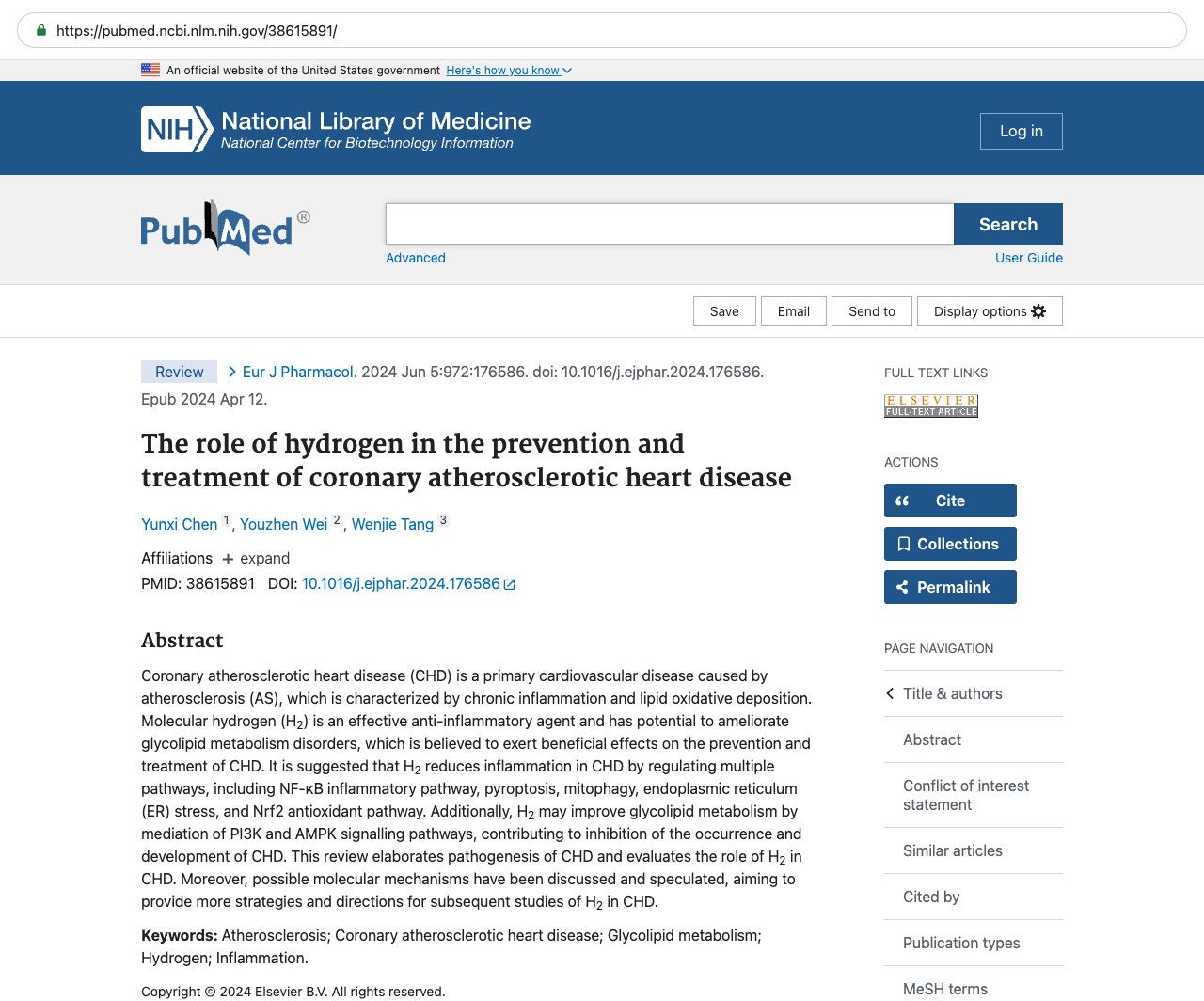
This page mirrors the published abstract (© the authors / publisher) for reference and citation. The canonical source is the PubMed record linked above. This is not medical advice.