2019 · Kura et al. — Molecular hydrogen: potential in mitigating oxidative-stress-induced radiation injury.
Super-Abstract
Molecular hydrogen (H₂) may help protect against radiation-induced oxidative damage by activating the body's own antioxidant defence systems — particularly the Nrf2 pathway — and reducing lipid peroxidation. This 2019 review and proof-of-principle study by Kura and colleagues demonstrates in rats that H₂ administration before irradiation significantly increased protective enzymes (SOD, pAKT) and reduced markers of oxidative damage (lipid peroxidation).
Commentary
Radiation therapy unavoidably generates oxidative and nitrosative stress, contributing to both acute side effects and long-term tissue damage. This paper combines a short review of H₂'s radical-scavenging properties in artificial systems with a rat in-vivo experiment: animals pre-treated with molecular hydrogen showed significantly higher superoxide dismutase (SOD) activity and pAKT (cell-survival signalling) in cardiac tissue, along with lower lipid peroxidation after irradiation. The proposed protective mechanism centres on Nrf2 — a master regulator of antioxidant gene expression. This is animal research; it does not constitute evidence that the same protection occurs in human radiotherapy patients.
Key quotes
- „administration of molecular hydrogen led to a significant increase in superoxide dismutase as well as pAKT, a cell survival signaling molecule.“ — the rat in-vivo result: H₂ boosted protective enzymes in cardiac tissue
- „Irradiation of the rats caused a significant increase in lipid peroxidation, which was mitigated by pre-treatment of the animals with molecular hydrogen.“ — H₂ pre-treatment reduced radiation-induced oxidative damage in the animal model
- „We suggest that the beneficial effects of molecular hydrogen may be through the activation of nuclear factor erythroid 2-related factor 2 pathway that promotes innate antioxidants and reduction of apoptosis, as well as inflammation.“ — proposed mechanism: Nrf2 pathway activation as the central protective route
Our assessment
This paper combines a narrative review with a proof-of-principle animal experiment (rat model). The in-vivo data are mechanistically coherent and add value beyond a pure literature review. Limitations: this is animal research — the rat cardiac model cannot be directly extrapolated to human radiation oncology contexts. Dosing, timing, and H₂ concentration used in the animal experiment may differ substantially from what is feasible in clinical practice. Nrf2 pathway activation is a plausible but not yet clinically validated mechanism for H₂'s radioprotective effects. Human trials would be necessary to confirm translational relevance.
Study design
- Type: narrative review + proof-of-principle animal experiment · Model: rat, cardiac tissue · H₂ delivery: not specified in detail (pre-treatment before irradiation)
- Key results: ↑ SOD activity, ↑ pAKT, ↓ lipid peroxidation in H₂ pre-treated irradiated rats vs. controls · Proposed mechanism: Nrf2 pathway activation → innate antioxidant induction + anti-apoptotic effect
Abstract
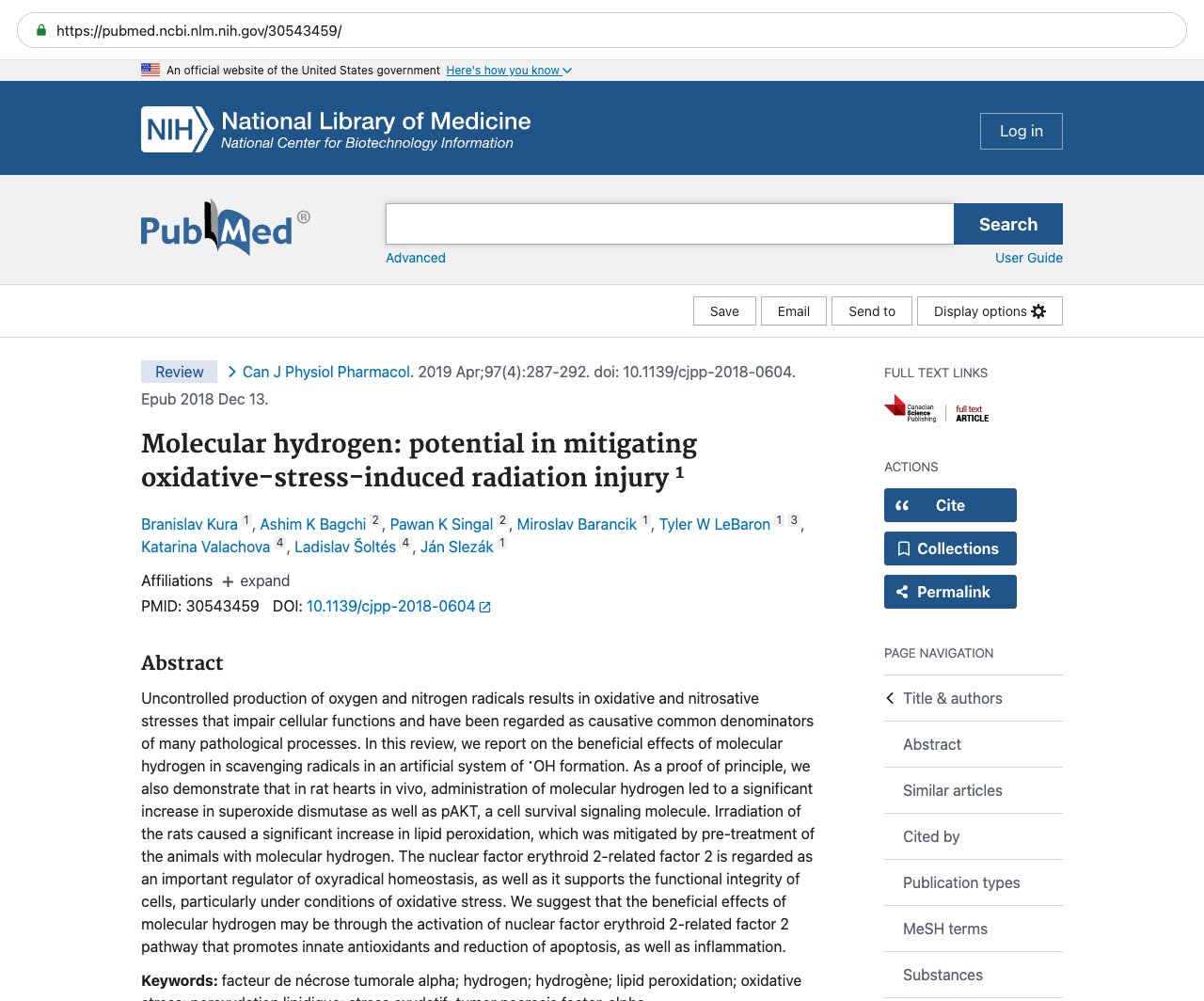
Uncontrolled production of oxygen and nitrogen radicals results in oxidative and nitrosative stresses that impair cellular functions and have been regarded as causative common denominators of many pathological processes. In this review, we report on the beneficial effects of molecular hydrogen in scavenging radicals in an artificial system of •OH formation. As a proof of principle, we also demonstrate that in rat hearts in vivo, administration of molecular hydrogen led to a significant increase in superoxide dismutase as well as pAKT, a cell survival signaling molecule. Irradiation of the rats caused a significant increase in lipid peroxidation, which was mitigated by pre-treatment of the animals with molecular hydrogen. The nuclear factor erythroid 2-related factor 2 is regarded as an important regulator of oxyradical homeostasis, as well as it supports the functional integrity of cells, particularly under conditions of oxidative stress. We suggest that the beneficial effects of molecular hydrogen may be through the activation of nuclear factor erythroid 2-related factor 2 pathway that promotes innate antioxidants and reduction of apoptosis, as well as inflammation.
Source & links
Screenshot of the PubMed page
This page mirrors the published abstract (© the authors / publisher) for reference and citation. The canonical source is the PubMed record linked above. This is not medical advice.