1996 · Mehta — Magnetization Transfer Magnetic Resonance Imaging: A Clinical Review
Super-Abstract
Magnetization transfer (MT) is a magnetic resonance imaging technique that exploits the interaction between free water protons and protons bound to macromolecules — providing tissue contrast that reveals structural integrity beyond conventional T1, T2, and proton-density images. This clinical review covers the physics of MT, normal brain appearances, and key neuroradiological applications including multiple sclerosis, white-matter lesions, tumors, and vascular imaging. (Topics in Magnetic Resonance Imaging, 1996.)
Commentary
This is a methodological review of magnetization transfer MRI — a diagnostic imaging technique, not a hydrogen therapy study. The term „hydrogen” appears here in its classical MRI context: the two pools of hydrogen protons (free water protons and macromolecule-bound protons) that underlie the MT contrast mechanism. The paper has no relevance to molecular hydrogen (H₂) therapy or dissolved H₂. It documents how MT imaging was clinically applied in the mid-1990s for neurological diseases. Its inclusion in a hydrogen-medicine database rests solely on the physics of proton exchange, not on therapeutic H₂.
Key quotes
- „tissues contain two or more separate populations of hydrogen protons: a highly mobile (free) hydrogen (water) pool, Hr, and an immobile (restricted) hydrogen pool“ — the biophysical basis of magnetization transfer — two hydrogen-proton pools
- „MT contrast is different from T1, T2, and PD, and it likely reflects the structural integrity of the tissue being imaged.“ — why MT MRI adds clinical value beyond standard sequences
- „A variety of clinically important uses of MT have emerged.“ — the motivation for this clinical review
Our assessment
This paper is a diagnostic imaging review, not a hydrogen therapy study. It describes magnetization transfer MRI physics and neuroradiological applications in the 1990s — a legitimate and well-established technique. Its connection to „hydrogen” is purely through MRI proton physics (¹H NMR), not through molecular H₂ or hydrogen-rich water. No therapeutic claims about H₂ should be drawn from this work. For researchers looking for clinical evidence on H₂ as a therapeutic agent, this paper is not relevant.
Study design
- Type: narrative clinical review · n: n/a (literature synthesis) · H₂ delivery: not applicable — study concerns hydrogen proton MRI physics, not molecular H₂ administration
- Result: no experimental data; the review summarizes MT MRI physics and neuroradiological applications (MS lesions, white-matter disease, vascular imaging, tumors) as of 1996
Abstract
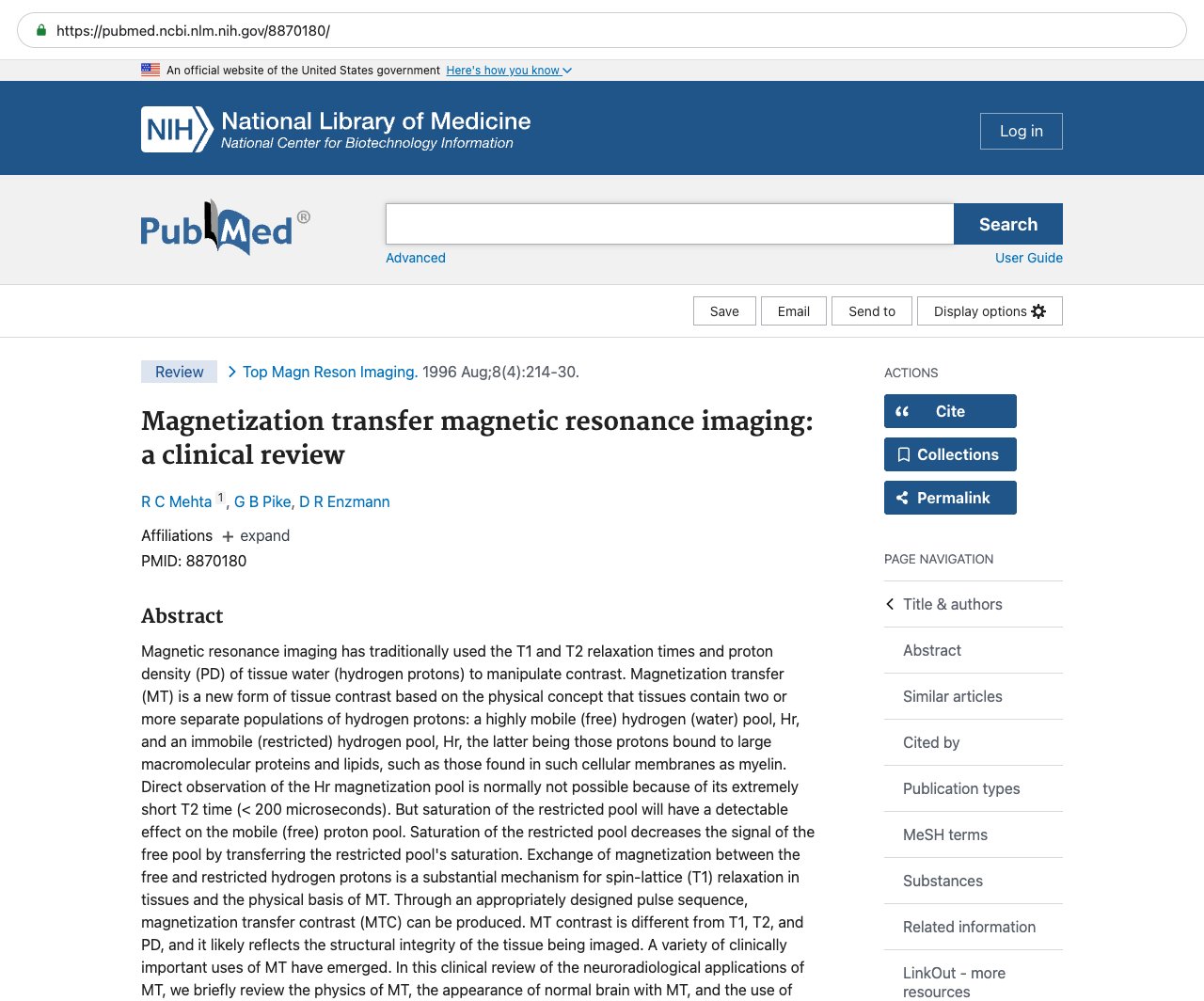
Magnetic resonance imaging has traditionally used the T1 and T2 relaxation times and proton density (PD) of tissue water (hydrogen protons) to manipulate contrast. Magnetization transfer (MT) is a new form of tissue contrast based on the physical concept that tissues contain two or more separate populations of hydrogen protons: a highly mobile (free) hydrogen (water) pool, Hr, and an immobile (restricted) hydrogen pool, Hr, the latter being those protons bound to large macromolecular proteins and lipids, such as those found in such cellular membranes as myelin. Direct observation of the Hr magnetization pool is normally not possible because of its extremely short T2 time (< 200 microseconds). But saturation of the restricted pool will have a detectable effect on the mobile (free) proton pool. Saturation of the restricted pool decreases the signal of the free pool by transferring the restricted pool's saturation. Exchange of magnetization between the free and restricted hydrogen protons is a substantial mechanism for spin-lattice (T1) relaxation in tissues and the physical basis of MT. Through an appropriately designed pulse sequence, magnetization transfer contrast (MTC) can be produced. MT contrast is different from T1, T2, and PD, and it likely reflects the structural integrity of the tissue being imaged. A variety of clinically important uses of MT have emerged. In this clinical review of the neuroradiological applications of MT, we briefly review the physics of MT, the appearance of normal brain with MT, and the use of MT as a method of contrast enhancement/background suppression and in tissue characterization, such as evaluation of multiple sclerosis and other white-matter lesions and tumors. The role of MT in small-vessel visualization on three-dimensional time-of-flight magnetic resonance angiography and in head and neck disease and newer applications of MT are also elaborated.
Source & links
Screenshot of the PubMed page
This page mirrors the published abstract (© the authors / publisher) for reference and citation. The canonical source is the PubMed record linked above. This is not medical advice.