2021 · Ohta — Direct Targets and Subsequent Pathways for Molecular Hydrogen to Exert Multiple Functions: Focusing on Interventions in Radical Reactions
Super-Abstract
Molecular hydrogen (H₂) is not simply a passive antioxidant — it actively intervenes in radical chain reactions, modifying lipid peroxides and downstream signaling cascades. This review by the researcher who first demonstrated H₂'s antioxidant properties traces the molecular pathway from H₂'s initial reaction with hydroxyl radicals to its far-reaching effects on calcium signaling, transcription factors, and energy metabolism. It also explores H₂'s potential relevance to COVID-19, Alzheimer's disease, and advanced cancer — strictly at the mechanistic hypothesis level.
Commentary
Ohta is one of the founding figures of hydrogen biology, having published the landmark 2007 Nature Medicine paper. This review consolidates nearly 15 years of mechanistic research into a coherent model: H₂ first quenches hydroxyl radicals (•OH) in vivo, which suppresses lipid peroxide formation; the resulting reduction of 4-hydroxy-2-nonenal (4-HNE) then upregulates PGC-1α, a master regulator of mitochondrial biogenesis and energy metabolism. In a parallel pathway, H₂ modifies oxidized phospholipids that antagonize calcium channels, thereby suppressing NFAT and CREB transcription factors — which may explain H₂'s broad anti-inflammatory and anti-allergic effects. The paper also entertains a novel hypothesis: H₂ may alter protein structure indirectly through changes in hydration water. Several open questions remain, including H₂'s exact role in LPS signaling, MAPK and NF-κB pathways, and the so-called Nrf2 paradox. This is a mechanistic review and does not constitute clinical evidence.
Key quotes
- „H2 may react directly with strong oxidants, such as hydroxyl radicals (•OH) in vivo.“ — the primary molecular target: hydroxyl radical scavenging
- „4-hydroxy-2-nonenal functions as a mediator that up-regulates multiple functional PGC-1α.“ — how H₂'s antioxidant effect connects to energy metabolism upregulation
- „This review introduces the possibility that H2 causes structural changes in proteins via hydrate water changes.“ — a novel, speculative hypothesis on H₂ mechanism — explicitly unproven
Our assessment
This is a valuable mechanistic synthesis from a founding researcher in the field. It offers the most detailed molecular model available for how H₂ might exert its multi-functional effects through a coherent radical-reaction pathway. Honest limitations: this is a review article, not new experimental data, and several proposed mechanisms (Nrf2 paradox, protein hydration effects, COVID-19 connection) remain at the hypothesis stage. The NFAT/Ca²⁺ signaling model is biologically plausible but requires confirmation in human studies. The paper does not constitute clinical evidence for any therapeutic application in humans.
Study design
- Type: narrative/mechanistic review · n: n/a (literature synthesis) · H₂ delivery: various (discussed across cited studies)
- Focus: molecular pathway from •OH scavenging → lipid peroxide suppression → 4-HNE → PGC-1α; parallel pathway via oxidized phospholipids → Ca²⁺ channel antagonism → NFAT/CREB suppression
- Result: no pooled effect sizes; mechanistic model proposed to explain H₂'s antioxidant, anti-inflammatory, anti-allergic, and energy-metabolic effects; several pathways (LPS, MAPK, NF-κB, Nrf2) flagged as unresolved
Abstract
Molecular hydrogen (H2) was long regarded as non-functional in mammalian cells. We overturned the concept by demonstrating that H2 exhibits antioxidant effects and protects cells against oxidative stress. Subsequently, it has been revealed that H2 has multiple functions in addition to antioxidant effects, including antiinflammatory, anti-allergic functions, and as cell death and autophagy regulation. Additionally, H2 stimulates energy metabolism. As H2 does not readily react with most biomolecules without a catalyst, it is essential to identify the primary targets with which H2 reacts or interacts directly. As a first event, H2 may react directly with strong oxidants, such as hydroxyl radicals (•OH) in vivo. This review addresses the key issues related to this in vivo reaction. •OH may have a physiological role because it triggers a free radical chain reaction and may be involved in the regulation of Ca2+- or mitochondrial ATP-dependent K+-channeling. In the subsequent pathway, H2 suppressed a free radical chain reaction, leading to decreases in lipid peroxide and its end products. Derived from the peroxides, 4-hydroxy-2-nonenal functions as a mediator that up-regulates multiple functional PGC-1α. As the other direct target in vitro and in vivo, H2 intervenes in the free radical chain reaction to modify oxidized phospholipids, which may act as an antagonist of Ca2+-channels. The resulting suppression of Ca2+-signaling inactivates multiple functional NFAT and CREB transcription factors, which may explain H2 multi-functionality. This review also addresses the involvement of NFAT in the beneficial role of H2 in COVID-19, Alzheimer's disease and advanced cancer. We discuss some unsolved issues of H2 action on lipopolysaccharide signaling, MAPK and NF-κB pathways and the Nrf2 paradox. Finally, as a novel idea for the direct targeting of H2, this review introduces the possibility that H2 causes structural changes in proteins via hydrate water changes.
Source & links
Screenshot of the PubMed page
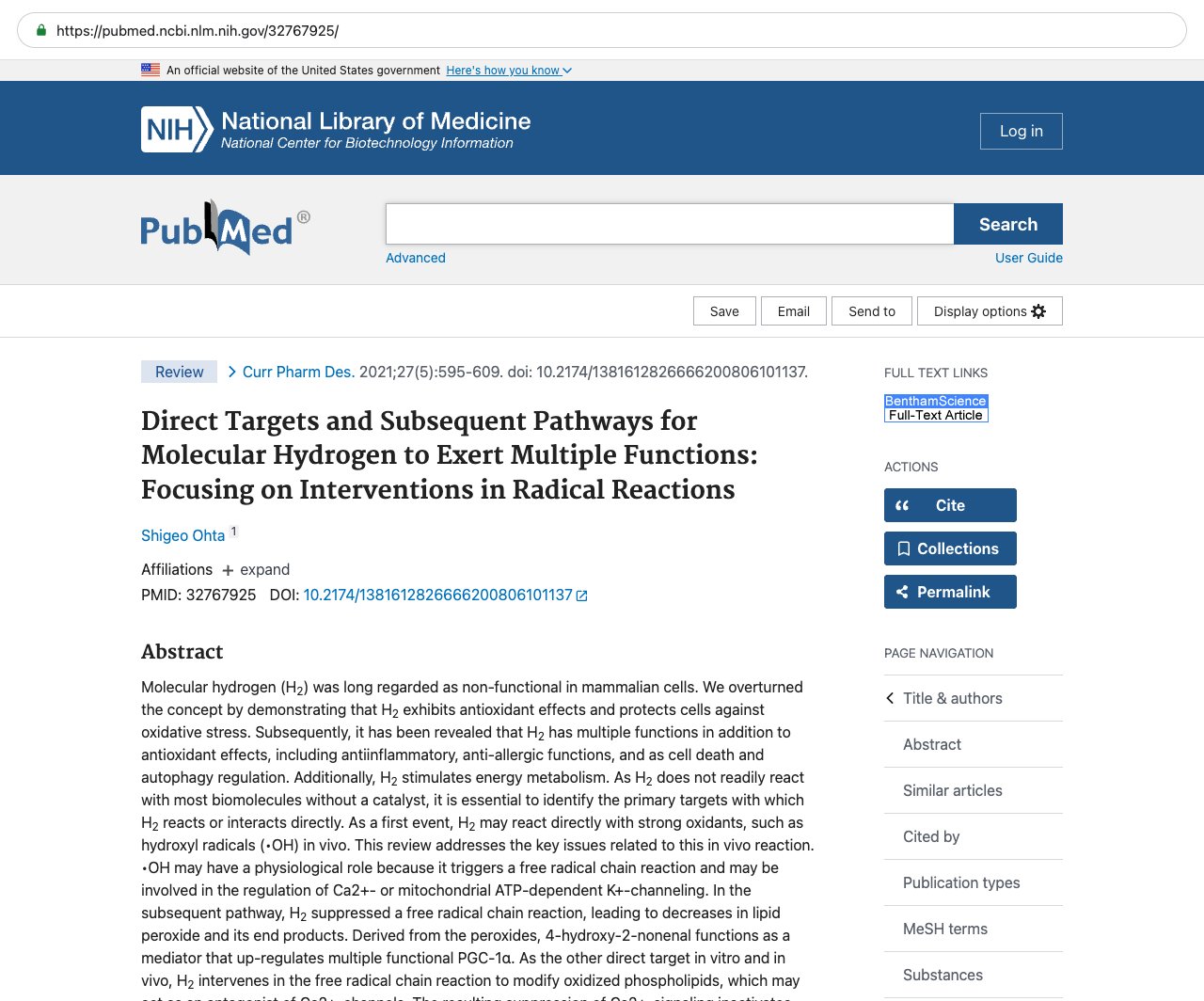
This page mirrors the published abstract (© the authors / publisher) for reference and citation. The canonical source is the PubMed record linked above. This is not medical advice.