2011 Medical science monitor : international medical journal of experimental and clinical research Mechanism / Preclinical InhalationSaline / IV
2011 · Chuai — A Possible Prevention Strategy of Radiation Pneumonitis: Combine Radiotherapy with Aerosol Inhalation of Hydrogen-Rich Solution
Super-Abstract
This theoretical paper proposes that combining radiotherapy with aerosol inhalation of hydrogen-rich physiological saline could reduce radiation pneumonitis — a serious complication of lung cancer radiotherapy — by exploiting H₂'s ability to scavenge the hydroxyl radicals that cause most radiation-induced cell damage. This is a hypothesis paper, not a clinical or experimental study; no patient data are presented. (Medical Science Monitor, 2011.)
Commentary
Radiation pneumonitis is one of the primary reasons why radiation doses to the lung cannot be increased — it is an inflammatory and fibrotic response to radiation damage that limits therapeutic options for thoracic cancers. Most radiation-induced cellular damage is caused by hydroxyl radicals generated when ionising radiation interacts with intracellular water. Molecular hydrogen (H₂) selectively scavages hydroxyl radicals and peroxynitrite without disrupting signalling ROS. This paper argues that delivering H₂ via aerosol inhalation of H₂-saturated physiological saline during or after radiotherapy could therefore provide targeted protection to the lung. The authors note that pure H₂ gas is explosive, making saline-dissolved H₂ a safer delivery vehicle. This is a medically rational hypothesis grounded in existing H₂ biology, but it remains speculative until tested in clinical trials.
Key quotes
- „Recent studies show that hydrogen has a potential as an effective and safe radioprotective agent by selectively reducing hydroxyl and peroxynitrite radicals.“ — the mechanistic rationale: H₂ scavenges the most damaging radiation-induced radicals
- „we hypothesize that a treatment combining radiotherapy with aerosol inhalation of a hydrogen-rich solution may be an effective and novel prevention strategy for radiation pneumonitis“ — the core hypothesis — explicitly stated as a hypothesis, not a proven result
- „hydrogen is explosive, while a hydrogen-rich solution such as physiological saline saturated with molecular hydrogen is safer“ — practical safety consideration for clinical translation of H₂ delivery
Our assessment
This is a theoretical/hypothesis paper — no experiments or patient data are presented. It is not a clinical or preclinical study. The scientific reasoning is internally consistent and grounded in prior H₂ research, but the hypothesis has not been experimentally validated in this paper. Honest note: hypothesis papers are an important part of the scientific process, but they do not constitute proof of efficacy. The clinical utility of H₂ aerosol inhalation for radiation pneumonitis prevention requires dedicated clinical trials to establish safety and efficacy in humans.
Study design
- Type: theoretical/hypothesis paper · Model: n/a (no experiments conducted) · H₂ delivery proposed: aerosol inhalation of H₂-saturated physiological saline during/after radiotherapy
- Result: hypothesis only — combination of radiotherapy + H₂ aerosol inhalation proposed as a novel prevention strategy for radiation pneumonitis; no experimental validation presented
Abstract
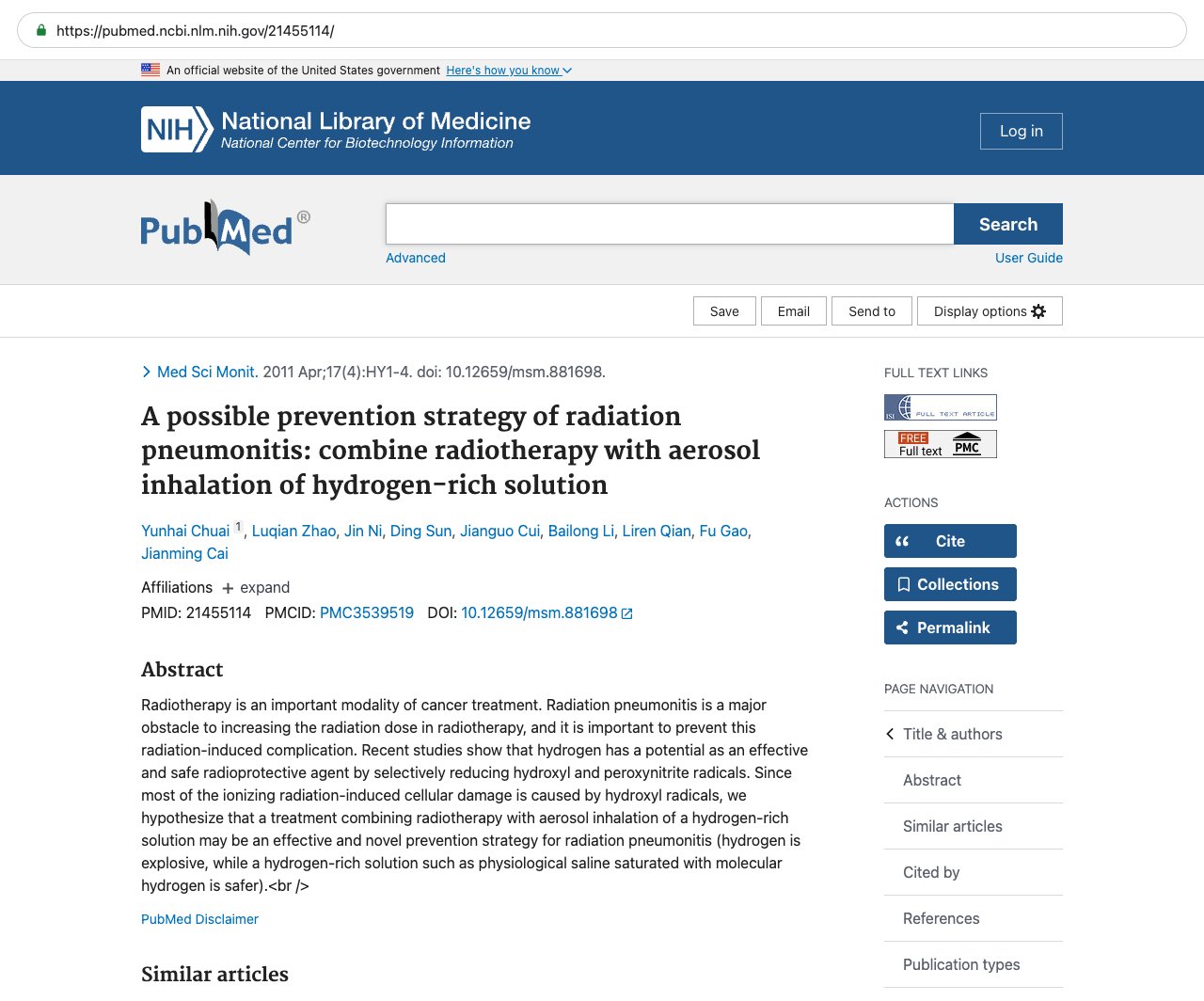
Radiotherapy is an important modality of cancer treatment. Radiation pneumonitis is a major obstacle to increasing the radiation dose in radiotherapy, and it is important to prevent this radiation-induced complication. Recent studies show that hydrogen has a potential as an effective and safe radioprotective agent by selectively reducing hydroxyl and peroxynitrite radicals. Since most of the ionizing radiation-induced cellular damage is caused by hydroxyl radicals, we hypothesize that a treatment combining radiotherapy with aerosol inhalation of a hydrogen-rich solution may be an effective and novel prevention strategy for radiation pneumonitis (hydrogen is explosive, while a hydrogen-rich solution such as physiological saline saturated with molecular hydrogen is safer).<br />
Source & links
Screenshot of the PubMed page
This page mirrors the published abstract (© the authors / publisher) for reference and citation. The canonical source is the PubMed record linked above. This is not medical advice.