1959 · CLARK LC Jr — Left-to-right shunt detection by an intravascular electrode with hydrogen as an indicator.
Super-Abstract
This 1959 paper from Science describes the foundational technique of using an intravascular platinum-tipped electrode to detect left-to-right intracardiac shunts with inhaled hydrogen as the indicator. Hydrogen crosses the pulmonary membrane and dissolves in blood, appearing first and at high concentration in the left heart, and later at lower concentration in the right heart — a pattern that reveals abnormal shunt flow. (Science, 1959.)
Commentary
This paper by L.C. Clark Jr. — the inventor of the Clark electrode (the basis of modern blood gas and glucose sensors) — describes what may be the seminal paper for hydrogen as a diagnostic cardiovascular tracer. Clark's genius was recognising that H₂'s physical properties (rapid membrane permeability, electrochemical detectability at polarised platinum) could be harnessed for non-invasive cardiovascular diagnostics. The technique described here — inhale H₂, detect its arrival by intravascular platinum electrode — formed the basis for a decade of subsequent publications (several of which appear in this same database chunk). This is foundational diagnostic methodology. H₂ is not administered therapeutically; its sole role is as a diffusible indicator gas for the detection of intracardiac communications.
Key quotes
- „Hydrogen gas crosses the pulmonary membrane and dissolves in blood, and it therefore appears immediately and in high concentration in the left heart and later and in lower concentration in the right heart.“ — the physical basis of the technique: H₂ pharmacokinetics across the pulmonary membrane
- „The hydrogen-sensing, platinum black-tipped catheter is uniquely sensitive in detecting the left-to-right shunts.“ — key conclusion: H₂ + platinum electrode = high-sensitivity shunt detection
Our assessment
This study has no relevance to H₂ therapy. It is the founding paper of hydrogen as a cardiovascular diagnostic tracer, published in Science by L.C. Clark Jr. — one of the most important medical device inventors of the 20th century. H₂ is used as an inert indicator gas exploiting membrane permeability and electrochemical detectability. Historical importance: this paper established the method used by multiple subsequent studies in the 1960s–70s for cardiac shunt detection. Off-topic for a therapeutic H₂ database, but represents foundational knowledge about H₂'s physical behaviour in the human body.
Study design
- Type: diagnostic methodology, foundational / proof-of-concept · n: not stated · H₂ delivery: inhaled H₂ as intravascular indicator (platinum-tipped catheter detection) — NOT therapeutic
- Result: H₂ appears immediately and at high concentration in left heart after inhalation; later/lower in right heart; intravascular platinum electrode detects left-to-right shunts with high sensitivity · See DOI 10.1126/science.130.3377.709
Abstract
Hydrogen gas crosses the pulmonary membrane and dissolves in blood, and it therefore appears immediately and in high concentration in the left heart and later and in lower concentration in the right heart. The hydrogen-sensing, platinum black-tipped catheter is uniquely sensitive in detecting the left-to-right shunts.
Source & links
Screenshot of the PubMed page
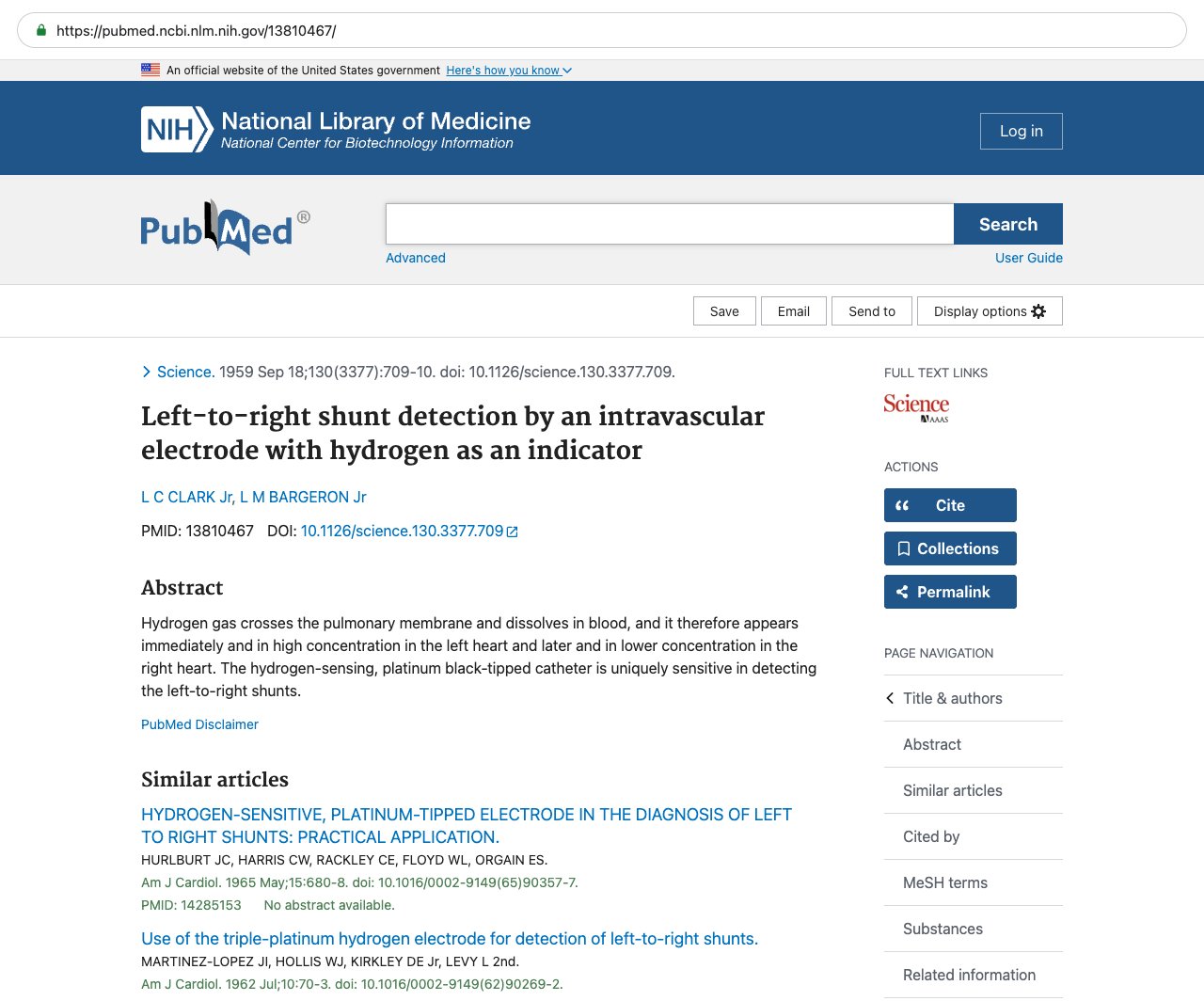
This page mirrors the published abstract (© the authors / publisher) for reference and citation. The canonical source is the PubMed record linked above. This is not medical advice.