1999 · Cole — Consequences of incomplete carbohydrate absorption from fruit juice consumption in infants.
Super-Abstract
In healthy infants aged ~5 months, consumption of pear juice (containing sorbitol and high fructose) caused carbohydrate malabsorption detectable by breath hydrogen testing, and was associated with increased physical activity and metabolic rate compared to infants who absorbed the carbohydrates normally. H₂ is a breath biomarker here, not a therapeutic agent. (Archives of Pediatrics & Adolescent Medicine, 1999.)
Commentary
This double-blind study in 14 infants used breath hydrogen analysis to detect carbohydrate malabsorption after fruit juice consumption. Pear juice (sorbitol-containing, high fructose/glucose ratio) caused malabsorption in 5 of 7 infants, while white grape juice (sorbitol-free, low fructose/glucose ratio) caused it in only 2 of 7. Infants with malabsorption showed significantly higher physical activity and metabolic rate — an interesting but not clinically alarming physiological response. Breath H₂ here is a well-established diagnostic tool for GI carbohydrate absorption, entirely unrelated to molecular hydrogen therapy.
Key quotes
- „Carbohydrate malabsorption is associated with increased physical activity and metabolic rate in infants.“ — the main finding: malabsorption drives measurable physiological changes in infants
- „Fruit juices containing sorbitol and high levels of fructose may not be optimal for young infants.“ — the practical dietary conclusion for infant nutrition
Our assessment
Assessment note: This study is not an H₂ therapy trial. Breath H₂ is used as a diagnostic marker of gut carbohydrate malabsorption in infants. No hydrogen was administered therapeutically. This is a pediatric nutrition/GI physiology study. No therapeutic claims regarding H₂ are applicable. It should not appear in an H₂ therapy database without a clear disclaimer.
Study design
- Type: double-blind dietary intervention study in infants · n: 14 healthy infants (mean age 5.1 ± 0.8 months; 7 received pear juice, 7 white grape juice) · H₂ delivery: none — breath H₂ measured as diagnostic carbohydrate-malabsorption marker
- Result: 5/7 pear-juice infants vs. 2/7 grape-juice infants showed carbohydrate malabsorption (peak breath H₂ ≥ 20 ppm above baseline, p < 0.01); malabsorbers had significantly higher physical activity (p < 0.001) and metabolic rate (p < 0.05)
Abstract
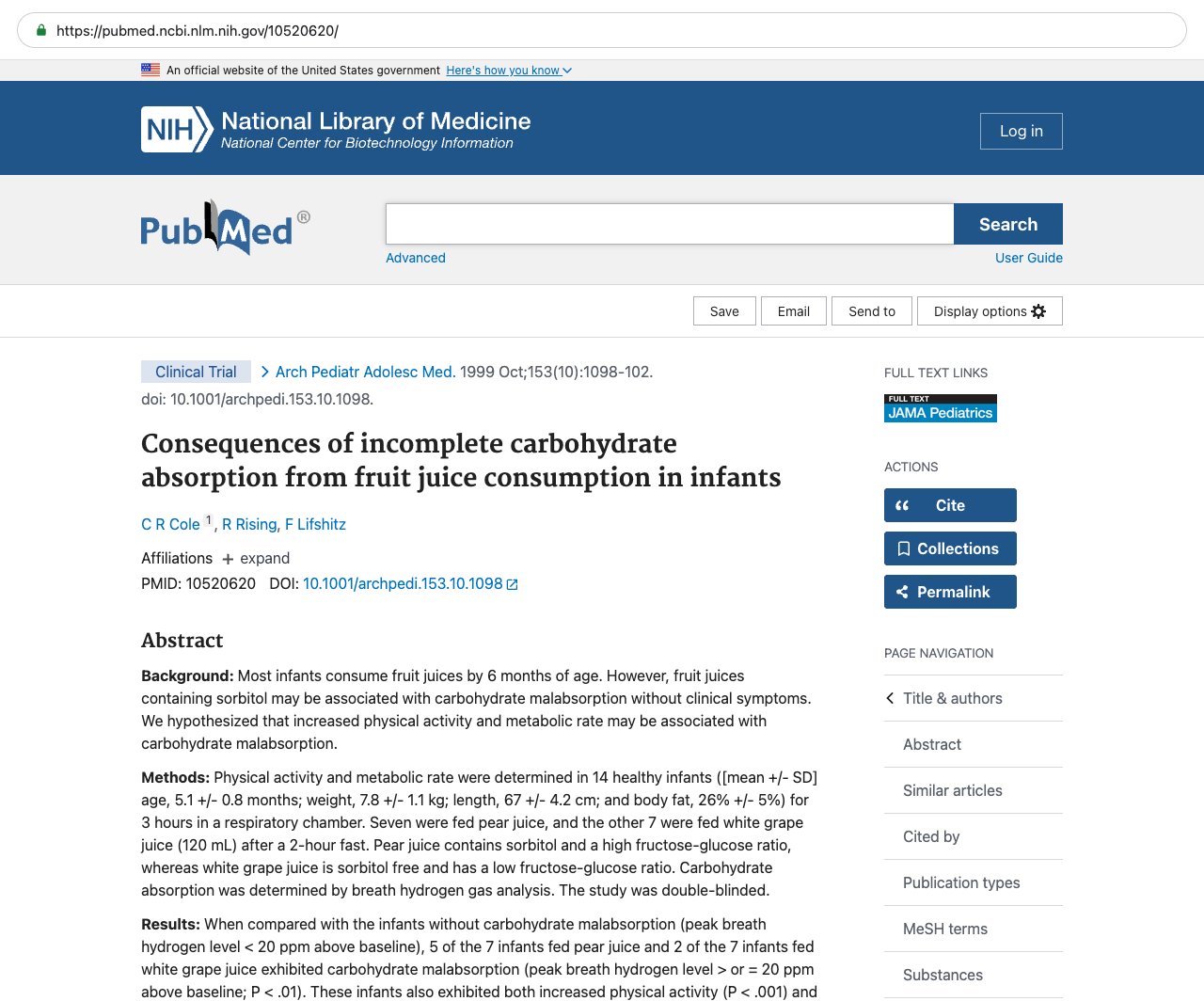
BACKGROUND: Most infants consume fruit juices by 6 months of age. However, fruit juices containing sorbitol may be associated with carbohydrate malabsorption without clinical symptoms. We hypothesized that increased physical activity and metabolic rate may be associated with carbohydrate malabsorption. METHODS: Physical activity and metabolic rate were determined in 14 healthy infants ([mean +/- SD] age, 5.1 +/- 0.8 months; weight, 7.8 +/- 1.1 kg; length, 67 +/- 4.2 cm; and body fat, 26% +/- 5%) for 3 hours in a respiratory chamber. Seven were fed pear juice, and the other 7 were fed white grape juice (120 mL) after a 2-hour fast. Pear juice contains sorbitol and a high fructose-glucose ratio, whereas white grape juice is sorbitol free and has a low fructose-glucose ratio. Carbohydrate absorption was determined by breath hydrogen gas analysis. The study was double-blinded. RESULTS: When compared with the infants without carbohydrate malabsorption (peak breath hydrogen level < 20 ppm above baseline), 5 of the 7 infants fed pear juice and 2 of the 7 infants fed white grape juice exhibited carbohydrate malabsorption (peak breath hydrogen level > or = 20 ppm above baseline; P < .01). These infants also exhibited both increased physical activity (P < .001) and metabolic rate (P < .05) after juice consumption in comparison with infants with normal carbohydrate absorption. When grouped according to the type of juice consumed, only infants fed pear juice exhibited increases in physical activity (P < .01). CONCLUSIONS: Carbohydrate malabsorption is associated with increased physical activity and metabolic rate in infants. Most of the infants who had carbohydrate malabsorption consumed pear juice. Therefore, fruit juices containing sorbitol and high levels of fructose may not be optimal for young infants.
Source & links
Screenshot of the PubMed page
This page mirrors the published abstract (© the authors / publisher) for reference and citation. The canonical source is the PubMed record linked above. This is not medical advice.