2023 · Dan et al. — Efficacy of Donepezil Plus Hydrogen-Oxygen Mixture Inhalation for Treatment of Patients With Alzheimer Disease: A Retrospective Study
Super-Abstract
In a retrospective analysis of 273 patients with Alzheimer's disease, those treated with donepezil plus hydrogen-oxygen inhalation improved more on cognitive scores (MMSE, MoCA, ADAS-Cog), daily living and P300 brain potentials than those receiving donepezil alone. All between-group differences after treatment were statistically significant, with p-values from below .001 to .013. Patients were grouped by the treatment they had received, not by randomisation, so the groups may have differed in ways that affected the results. (Medicine, 2023.)
Commentary
The study asked whether adding hydrogen-oxygen inhalation to donepezil improves outcomes in Alzheimer's disease. The authors retrospectively analysed 273 patients admitted to their hospital between March 2018 and March 2022. Patients were assigned to an observation group (n = 138, donepezil tablets plus hydrogen-oxygen mixture inhalation) or a control group (n = 135, donepezil tablets alone) according to the treatment they had received. Per full text, the gas contained 66.67% hydrogen and 33.33% oxygen at 3 L per minute, inhaled once a day, 6 days a week for 4 weeks, and both groups took donepezil 5 mg once daily. The length of each inhalation session is not reported. Outcomes were the MMSE, MoCA, ADAS-Cog, an activities of daily living scale (ADL) and the latency and amplitude of the P300 event-related potential, compared before and after treatment. The abstract does not name a primary endpoint, does not mention blinding and does not report adverse events.
Key quotes
- „After treatment, MMSE score, MoCA score, and ADL score in both groups increased after treatment (P < .01), while the improvement in the observation group was more significant than that in the control group (P < .001 for MMSE, P = .003 for MoCA, and P = .013 for ADL).“ — the main cognitive and daily-living results in both groups
- „a total of 273 AD patients admitted to our hospital from March 2018 to March 2022 were retrospectively analyzed and assigned into an observation group (n = 138) and a control group (n = 135) according to the different treatment that they received.“ — the design: groups formed by treatment received, not by random allocation
- „The clinical efficacy of donepezil combined with hydrogen-oxygen mixture inhalation in the treatment of AD is better than that of donepezil alone, which is worthy of further study.“ — the authors' conclusion, with a call for further research
Our assessment
The sample is large for hydrogen research, and all outcome measures point in the same direction. Every between-group comparison after treatment favoured the hydrogen-oxygen group. The design limits what this means. Patients were not randomised, so those who received inhalation may have differed from those who did not in ways the analysis did not capture. Without a sham inhalation, expectation effects cannot be separated from an effect of hydrogen. Limitations: retrospective data from one hospital, no randomisation, no blinding reported, no primary endpoint, several outcomes tested and, per full text, a treatment period of 4 weeks. The abstract gives p-values but no group means or effect sizes, and it does not report adverse events or when exactly the post-treatment measurements were taken. The results call for a randomised, blinded trial and on their own cannot establish an effect of hydrogen.
Study design
- Type: retrospective comparison of two treatment groups at one hospital (2018–2022), groups formed by treatment received · n: 273 (138 donepezil plus hydrogen-oxygen, 135 donepezil alone) · H₂ delivery: inhaled hydrogen-oxygen mixture (per full text 66.67% hydrogen, 3 L/min, once a day, 6 days a week for 4 weeks)
- Comparator: donepezil tablets alone (per full text 5 mg once daily in both groups)
- Result: greater improvement with hydrogen-oxygen in MMSE (P < .001), MoCA (P = .003), ADL (P = .013), ADAS-Cog (P = .005), P300 latency (P < .001) and P300 amplitude (P = .007). No group means in the abstract
Abstract
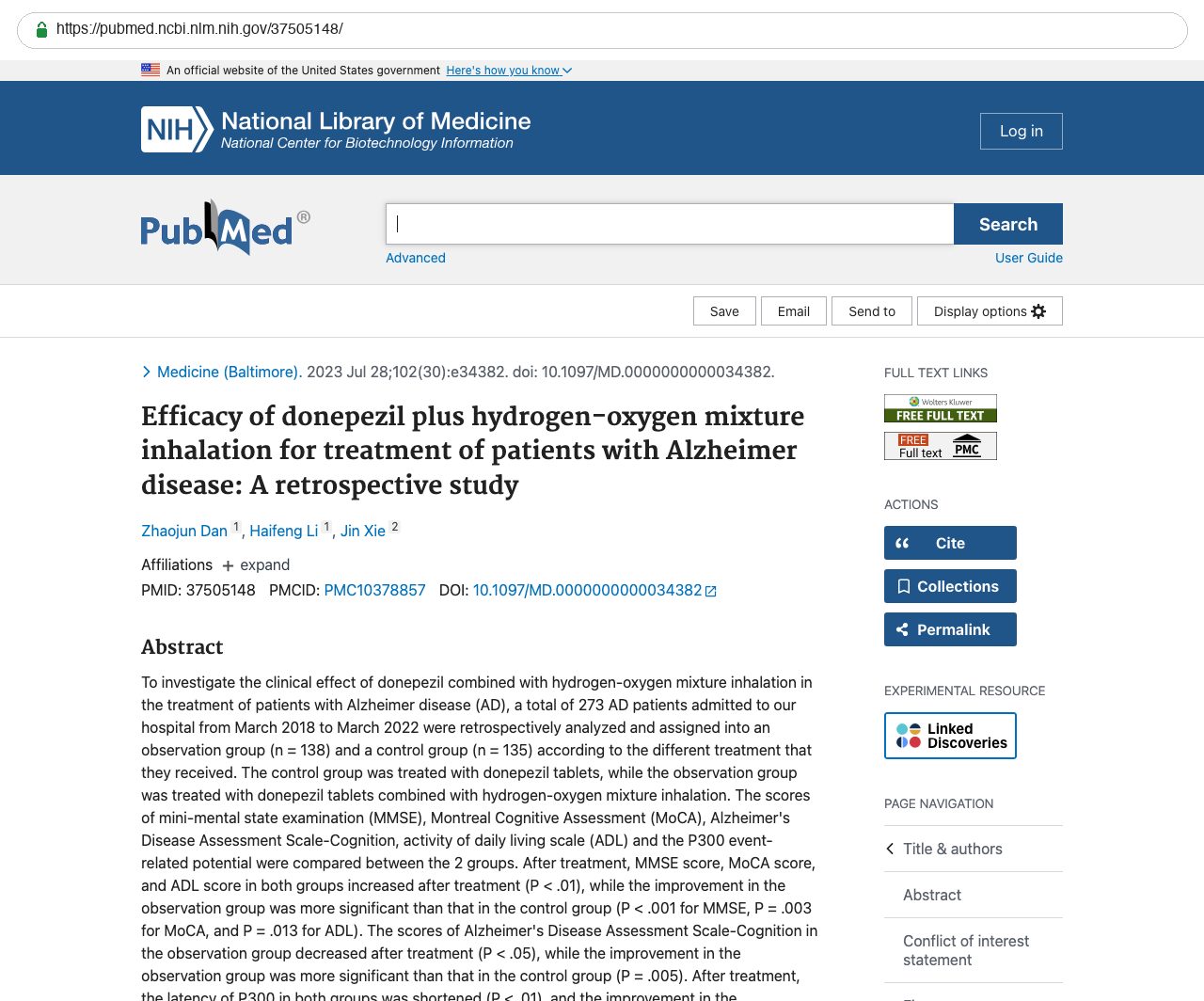
To investigate the clinical effect of donepezil combined with hydrogen-oxygen mixture inhalation in the treatment of patients with Alzheimer disease (AD), a total of 273 AD patients admitted to our hospital from March 2018 to March 2022 were retrospectively analyzed and assigned into an observation group (n = 138) and a control group (n = 135) according to the different treatment that they received. The control group was treated with donepezil tablets, while the observation group was treated with donepezil tablets combined with hydrogen-oxygen mixture inhalation. The scores of mini-mental state examination (MMSE), Montreal Cognitive Assessment (MoCA), Alzheimer's Disease Assessment Scale-Cognition, activity of daily living scale (ADL) and the P300 event-related potential were compared between the 2 groups. After treatment, MMSE score, MoCA score, and ADL score in both groups increased after treatment (P < .01), while the improvement in the observation group was more significant than that in the control group (P < .001 for MMSE, P = .003 for MoCA, and P = .013 for ADL). The scores of Alzheimer's Disease Assessment Scale-Cognition in the observation group decreased after treatment (P < .05), while the improvement in the observation group was more significant than that in the control group (P = .005). After treatment, the latency of P300 in both groups was shortened (P < .01), and the improvement in the observation group was more significant than that in the control group (P < .001). The amplitude of the observation group increased after treatment (P < .01), and the improvement of the observation group was significant than that of the control group (P = .007). The clinical efficacy of donepezil combined with hydrogen-oxygen mixture inhalation in the treatment of AD is better than that of donepezil alone, which is worthy of further study.
Source & links
Screenshot of the PubMed page
This page mirrors the published abstract (© the authors / publisher) for reference and citation. The canonical source is the PubMed record linked above. This is not medical advice.