2023 · Tamura et al. — Efficacy of Inhaled Hydrogen on Neurological Outcome Following Brain Ischaemia During Post-Cardiac Arrest Care (HYBRID II): A Multi-Centre, Randomised, Double-Blind, Placebo-Controlled Trial
Super-Abstract
Adding 2% hydrogen to inhaled oxygen for 18 hours after cardiac arrest gave no statistically significant difference in good neurological outcome at 90 days (56% compared with 39%, P = 0.15). The trial randomised 73 comatose patients. Secondary endpoints favoured the hydrogen group: 90-day survival was 85% compared with 61% (P = 0.02), and the median modified Rankin score was 1 compared with 5 (P = 0.01). The trial stopped early because COVID-19 restrictions halted enrolment, so these secondary results need confirmation in a larger study. (eClinicalMedicine, 2023.)
Commentary
HYBRID II is the results paper of the trial whose protocol was published in 2017. It followed a first-in-human feasibility study from 2016. The question was whether inhaled hydrogen reduces brain injury after cardiac arrest. Between February 2017 and September 2021, 15 hospitals in Japan enrolled patients aged 20 to 80 who remained in a coma after an out-of-hospital cardiac arrest of cardiac origin. Of 429 patients screened, 73 were randomised: 39 received oxygen with 2% H₂ and 34 received oxygen without hydrogen for 18 hours, supplied from blinded gas cylinders. Both groups also received standard post-arrest care, including targeted temperature management. The primary endpoint was the share of patients with a good neurological outcome, defined as Cerebral Performance Category (CPC) 1 or 2, at 90 days. Secondary endpoints included the modified Rankin scale (mRS) and survival at 90 days. The protocol had planned 360 patients.
Key quotes
- „The primary outcome, i.e., a CPC of 1 or 2 at 90 days, was achieved in 22 (56%) and 13 (39%) patients in the H2 and control groups (relative risk compared with the control group, 0.72; 95% CI, 0.46-1.13; P = 0.15), respectively.“ — the primary endpoint: more good outcomes in the hydrogen group, but the difference was not statistically significant
- „The 90-day survival rate was 85% (33/39) and 61% (20/33) in the H2 and control groups, respectively (P = 0.02).“ — a secondary endpoint; the trial was not powered to show an effect on survival
- „The increase in participants with good neurological outcomes following post-OHCA H2 inhalation in a selected population of patients was not statistically significant. However, the secondary outcomes suggest that H2 inhalation may increase 90-day survival without neurological deficits.“ — the authors' own interpretation, which separates the primary result from the secondary signals
Our assessment
HYBRID II is a randomised, double-blind trial run at 15 hospitals. Its primary endpoint showed no statistically significant difference. Survival and mRS point in the same direction, but they are secondary endpoints and can only generate hypotheses for a new trial. According to the full text, the hydrogen group had more patients with a shockable initial rhythm (74% vs. 53%) and witnessed arrest (74% vs. 65%), both linked to better outcomes, and in the adjusted survival analysis the difference was not statistically significant (hazard ratio 0.38, 95% CI 0.12–1.19, P = 0.09). Limitations: enrolment stopped early because of the COVID-19 pandemic, after 73 of 360 planned patients, which limits precision in both directions. All hospitals were in Japan, and only patients aged 20 to 80 with a presumed cardiac cause were included. In the full text, adverse events within 72 hours occurred in 95% vs. 88% of patients and serious adverse events in 18% vs. 21%. An independent safety committee attributed none of them to the trial gas. The study was funded by Taiyo Nippon Sanso Corporation, a manufacturer of medical gases. The authors state that the funder had no role in design, analysis or writing. A post hoc analysis of the same trial looks at hydrogen combined with temperature control: Tamura 2024.
Study design
- Type: multicentre, randomised, double-blind, placebo-controlled trial (15 hospitals in Japan, 2017–2021), stopped early · n: 73 randomised (39 H₂, 34 control) of 429 screened · H₂ delivery: inhaled oxygen with 2% H₂ for 18 hours
- Comparator: oxygen without hydrogen, supplied from blinded gas cylinders
- Result: primary endpoint (CPC 1–2 at 90 days) 56% vs. 39%, P = 0.15, not significant. Secondary: median mRS 1 vs. 5 (P = 0.01), mRS 0 in 46% vs. 21% (P = 0.03), 90-day survival 85% vs. 61% (P = 0.02)
Abstract
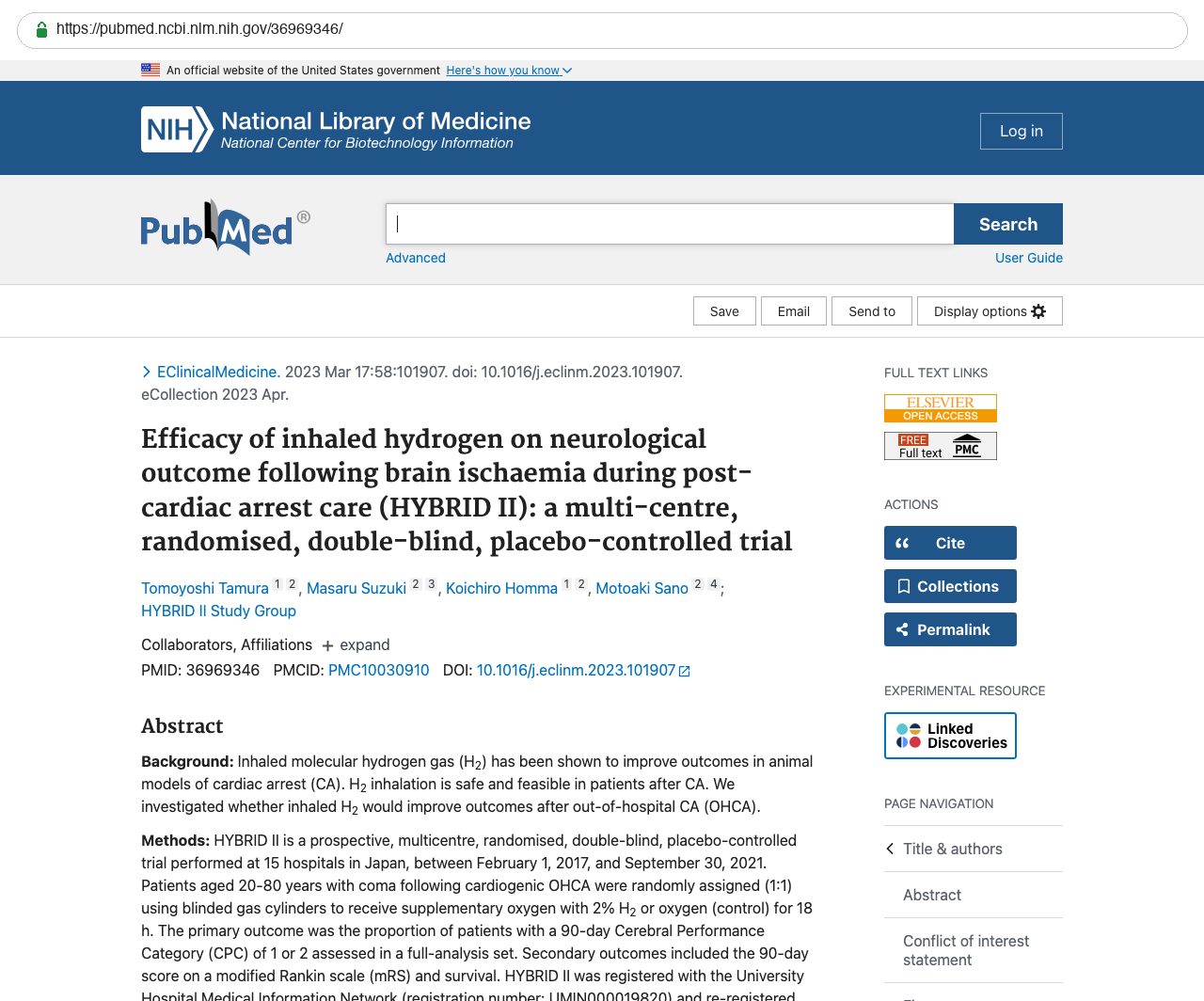
BACKGROUND: Inhaled molecular hydrogen gas (H2) has been shown to improve outcomes in animal models of cardiac arrest (CA). H2 inhalation is safe and feasible in patients after CA. We investigated whether inhaled H2 would improve outcomes after out-of-hospital CA (OHCA). METHODS: HYBRID II is a prospective, multicentre, randomised, double-blind, placebo-controlled trial performed at 15 hospitals in Japan, between February 1, 2017, and September 30, 2021. Patients aged 20-80 years with coma following cardiogenic OHCA were randomly assigned (1:1) using blinded gas cylinders to receive supplementary oxygen with 2% H2 or oxygen (control) for 18 h. The primary outcome was the proportion of patients with a 90-day Cerebral Performance Category (CPC) of 1 or 2 assessed in a full-analysis set. Secondary outcomes included the 90-day score on a modified Rankin scale (mRS) and survival. HYBRID II was registered with the University Hospital Medical Information Network (registration number: UMIN000019820) and re-registered with the Japan Registry for Clinical Trials (registration number: jRCTs031180352). FINDINGS: The trial was terminated prematurely because of the restrictions imposed on enrolment during the COVID-19 pandemic. Between February 1, 2017, and September 30, 2021, 429 patients were screened for eligibility, of whom 73 were randomly assigned to H2 (n = 39) or control (n = 34) groups. The primary outcome, i.e., a CPC of 1 or 2 at 90 days, was achieved in 22 (56%) and 13 (39%) patients in the H2 and control groups (relative risk compared with the control group, 0.72; 95% CI, 0.46-1.13; P = 0.15), respectively. Regarding the secondary outcomes, median mRS was 1 (IQR: 0-5) and 5 (1-6) in the H2 and control groups, respectively (P = 0.01). An mRS score of 0 was achieved in 18 (46%) and 7 (21%) patients in the H2 and control groups, respectively (P = 0.03). The 90-day survival rate was 85% (33/39) and 61% (20/33) in the H2 and control groups, respectively (P = 0.02). INTERPRETATION: The increase in participants with good neurological outcomes following post-OHCA H2 inhalation in a selected population of patients was not statistically significant. However, the secondary outcomes suggest that H2 inhalation may increase 90-day survival without neurological deficits. FUNDING: Taiyo Nippon Sanso Corporation. TRANSLATION: For the Japanese translation of the abstract see Supplementary Materials section.
Source & links
Screenshot of the PubMed page
This page mirrors the published abstract (© the authors / publisher) for reference and citation. The canonical source is the PubMed record linked above. This is not medical advice.