2018 The Journal of sports medicine and physical fitness Pilot / Observational Human H₂ therapy Drinking (HRW)
2018 · Da Ponte — Effects of Hydrogen-Rich Water on Prolonged Intermittent Exercise
Super-Abstract
Two weeks of hydrogen-rich water intake helped trained cyclists maintain peak power output during repeated all-out sprints over 30 minutes — where the placebo group showed significant power decline in the later sprints. This crossover study adds controlled evidence to H₂'s role in sustaining high-intensity exercise performance. (The Journal of Sports Medicine and Physical Fitness, 2018.)
Commentary
The performance-sustaining potential of H₂ in exercise has generated interest due to its antioxidant properties and possible role in acid-base homeostasis. Da Ponte et al. designed a well-controlled crossover protocol where 8 trained male cyclists underwent 30-minute intermittent cycling tests (10 blocks of sprint + moderate + easy intervals) at baseline and after 2 weeks of HRW (pH 9.8, ORP –180 mV, 450 ppb H₂) or placebo (pH 7.6, ORP +230 mV, 0 ppb H₂) consumption. The primary finding: peak power output (PPO) in absolute values declined significantly at the 8th and 9th sprints in the placebo group (mean –12% at the 6th, 8th, and 9th sprints in relative terms), while the HRW group maintained PPO throughout all 10 sprints without a statistically significant decline. This is a specific and practically meaningful performance difference. However, mean power, fatigue index, time to peak power, and total work showed no significant differences between groups. Lactate, pH, and bicarbonate changed similarly in both conditions — suggesting the mechanism of PPO maintenance is not simply acid-base buffering.
Key quotes
- „PPO in absolute values decreased significantly at the 8th and 9th of 10 sprints and in relative values, ΔPPO, decreased significantly at 6th, 8th and 9th of 10 sprints (by mean: -12±5%, P<0.006), while it remained unchanged in HRW group.“ — the key performance finding: placebo sprinters faded significantly; HRW group held steady
- „In both conditions lactate levels increased while pH and HCO3- decreased progressively as a function of the number of sprints.“ — acid-base parameters changed similarly in both groups — the mechanism is not simple buffering
- „Two weeks of HRW intake may help to maintain PPO in repetitive sprints to exhaustion over 30 minutes.“ — the authors' cautious conclusion — appropriate hedge for an n=8 pilot
Our assessment
A well-designed crossover study with a specific and objective performance outcome (PPO maintenance). The placebo-controlled, crossover design with randomized sequence and trained athletes is methodologically sound. Limitations: n = 8 is very small — a crossover design partially compensates for this, but statistical power is still limited; only male cyclists aged 41±7 years — results may not generalize to other populations or sports; the study is single-blind (investigator blinded, but the distinctive pH and ORP of HRW vs. placebo may have allowed athletes to distinguish them by taste); the mechanism remains unclear (acid-base parameters were similar in both groups); no data on H₂ absorption or systemic H₂ levels were measured. The PPO maintenance finding is the most practically relevant result, but replication in a larger cohort is needed.
Study design
- Type: crossover, single-blind, placebo-controlled pilot study · n: 8 trained male cyclists · H₂ delivery: 2 liters/day HRW (pH 9.8, ORP –180 mV, 450 ppb H₂) for 2 weeks
- Protocol: 30-minute intermittent cycling test (10 × 3-min blocks including 16-sec all-out sprint) at baseline and after 2 weeks; crossover with washout
- Result: PPO maintained across all 10 sprints in HRW group; significant PPO decline at sprints 6, 8, 9 in placebo (–12%, P < 0.006); mean power, fatigue index, lactate, pH, HCO₃⁻ — no significant differences between groups
Abstract
BACKGROUND: Recent studies showed a positive effect of hydrogen rich water (HRW) intake on acid-base homeostasis at rest. We investigated 2-weeks of HRW intake on repeated sprint performance and acid-base status during prolonged intermittent cycling exercise. METHODS: In a cross over single-blind protocol, 8 trained male cyclists (age [mean±SD] 41±7 years, body mass 72.3±4.4 kg, height 1.77±0.04 m, maximal oxygen uptake [V̇O2max] 52.6±4.4 mL·kg-1·min-1) were provided daily with 2 liters of placebo normal water (PLA, pH 7.6, oxidation/reduction potential [ORP] +230 mV, free hydrogen content 0 ppb) or HRW (pH 9.8, ORP -180 mV, free Hydrogen 450 ppb). Tests were performed at baseline and after each period of 2 weeks of treatment. The treatments were counter-balanced and the sequence randomized. The 30-minute intermittent cycling trial consisted in 10 3-minute blocks, each one composed by 90 seconds at 40% V̇O2max, 60 seconds at 60% V̇O2max, 16 seconds all out sprint, and 14 seconds active recovery. Oxygen uptake (V̇O2), heart rate and power output were measured during the whole test, while mean and peak power output (PPO), time to peak power and Fatigue Index (FI) were determined during all the 16 seconds sprints. Lactate, pH and bicarbonate (HCO3-) concentrations were determined at rest and after each sprint on blood obtained by an antecubital vein indwelling catheter. RESULTS: In the PLA group, PPO in absolute values decreased significantly at the 8th and 9th of 10 sprints and in relative values, ΔPPO, decreased significantly at 6th, 8th and 9th of 10 sprints (by mean: -12±5%, P<0.006), while it remained unchanged in HRW group. Mean power, FI, time to peak power and total work showed no differences between groups. In both conditions lactate levels increased while pH and HCO3- decreased progressively as a function of the number of sprints. CONCLUSIONS: Two weeks of HRW intake may help to maintain PPO in repetitive sprints to exhaustion over 30 minutes.
Source & links
Screenshot of the PubMed page
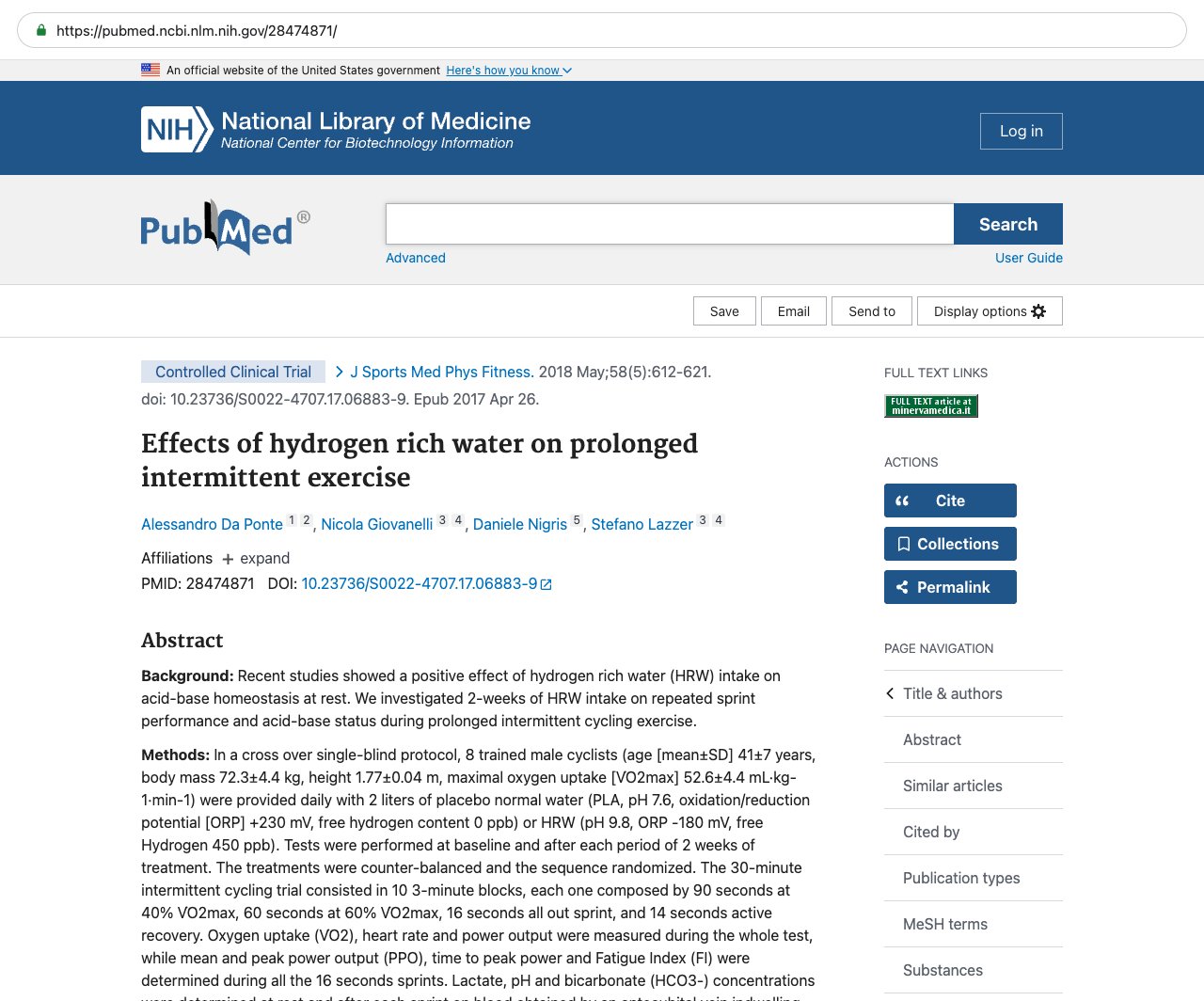
This page mirrors the published abstract (© the authors / publisher) for reference and citation. The canonical source is the PubMed record linked above. This is not medical advice.