2014 · Ostojic et al. — Hydrogen-rich water affected blood alkalinity in physically active men.
Super-Abstract
Drinking 2 L of hydrogen-rich water (HRW) daily for 14 days significantly raised both resting and post-exercise arterial blood pH, and elevated fasting bicarbonate levels, in 52 healthy physically active men — without any reported side effects. This randomized, double-blind, placebo-controlled trial points to a potential alkalizing effect of HRW relevant to exercise-induced acidosis. (Research in Sports Medicine, 2014.)
Commentary
During intense exercise, lactate and H⁺ ions accumulate, driving blood pH down. This exercise-induced acidosis impairs muscle contractility and accelerates fatigue. If HRW can modestly raise baseline and post-exercise pH, it could theoretically delay fatigue onset. In this study, 14 days of HRW consumption raised resting arterial pH by 0.04 units and post-exercise pH by 0.07 units — small shifts, but statistically significant and directionally relevant. Fasting bicarbonate levels also rose meaningfully (28.3 → 30.5 mEq/L), which is consistent with a mild systemic alkalizing effect. The study is methodologically solid: 52 subjects, double-blind, randomized, with direct arterial blood gas measurements. An important mechanistic question — whether the pH shift is due to H₂ per se or to trace minerals from the preparation — is not fully resolved here. Still, the zero dropout rate and absence of side effects add to the safety profile of HRW.
Key quotes
- „Intake of HRW significantly increased fasting arterial blood pH by 0.04 (95% confidence interval; 0.01 - 0.08; p < 0.001), and postexercise pH by 0.07 (95% confidence interval; 0.01 - 0.10; p = 0.03) after 14 days of intervention.“ — the core result: modest but significant pH increase at rest and after exercise
- „Fasting bicarbonates were significantly higher in the HRW trial after the administration regimen as compared with the preadministration (30.5 ± 1.9 mEq/L vs. 28.3 ± 2.3 mEq/L; p < 0.0001).“ — bicarbonate rise confirms the alkalizing effect
- „These results support the hypothesis that HRW administration is safe and may have an alkalizing effect in young physically active men.“ — authors' conclusion: safety confirmed, alkalizing effect probable
Our assessment
A well-designed, adequately powered study with objective arterial blood gas measurements. Results are statistically significant and internally consistent. The effect sizes are small (ΔpH ≈ 0.04–0.07), and whether they translate into measurable performance benefits was not tested here. The mechanism (is it the H₂ itself, or the water's mineral content?) is not isolated. Limitations: all-male, young, physically active population only; alkalizing mechanism not mechanistically confirmed; no performance outcome tested; arterial blood sampling is invasive and limits real-world applicability of the findings.
Study design
- Type: randomized, double-blind, placebo-controlled RCT · n: 52 healthy physically active men (26 HRW, 26 placebo) · H₂ delivery: 2 L/day HRW orally for 14 days
- Comparator: tap water placebo · Outcomes: arterial blood pH, pCO₂, bicarbonate at baseline and post-exercise (day 0 and day 14)
- Result: resting pH +0.04 (p<0.001), post-exercise pH +0.07 (p=0.03), fasting bicarbonate 28.3→30.5 mEq/L (p<0.0001); zero dropouts, no side effects reported
Abstract
Possible appliance of effective and safe alkalizing agent in the treatment of metabolic acidosis could be of particular interest to humans experiencing an increase in plasma acidity, such as exercise-induced acidosis. In the present study we tested the hypothesis that the daily oral intake of 2L of hydrogen-rich water (HRW) for 14 days would increase arterial blood alkalinity at baseline and post-exercise as compared with the placebo. This study was a randomized, double blind, placebo-controlled trial involving 52 presumably healthy physically active male volunteers. Twenty-six participants received HRW and 26 a placebo (tap water) for 14 days. Arterial blood pH, partial pressure for carbon dioxide (pCO2), and bicarbonates were measured at baseline and postexercise at the start (day 0) and at the end of the intervention period (day 14). Intake of HRW significantly increased fasting arterial blood pH by 0.04 (95% confidence interval; 0.01 - 0.08; p < 0.001), and postexercise pH by 0.07 (95% confidence interval; 0.01 - 0.10; p = 0.03) after 14 days of intervention. Fasting bicarbonates were significantly higher in the HRW trial after the administration regimen as compared with the preadministration (30.5 ± 1.9 mEq/L vs. 28.3 ± 2.3 mEq/L; p < 0.0001). No volunteers withdrew before the end of the study, and no participant reported any vexatious side effects of supplementation. These results support the hypothesis that HRW administration is safe and may have an alkalizing effect in young physically active men.
Source & links
Screenshot of the PubMed page
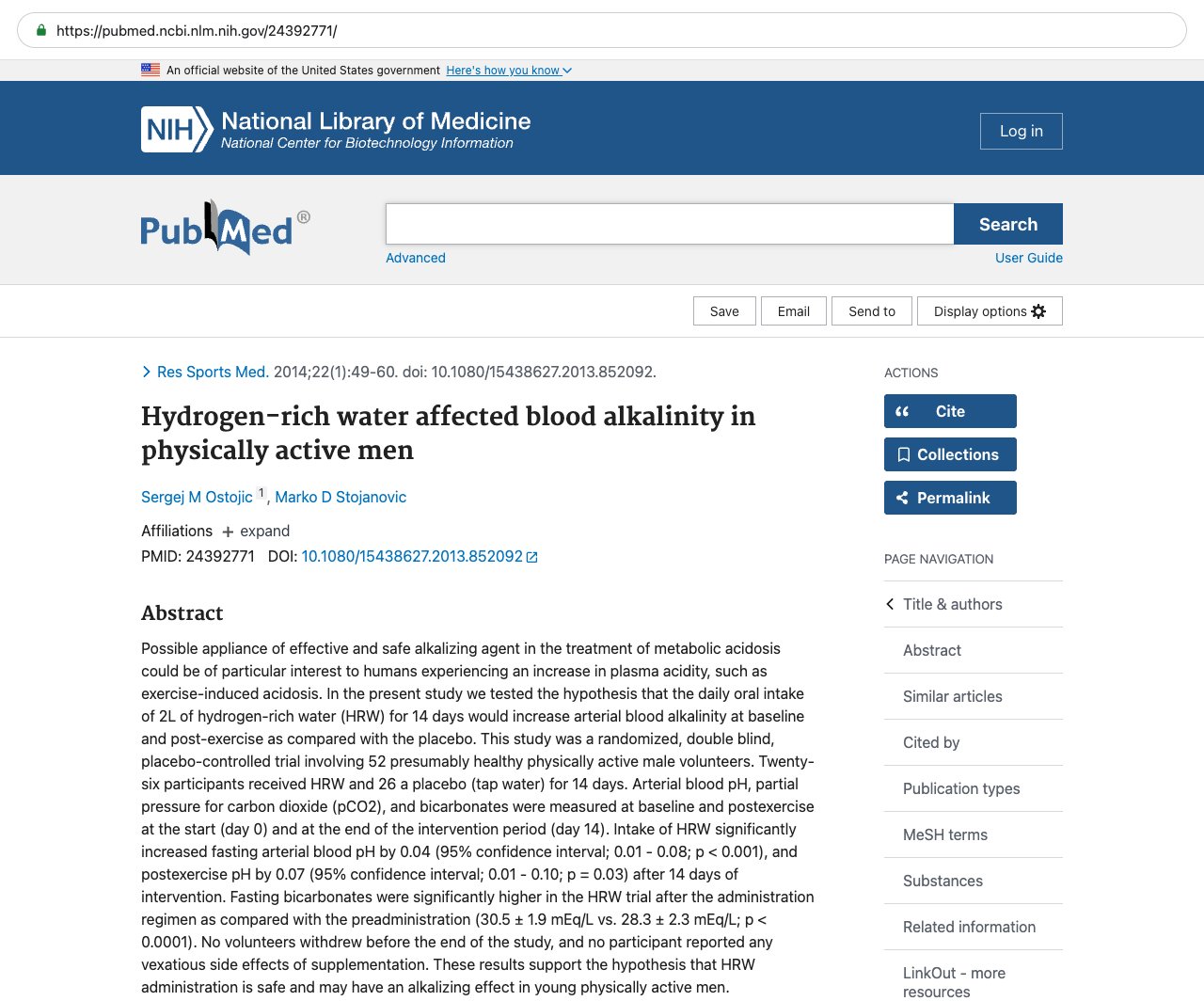
This page mirrors the published abstract (© the authors / publisher) for reference and citation. The canonical source is the PubMed record linked above. This is not medical advice.