2008 · da Silva — Hydrogen as an energy source for the human pathogen Bilophila wadsworthia.
Super-Abstract
This in-vitro microbiology study showed that the gut pathogen Bilophila wadsworthia can use molecular hydrogen (H₂) as an excellent growth substrate through its multiple hydrogenase enzymes. The organism — the third most common isolate in perforated appendicitis — can express up to five different hydrogenases and oxidize H₂ for energy. (Antonie van Leeuwenhoek, 2008.)
Commentary
This is a microbiology study about the energy metabolism of an anaerobic gut pathogen, not about H₂ therapy. Bilophila wadsworthia is an obligate anaerobe isolated from serious gut infections. The study's connection to H₂ is metabolic: this bacterium can consume H₂ — produced by fermentative gut bacteria — as a respiratory substrate via hydrogenase enzymes. This is the opposite direction from H₂ therapy: here H₂ feeds a pathogen rather than acting as a therapeutic agent in the host. The paper also raises a question about whether H₂ oxidation contributes to the organism's virulence — a concern for any hypothesis suggesting that increasing gut H₂ (e.g., via diet or drugs) would be universally beneficial. This study does not address therapeutic H₂ use in humans.
Key quotes
- „molecular hydrogen, one of the major products of fermentative bacteria in the colon, is an excellent growth substrate for B. wadsworthia.“ — the key finding: the gut pathogen thrives on H₂ produced by fermentation
- „up to five different hydrogenases can be expressed by this organism.“ — the enzymatic breadth of H₂ utilization in this pathogen
- „Further work should be carried out to reveal whether oxidation of hydrogen contributes to the virulence of B. wadsworthia.“ — open question: might H₂ availability worsen infections by this organism?
Our assessment
This paper is not relevant to therapeutic molecular hydrogen (H₂). It concerns the metabolic use of H₂ by a gut pathogen as an energy source. The study is solid microbiology on Bilophila wadsworthia, but it does not support claims about H₂ health benefits in humans. If anything, it raises a nuanced counterpoint: some anaerobic gut pathogens thrive on H₂, which is relevant context when evaluating strategies to increase gut H₂ production.
Study design
- Type: in-vitro microbiology study (enzymatic activity assays; growth conditions) · Model: Bilophila wadsworthia cultures under different growth conditions (H₂, formate, pyruvate) · H₂ connection: metabolic — pathogen uses H₂ as an energy source via hydrogenases; not therapeutic
- Result: B. wadsworthia can grow on H₂ as sole energy source; up to 5 hydrogenases expressed; constitutive and inducible hydrogenases identified; H₂ oxidation may contribute to virulence (hypothesis)
Abstract
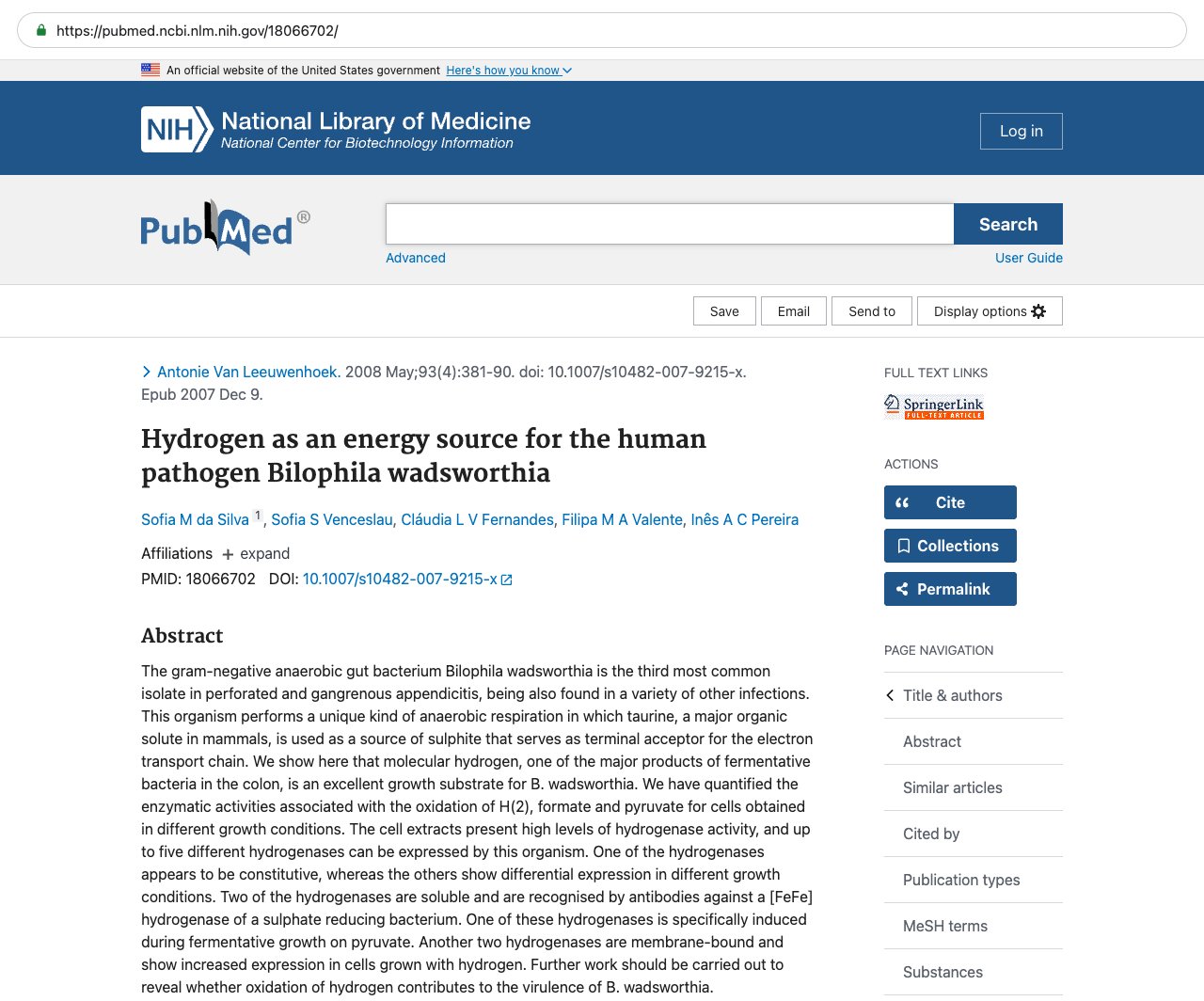
The gram-negative anaerobic gut bacterium Bilophila wadsworthia is the third most common isolate in perforated and gangrenous appendicitis, being also found in a variety of other infections. This organism performs a unique kind of anaerobic respiration in which taurine, a major organic solute in mammals, is used as a source of sulphite that serves as terminal acceptor for the electron transport chain. We show here that molecular hydrogen, one of the major products of fermentative bacteria in the colon, is an excellent growth substrate for B. wadsworthia. We have quantified the enzymatic activities associated with the oxidation of H(2), formate and pyruvate for cells obtained in different growth conditions. The cell extracts present high levels of hydrogenase activity, and up to five different hydrogenases can be expressed by this organism. One of the hydrogenases appears to be constitutive, whereas the others show differential expression in different growth conditions. Two of the hydrogenases are soluble and are recognised by antibodies against a [FeFe] hydrogenase of a sulphate reducing bacterium. One of these hydrogenases is specifically induced during fermentative growth on pyruvate. Another two hydrogenases are membrane-bound and show increased expression in cells grown with hydrogen. Further work should be carried out to reveal whether oxidation of hydrogen contributes to the virulence of B. wadsworthia.
Source & links
Screenshot of the PubMed page
This page mirrors the published abstract (© the authors / publisher) for reference and citation. The canonical source is the PubMed record linked above. This is not medical advice.