2022 · Di et al. — A Bio-Inspired, Ultra-Tough, High-Sensitivity, and Anti-Swelling Conductive Hydrogel Strain Sensor for Motion Detection and Information Transmission
Super-Abstract
Researchers developed a bio-inspired conductive hydrogel with exceptional mechanical toughness (elongation >2000%), high sensitivity, and resistance to swelling — enabling its use as a wearable strain sensor for motion detection and Morse-code information encryption. The material exploits hydrogen bonding as one of multiple non-covalent interactions to achieve its properties. This is a materials science study with no connection to therapeutic molecular hydrogen (H₂). (Materials Horizons, 2022.)
Commentary
This paper presents advanced polymer chemistry and materials engineering. The „hydrogen” referenced throughout is hydrogen bonding — a fundamental intermolecular force in polymer science — not molecular hydrogen gas (H₂) as used in hydrogen therapy or hydrogen-rich water research. The hydrogel's architecture combines hydrophobic micro-regions, π-π stacking, and ionic coordination to achieve high toughness and sensing performance. While technically impressive for wearable electronics research, this study has no relevance to biological or therapeutic H₂ applications.
Key quotes
- „A heterogeneous structure was constructed by the combination of a 'soft' hydrophobic-conjugated micro-region structural domain with inter/intra-molecular hydrogen bonding and π-π stacking along with 'rigid' cross-linking via strong ionic coordination interactions.“ — the structural design principle — hydrogen bonding here is a polymer-chemistry term, not molecular H₂
- „Hydrogels displayed good anti-swelling properties even in solutions with different pH (pH 2-11) and solvents.“ — a key practical property for wearable sensor applications in varying environments
- „The hydrogel further exhibited fast response (47.4 ms) and high sensitivity due to the presence of dynamic ions (Fe3+, Na+, and Cl-).“ — the sensing performance enabling motion detection and Morse-code signal transmission
Our assessment
This is a materials science / computational-experimental study with no connection to molecular hydrogen therapy or H₂ biology. „Hydrogen” in this paper refers exclusively to hydrogen bonds — a ubiquitous intermolecular interaction in polymer chemistry. The study is technically sound and innovative in its field (wearable electronics), but is out of scope for any therapeutic H₂ research database. Honest note: This study appears due to keyword matching on „hydrogen” in polymer-science contexts, not because it investigates H₂ as a therapeutic agent.
Study design
- Type: materials science study (in-vitro / laboratory) · n: n/a (material characterisation) · H₂ relevance: none — „hydrogen” refers to hydrogen bonding as a polymer-chemistry interaction
- Result: hydrogel achieves >2000% elongation at break, ~60 MJ/m³ toughness, >88% recovery, fast sensor response of 47.4 ms; successfully demonstrated as motion sensor and Morse-code signal transmitter
Abstract
Conductive hydrogels are excellent candidates for the next-generation wearable materials and are being extensively investigated for their potential use in health monitoring devices, human-machine interfaces, and other fields. However, their relatively low mechanical strength and performance degradation due to swelling have presented challenges in their practical application. Inspired by the multiscale heterogeneous architecture of biological tissue, a dynamic cross-linked, ultra-tough, and high-sensitivity hydrogel with a swelling resistance characteristic was fabricated by the principle of multiple non-covalent interaction matching and a step-by-step construction strategy. A heterogeneous structure was constructed by the combination of a 'soft' hydrophobic-conjugated micro-region structural domain with inter/intra-molecular hydrogen bonding and π-π stacking along with 'rigid' cross-linking via strong ionic coordination interactions. Reversible cross-linking synergies and variations in the content of rigid and flexible components guaranteed the hydrogel to undergo flexible and efficient modulation of the structures and gain excellent mechanics, including elongation at break (>2000%), toughness (∼60 MJ m-3), and recovery (>88%). Notably, hydrogels displayed good anti-swelling properties even in solutions with different pH (pH 2-11) and solvents. Moreover, the hydrogel further exhibited fast response (47.4 ms) and high sensitivity due to the presence of dynamic ions (Fe3+, Na+, and Cl-); therefore, it was assembled into a sensor to detect various human motions and used as a signal transmitter for the encryption and decryption of information according to Morse code. This study provides basis for the development of a variety of robust and flexible conductive hydrogels with multifunctional sensing applications in next-generation wearable devices.
Source & links
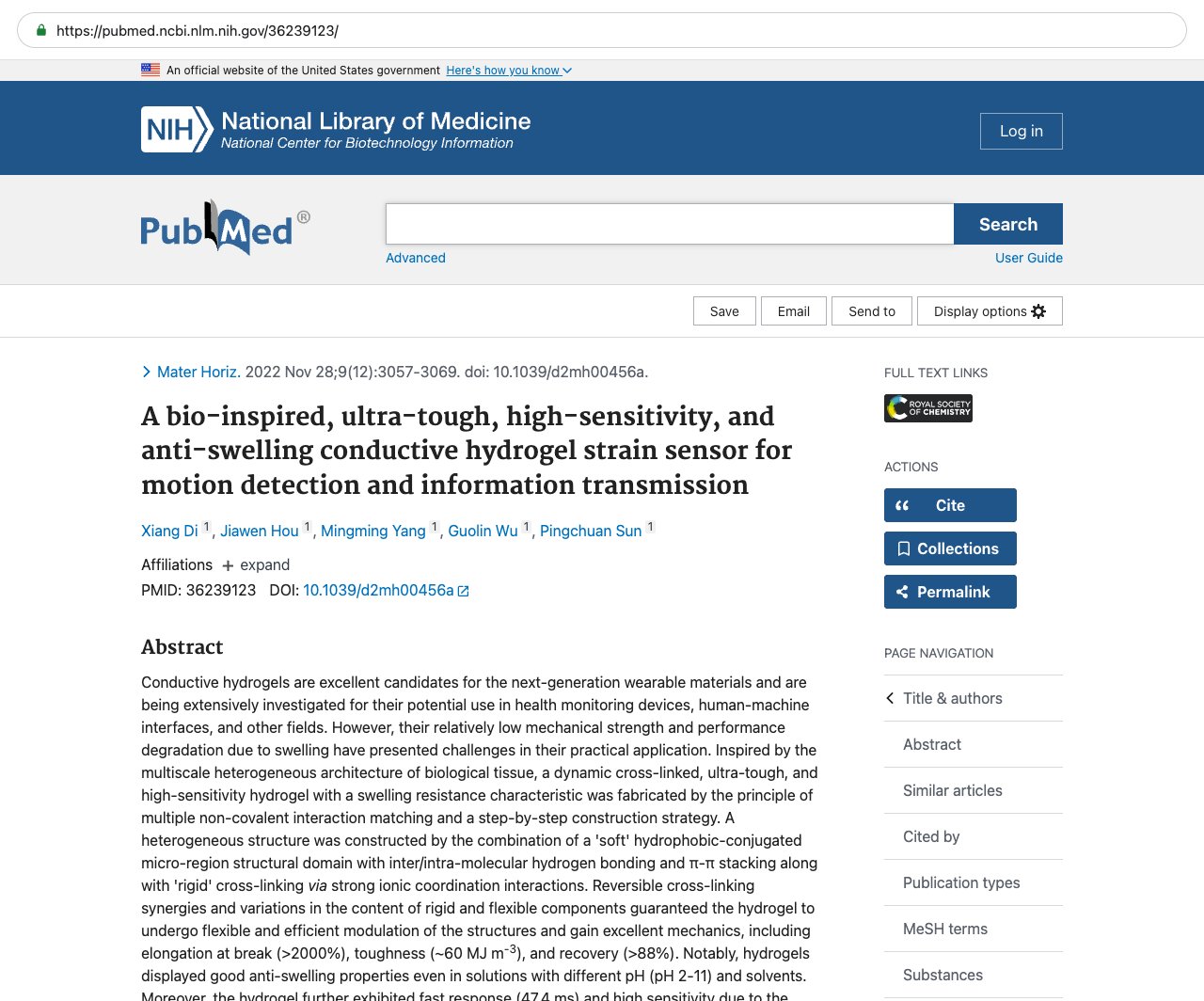
Screenshot of the PubMed page
This page mirrors the published abstract (© the authors / publisher) for reference and citation. The canonical source is the PubMed record linked above. This is not medical advice.