2020 · De Paepe — Bio-electrochemical COD Removal for Energy-efficient, Maximum and Robust Nitrogen Recovery from Urine through Membrane Aerated Nitrification
Super-Abstract
This study develops a two-stage electrochemical urine treatment system for sustainable nitrogen recovery — primarily for space exploration applications. In the first stage, a microbial electrolysis cell removes up to 85 % of organic matter and produces hydrogen gas as a byproduct, while the second stage converts ammoniacal nitrogen to nitrate. This research is focused on wastewater engineering and bioelectrochemistry, not on therapeutic hydrogen. (Water Research, 2020.)
Commentary
This paper is fundamentally an environmental engineering and bioelectrochemistry study. Its core aim is efficient nutrient recovery from source-separated urine for use in regenerative life support systems for deep-space exploration. H₂ gas appears here as a byproduct of the microbial electrolysis cell (MEC) step — a consequence of organic compound conversion — rather than as a subject of therapeutic interest. The system achieves complete nitrogen recovery as nitrate while preventing denitrification losses, representing a solid engineering advance. The highly specialised microbial communities characterised in the MEC and MABR are of interest to bioelectrochemistry researchers. This study has no direct relevance to therapeutic H₂ for human health.
Key quotes
- „up to 85% of the COD was removed in a microbial electrolysis cell (MEC), converting part of the energy in organic compounds (27-46%) into hydrogen gas.“ — H₂ as an electrochemical byproduct of organic matter oxidation
- „Bio-electrochemical pre-treatment allowed to recover all nitrogen as nitrate in the MABR at a bulk-phase dissolved oxygen level below 0.1 mg O2 L-1.“ — the key engineering outcome: complete nitrogen recovery under near-anaerobic conditions
- „Resource recovery from source-separated urine can shorten nutrient cycles on Earth and is essential in regenerative life support systems for deep-space exploration.“ — the application context: space exploration life support
Our assessment
This is an in-vitro / reactor engineering study with no relevance to therapeutic hydrogen in humans. H₂ production is a side-effect of the electrochemical process, not the study focus. The research is solidly conducted and addresses a genuine engineering challenge in closed-loop life support. It provides no evidence for any health benefit of molecular hydrogen. Its inclusion in an H₂-medicine database is marginal — the link is the incidental H₂ production in the MEC step.
Study design
- Type: in-vitro bioelectrochemical engineering study · System: two-stage MEC + MABR reactor treating real human urine · H₂ context: H₂ gas as MEC byproduct (not therapeutic)
- Result: up to 85 % COD removal in MEC; 27–46 % energy from organics converted to H₂ gas; complete nitrogen recovery as nitrate in MABR; microbial community characterised (Geobacter dominant in MEC; Nitrosomonas dominant in MABR)
Abstract
Resource recovery from source-separated urine can shorten nutrient cycles on Earth and is essential in regenerative life support systems for deep-space exploration. In this study, a robust two-stage, energy-efficient, gravity-independent urine treatment system was developed to transform fresh real human urine into a stable nutrient solution. In the first stage, up to 85% of the COD was removed in a microbial electrolysis cell (MEC), converting part of the energy in organic compounds (27-46%) into hydrogen gas and enabling full nitrogen recovery by preventing nitrogen losses through denitrification in the second stage. Besides COD removal, all urea was hydrolysed in the MEC, resulting in a stream rich in ammoniacal nitrogen and alkalinity, and low in COD. This stream was fed into a membrane-aerated biofilm reactor (MABR) in order to convert the volatile and toxic ammoniacal nitrogen to non-volatile nitrate by nitrification. Bio-electrochemical pre-treatment allowed to recover all nitrogen as nitrate in the MABR at a bulk-phase dissolved oxygen level below 0.1 mg O2 L-1. In contrast, feeding the MABR directly with raw urine (omitting the first stage), at the same nitrogen loading rate, resulted in nitrogen loss (18%) due to denitrification. The MEC and MABR were characterised by very distinct and diverse microbial communities. While (strictly) anaerobic genera, such as Geobacter (electroactive bacteria), Thiopseudomonas, a Lentimicrobiaceae member, Alcaligenes and Proteiniphilum prevailed in the MEC, the MABR was dominated by aerobic genera, including Nitrosomonas (a known ammonium oxidiser), Moheibacter and Gordonia. The two-stage approach yielded a stable nitrate-rich, COD-low nutrient solution, suitable for plant and microalgae cultivation.
Source & links
Screenshot of the PubMed page
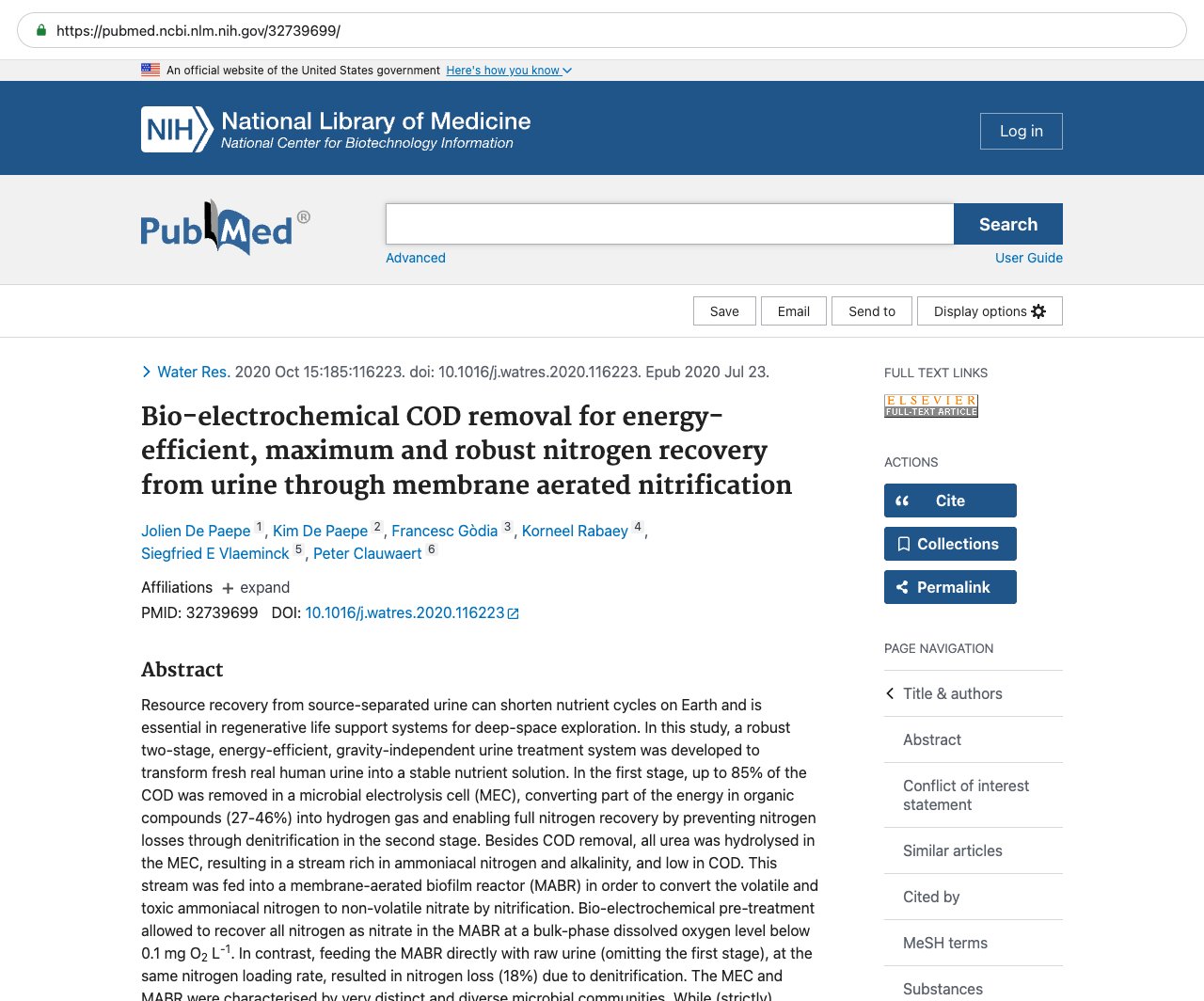
This page mirrors the published abstract (© the authors / publisher) for reference and citation. The canonical source is the PubMed record linked above. This is not medical advice.