2023 · Kopp — Long-term in vivo observations show biocompatibility and performance of ZX00 magnesium screws surface-modified by plasma-electrolytic oxidation in Göttingen miniature pigs
Super-Abstract
Bioabsorbable magnesium bone screws with a special surface coating (plasma-electrolytic oxidation) showed good biocompatibility and significantly slower, more controlled degradation over 18 months in large animals — with H₂ evolution serving as a standard measurement tool during in-vitro degradation testing, not as a therapy. This is a preclinical orthopedic implant study in Göttingen miniature pigs; it tests implant materials, not H₂ as a therapeutic agent.
Commentary
This study is essentially an orthopedic biomaterials paper, not an H₂ therapy study. The relevance to H₂ is that magnesium implants generate H₂ gas as a byproduct of their corrosion/degradation reaction — and measuring H₂ evolution is used as a standardized laboratory method (per ISO 10993 and ASTM standards) to quantify in-vitro degradation rates. The clinical concern with magnesium implants historically has been too-rapid degradation, which produces gas pockets in tissue (a known complication). Plasma-electrolytic oxidation (PEO) surface modification significantly slows this degradation. The 18-month large-animal study in Göttingen minipigs is a methodological strength: long-term large-animal data for magnesium implants are rare. The paper demonstrates both good biocompatibility and improved osseointegration. H₂ here is a degradation byproduct and a measurement tool — not a treatment.
Key quotes
- „cytocompatibility and degradation testing facilitating hydrogen gas evolution, carried out following ISO 10993-5/-12 and ASTM F3268-18a/ASTM G1-03 (E1:2017)“ — H₂ evolution is used as a standardized degradation measurement method, not as therapy
- „A significant reduction of degradation rate and enhanced bone formation around the ZX00MEO-PEO screws in vivo was confirmed.“ — the key in-vivo result: PEO coating improves bone integration and reduces degradation
- „Proficient biocompatibility and tissue integration could generally be shown in vivo regardless of surface state.“ — general finding: both coated and uncoated magnesium alloy screws were biocompatible
Our assessment
This study is not an H₂ therapy study — it is an orthopedic biomaterials study in which H₂ gas measurement is a laboratory tool. The finding that PEO surface modification improves degradation control and bone integration is clinically relevant for orthopedic surgery, and the 18-month large-animal dataset fills an important evidence gap for bioabsorbable magnesium implants. No conclusions about H₂ health benefits can be drawn from this paper. Its inclusion in an H₂ medicine context is relevant only for understanding that magnesium-based implants produce H₂ as a degradation byproduct — and that controlling this is important for implant safety.
Study design
- Type: preclinical in-vivo + in-vitro study · Model: Göttingen miniature pigs (frontal bone implantation, 6/12/18 months); in-vitro cell/degradation testing · H₂ delivery: H₂ gas evolution as byproduct of magnesium screw degradation — not therapeutic
- Result: PEO surface modification significantly reduced degradation rate; enhanced bone formation around PEO-coated screws; good biocompatibility for both surface states; in-vitro H₂ evolution testing confirmed slower degradation for PEO group
Abstract
Bioabsorbable magnesium implants for orthopedic fixation of bone have recently become available for different fields of indication. While general questions of biocompatibility have been answered, tailoring suitable degradation kinetics for specific applications as well as long-term tissue integration remain the focus of current research. The aim of this study was the evaluation of the long-term degradation behavior and osseointegration of Mg-Ca-Zn (ZX00MEO) based magnesium implants with plasma-electrolytic oxidation (PEO) surface modification (ZX00MEO-PEO) in comparison to non-surface modified implants in vivo and in vitro. Besides a general evaluation of the biological performance of the alloy over a prolonged period, the main hypothesis was that PEO surface modification significantly reduces implant degradation rate and improves tissue interaction. In vitro, the microstructure and surface of the bioabsorbable screws were characterized by SEM/EDS, cytocompatibility and degradation testing facilitating hydrogen gas evolution, carried out following ISO 10993-5/-12 and ASTM F3268-18a/ASTM G1-03 (E1:2017). In vivo, screws were implanted in the frontal bone of Minipigs for 6, 12, and 18 months, following radiological and histomorphometric analysis. A slower and more uniform degradation and improved cytocompatibility could be shown for the ZX00MEO-PEO group in vitro. A significant reduction of degradation rate and enhanced bone formation around the ZX00MEO-PEO screws in vivo was confirmed. Proficient biocompatibility and tissue integration could generally be shown in vivo regardless of surface state. The tested magnesium alloy shows generally beneficial properties as an implant material, while PEO-surface modification further improves the bioabsorption behavior both in vitro and in vivo. STATEMENT OF SIGNIFICANCE: Devices from bioabsorbable Magnesium have recently been introduced to orthopedic applications. However, the vast degradation of Magnesium within the human body still gives limitations. While reliable in-vivo data on most promising surface treatments such as Plasma-electrolytic-Oxidation is generally scarce, long-time results in large animals are to this date completely missing. To overcome this lack of evidence, we studied a Magnesium-Calzium-Zinc-alloy with surface enhancement by PEO for the first time ever over a period of 18 months in a large animal model. In-vitro, surface-modified screws showed significantly improved cytocompatibility and reduction of degradation confirmed by hydrogen gas evolution testing, while in-vivo radiological and histological evaluation generally showed good biocompatibility and bioabsorption as well as significantly enhanced reduction of degradation and faster bone regeneration in the PEO-surface-modified group.
Source & links
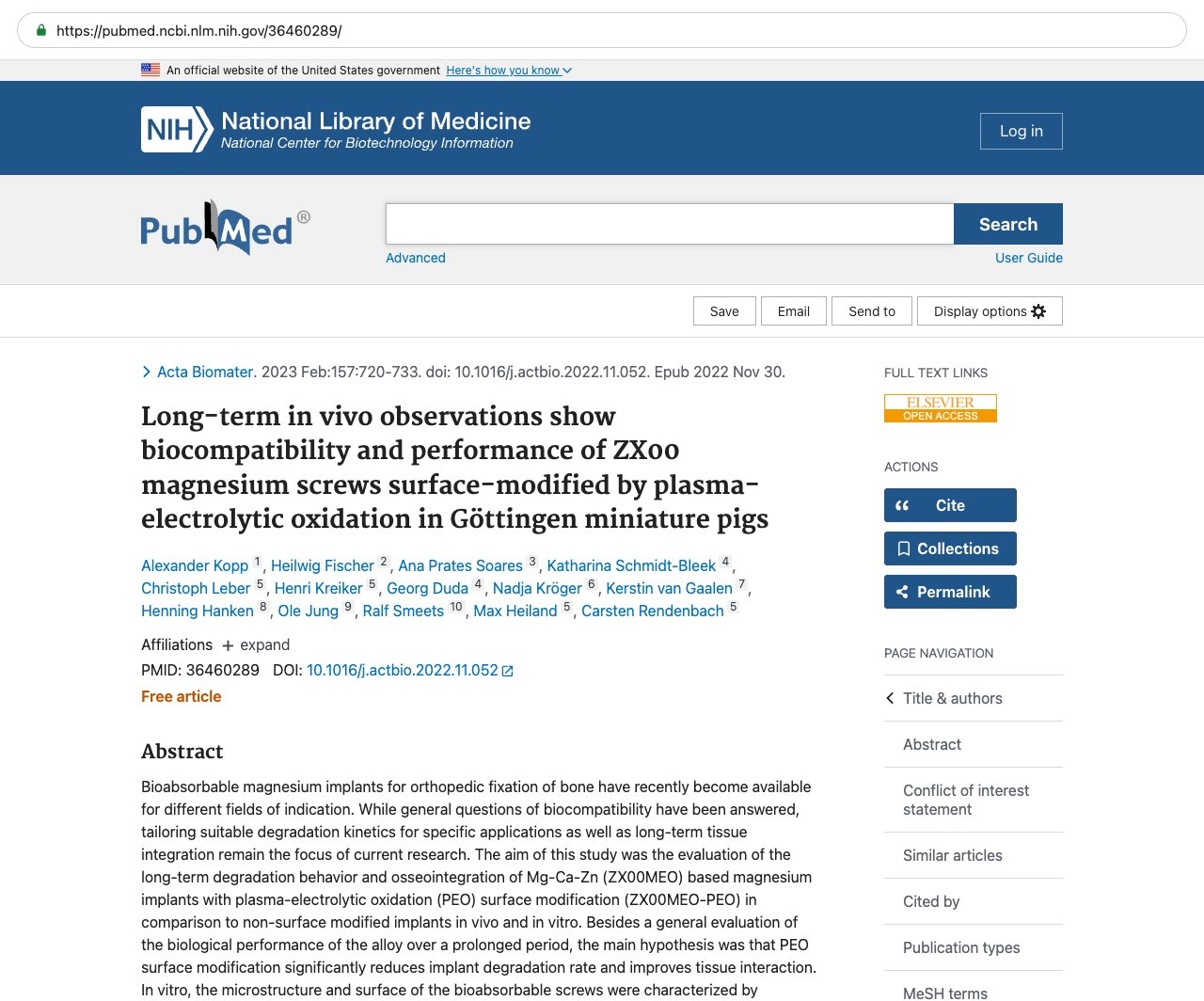
Screenshot of the PubMed page
This page mirrors the published abstract (© the authors / publisher) for reference and citation. The canonical source is the PubMed record linked above. This is not medical advice.