2020 · Dobashi et al. — Hydrogen-rich water suppresses the reduction in blood total antioxidant capacity induced by 3 consecutive days of severe exercise in physically active males.
Super-Abstract
In a crossover trial with 8 active men, drinking H₂-rich water (5.14 ppm) before and after each of 3 consecutive intense exercise sessions maintained the blood antioxidant status — measured as the BAP/d-ROM ratio — while placebo water allowed it to decline progressively. Exercise performance was not significantly different between conditions, meaning H₂ supported redox balance without masking fatigue or altering output. (Medical Gas Research, 2020.)
Commentary
This clean crossover study addresses a practically relevant question in sports science: can H₂-rich water attenuate the cumulative oxidative stress from days of repeated intense training? The BAP/d-ROM ratio (biological antioxidant potential vs. reactive oxygen metabolites) is an established, if imperfect, proxy for systemic redox status. The finding that H₂ water preserved this ratio across three training days while placebo did not is the central result. Critically, exercise performance itself (countermovement jump, isometric knee extension force, sprint cycling output) was not significantly different between H₂ and placebo — suggesting H₂ is not masking training stimulus, but is modulating the redox consequence. The study size (n = 8) is small, and the single-blind design (participants presumably could distinguish H₂ from placebo water by taste/bubbling) is a limitation.
Key quotes
- „In PW trial, relative changes in biological antioxidant potential/diacron-reactive oxygen metabolites, as an index of systemic antioxidant potential, from baseline gradually decreased as the day passed.“ — placebo arm shows progressive antioxidant decline over consecutive exercise days
- „HW suppressed the reduction in biological antioxidant potential/diacron-reactive oxygen metabolites observed in PW.“ — the key positive finding — H₂ water maintained redox balance vs. placebo
- „Exercise performances in both conditions were not significantly different over 3 consecutive days.“ — null result for performance — H₂ did not alter output or mask training fatigue
Our assessment
A well-structured small crossover trial with a clear readout (redox status) and an honest null finding for performance. The preservation of antioxidant status under repeated exercise stress is a meaningful signal, though the clinical relevance of BAP/d-ROM maintenance in healthy athletes is uncertain. Limitations: n = 8; single-blind; H₂ concentration high (5.14 ppm) — not typical of commercially available products; no long-term follow-up; no muscle biopsy or inflammatory marker data; performance null result is important but was measured 16 hours after exercise (acute performance impact not excluded).
Study design
- Type: randomized, single-blind, crossover controlled trial · n: 8 physically active males · H₂ delivery: 500 mL H₂-rich water at 5.14 ppm, before and after each exercise session over 3 days
- Exercise protocol: countermovement jump + maximal isometric knee extension + sprint cycling (3 × 10 sec at 7.5 % body mass resistance) daily for 3 days
- Result: BAP/d-ROM ratio maintained in H₂ arm vs. progressive decline in placebo; exercise performance not significantly different between conditions
Abstract
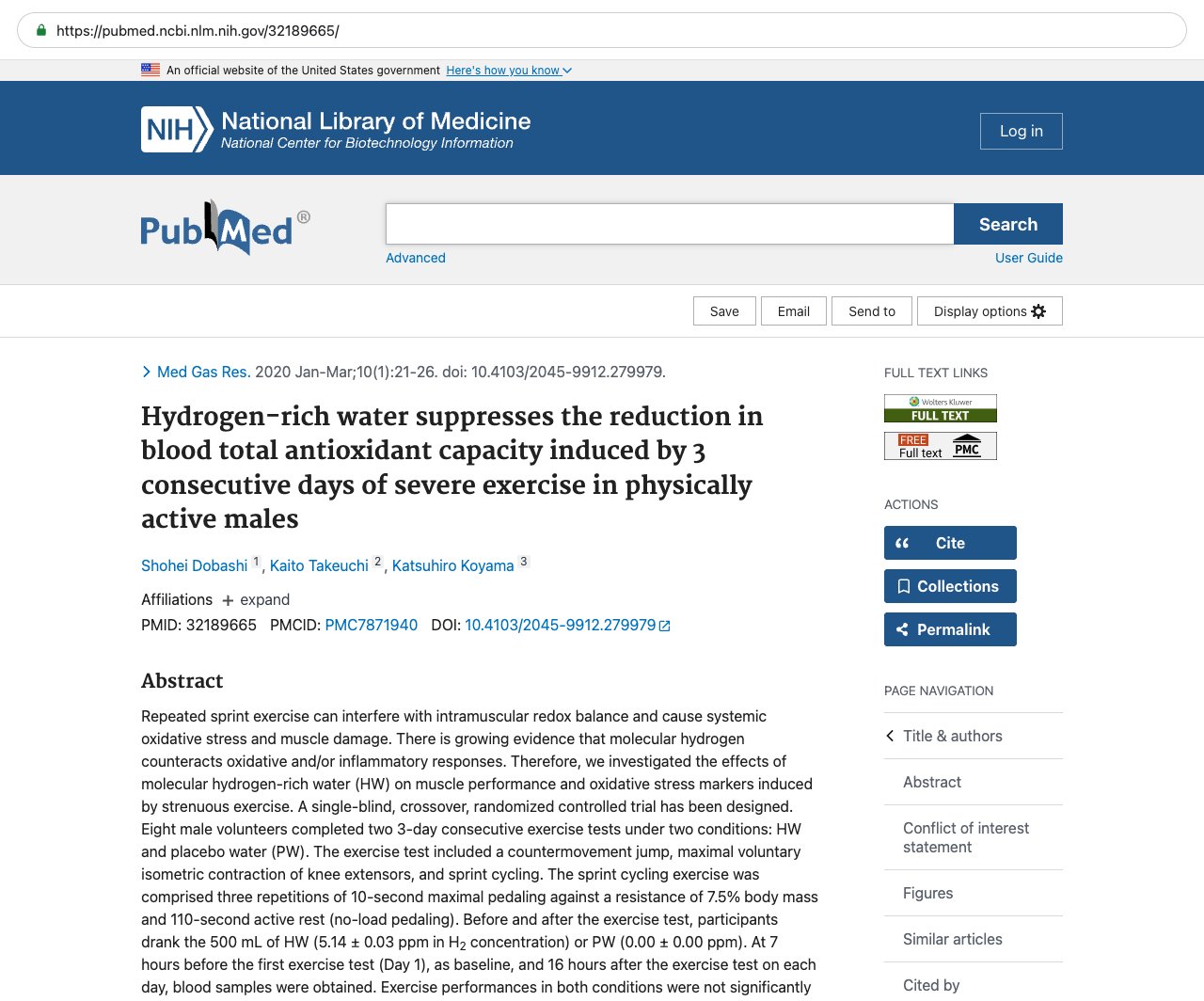
Repeated sprint exercise can interfere with intramuscular redox balance and cause systemic oxidative stress and muscle damage. There is growing evidence that molecular hydrogen counteracts oxidative and/or inflammatory responses. Therefore, we investigated the effects of molecular hydrogen-rich water (HW) on muscle performance and oxidative stress markers induced by strenuous exercise. A single-blind, crossover, randomized controlled trial has been designed. Eight male volunteers completed two 3-day consecutive exercise tests under two conditions: HW and placebo water (PW). The exercise test included a countermovement jump, maximal voluntary isometric contraction of knee extensors, and sprint cycling. The sprint cycling exercise was comprised three repetitions of 10-second maximal pedaling against a resistance of 7.5% body mass and 110-second active rest (no-load pedaling). Before and after the exercise test, participants drank the 500 mL of HW (5.14 ± 0.03 ppm in H2 concentration) or PW (0.00 ± 0.00 ppm). At 7 hours before the first exercise test (Day 1), as baseline, and 16 hours after the exercise test on each day, blood samples were obtained. Exercise performances in both conditions were not significantly different over 3 consecutive days. In PW trial, relative changes in biological antioxidant potential/diacron-reactive oxygen metabolites, as an index of systemic antioxidant potential, from baseline gradually decreased as the day passed. However, HW suppressed the reduction in biological antioxidant potential/diacron-reactive oxygen metabolites observed in PW. Drinking HW contributed to the maintenance of the redox status during consecutive days of strenuous exercise and might help prevent accumulative muscular fatigue. The study was approved by the Human Research Ethics Committee of the University of Yamanashi, Japan (approval No. H26-008) on December 17, 2014.
Source & links
Screenshot of the PubMed page
This page mirrors the published abstract (© the authors / publisher) for reference and citation. The canonical source is the PubMed record linked above. This is not medical advice.