2020 QJM : monthly journal of the Association of Physicians Pilot / Observational Human H₂ therapy Inhalation
2020 · Wang et al. — Hydrogen gas (XEN) inhalation ameliorates airway inflammation in asthma and COPD patients.
Super-Abstract
A single 45-minute inhalation of hydrogen-containing steam (2.4 % H₂) reduced key inflammatory cytokines in airways of 10 asthma and 10 COPD patients — including monocyte chemotactic protein 1 in both groups and IL-8 in asthma. The acute reduction in airway inflammation markers is encouraging, though the study examines only a one-time intervention and does not assess clinical symptoms or lung function. (QJM, 2020.)
Commentary
This prospective study takes a straightforward approach: measure specific inflammatory markers in blood and exhaled breath condensate (EBC) before and after a single H₂ inhalation session in two distinct patient groups. The use of EBC to sample airway inflammation directly is methodologically sound. The cytokine changes documented — MCP-1 reduction in both COPD and asthma, IL-4 and IL-6 reduction in EBC, IL-8 reduction in asthma blood — are modest in magnitude but statistically significant. Importantly, the study notes some dissimilarities: EBC soluble CD40L in COPD actually increased after inhalation, a finding the authors do not fully explain. One-time sessions cannot inform about sustained clinical benefit. The small sample and lack of a sham-inhalation control are significant weaknesses.
Key quotes
- „45 minutes 'XEN' inhalation once decreased monocyte chemotactic protein 1 level in both COPD (564.70–451.51 pg/mL, P = 0.019) and asthma (386.39–332.76 pg/mL, P = 0.033) group.“ — MCP-1 reduction across both conditions — the most consistent finding
- „IL-4 and IL-6 levels in EBC were significantly lower after inhalation in the COPD (0.80–0.64 pg/mL, P = 0.025) and asthma (0.06–0.05 pg/mL, P = 0.007) group, respectively.“ — direct airway anti-inflammatory signal via exhaled breath condensate
- „A single inhalation of hydrogen for 45 min attenuated inflammatory status in airways in patients with asthma and COPD.“ — authors' summary conclusion — limited to acute inflammatory markers
Our assessment
Proof-of-concept data for acute anti-inflammatory effects of H₂ inhalation in obstructive airway disease. The MCP-1 reduction across both conditions is the most robust signal. Limitations: very small sample (10 per group); no sham control; single session — no sustainability data; no lung function (FEV₁, FVC) or symptom endpoints; the increase in EBC soluble CD40L in COPD after H₂ is unexplained and could indicate a complex immune interaction. Results warrant a multi-session, controlled trial with clinical endpoints.
Study design
- Type: prospective pre-post study · n: 10 asthma + 10 COPD · H₂ delivery: 2.4 % hydrogen-containing steam (XEN), single 45-min inhalation
- Measurements: cytokine panel in peripheral blood + exhaled breath condensate (EBC) before and after inhalation
- Result: MCP-1 significantly reduced in blood (both groups); IL-4 and IL-6 reduced in EBC (both groups); IL-8 reduced in blood (asthma only); EBC soluble CD40L increased in COPD (unexplained)
Abstract
BACKGROUND: Hydrogen was proven to have anti-oxidative and anti-inflammation effects to various diseases. AIM: We wish to investigate the acute effects of inhaled hydrogen on airway inflammation in patients with asthma and chronic obstructive pulmonary disease (COPD). DESIGN: Prospective study. METHODS: In total, 2.4% hydrogen containing steam mixed gas (XEN) was inhaled once for 45 min in 10 patients with asthma and 10 patients with COPD. The levels of granulocyte-macrophage colony stimulating factor, interferon-γ, interleukin-1β (IL-1β), IL-2, IL-4, IL-6 and so on in peripheral blood and exhaled breath condensate (EBC) before and after 'XEN' inhalation were measured. RESULTS: 45 minutes 'XEN' inhalation once decreased monocyte chemotactic protein 1 level in both COPD (564.70-451.51 pg/mL, P = 0.019) and asthma (386.39-332.76 pg/mL, P = 0.033) group, while decreased IL-8 level only in asthma group (5.25-4.49 pg/mL, P = 0.023). The level of EBC soluble cluster of differentiation-40 ligand in COPD group increased after inhalation (1.07-1.16 pg/mL, P = 0.031), while IL-4 and IL-6 levels in EBC were significantly lower after inhalation in the COPD (0.80-0.64 pg/mL, P = 0.025) and asthma (0.06-0.05 pg/mL, P = 0.007) group, respectively. CONCLUSIONS: A single inhalation of hydrogen for 45 min attenuated inflammatory status in airways in patients with asthma and COPD.
Source & links
Screenshot of the PubMed page
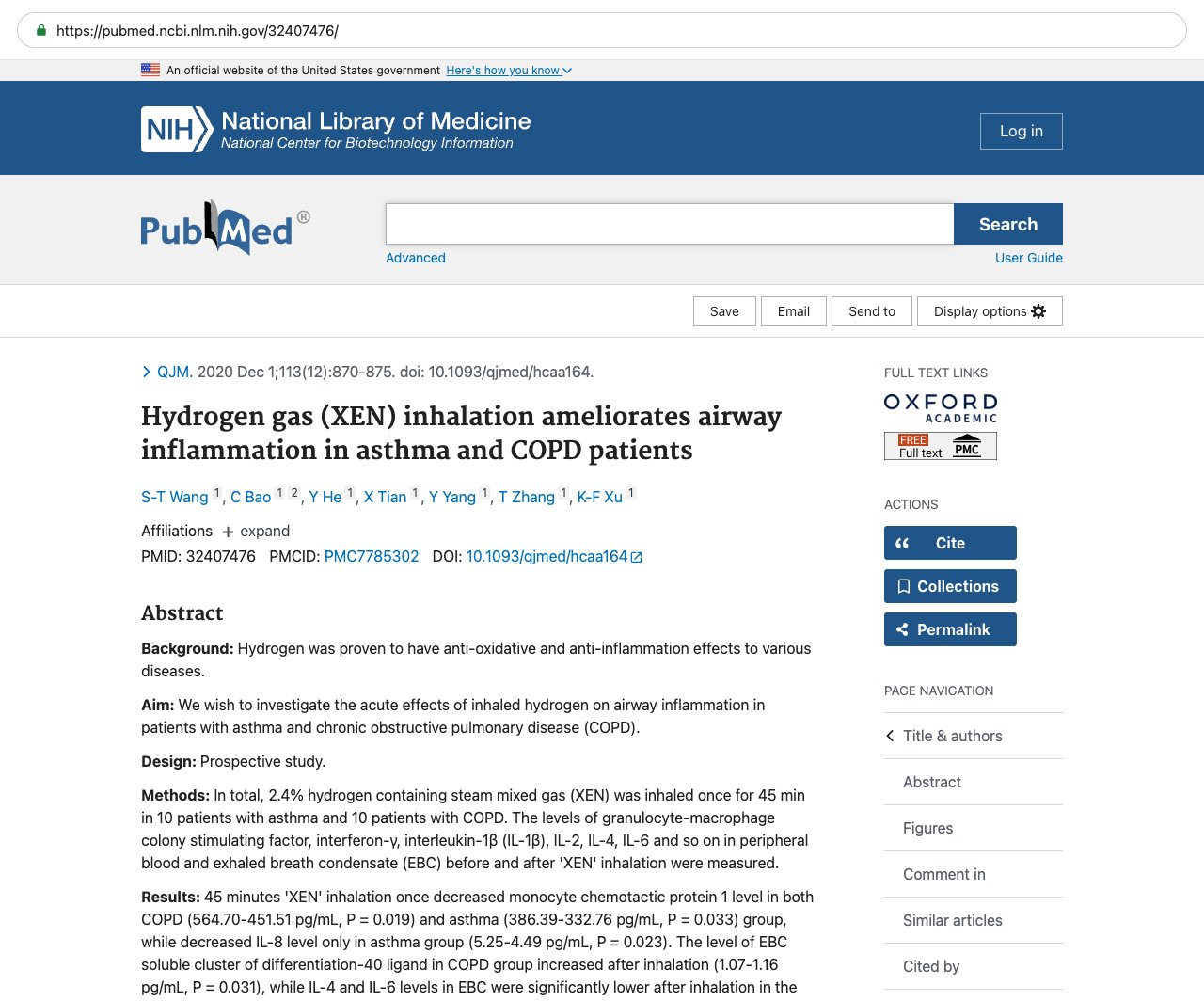
This page mirrors the published abstract (© the authors / publisher) for reference and citation. The canonical source is the PubMed record linked above. This is not medical advice.