2024 · Dong — Inhalation of Hydrogen-Rich Gas before Acute Exercise Alleviates Exercise Fatigue: A Randomized Crossover Study
Super-Abstract
Pre-exercise inhalation of hydrogen-rich gas (HRG) reduced subjective fatigue, improved cycling performance during the final phase of exhaustion trials, and lowered post-exercise lactate and oxidative stress markers in healthy men — compared to placebo air inhalation. Not all measures improved: counter-movement jump height and glutathione peroxidase activity showed no significant difference between HRG and placebo. (International Journal of Sports Medicine, 2024.)
Commentary
This 24-participant randomized crossover study tests a specific and practical question: can breathing hydrogen-rich gas before a ride-to-exhaustion protocol reduce the fatigue athletes feel? The results are partially positive. On subjective fatigue (VAS), perceived exertion (RPE), and cycling frequency in the last 30 seconds — as well as lactate and hydroxyl radical scavenging — HRG showed a statistically significant advantage over placebo (all p<0.028). However, counter-movement jump height (a functional marker of lower-body power) and glutathione peroxidase activity were not significantly different, which the authors honestly report. This null finding in jump performance matters: it suggests HRG's effects may be specific to endurance-fatigue perception and lactate management rather than explosive power or broader antioxidant enzyme upregulation. The double-blind, counterbalanced crossover design is a methodological strength for a sports science study.
Key quotes
- „HRG inhalation induced significant improvement in VAS, RPE, the cycling frequency during the last 30 seconds in the fatigue modeling process, the ability to inhibit hydroxyl radicals, and serum lactate after exercise (p<0.028), but not in CMJ height and glutathione peroxidase activity.“ — the honest mixed result: fatigue and lactate improved, but jump performance and one antioxidant enzyme did not
- „HRG inhalation prior to acute exercise can alleviate exercise-induced fatigue, maintain functional performance, and improve hydroxyl radical and lactate levels.“ — the authors' overall conclusion — note that 'maintain functional performance' refers to cycling frequency, not CMJ
- „This study focused on a previously unexplored approach involving pre-exercise inhalation of hydrogen-rich gas (HRG).“ — the novelty claim: pre-exercise inhalation timing had not been studied before in this protocol
Our assessment
A methodologically solid small crossover study with an honest mixed result. Positive: fatigue perception, lactate, hydroxyl radical inhibition, and late-phase cycling frequency all improved significantly with HRG vs. placebo. Null findings (explicitly reported): counter-movement jump height did not improve, and glutathione peroxidase activity was unchanged — important limits on what H₂ inhalation actually does in this context. Key limitations: n=24 (only men), single exercise modality (cycling), no information on H₂ concentration in inhaled gas. The crossover design controls for individual variation well. Overall: suggestive positive effect on fatigue and lactate with documented null findings for explosive power.
Study design
- Type: double-blind, counterbalanced, randomized crossover · n: 24 healthy adult men · H₂ delivery: inhalation of hydrogen-rich gas (HRG) for 60 min pre-exercise
- Exercise protocol: cycling at 80% Wmax for Tmax (time to exhaustion); cycling frequency and RPE recorded; VAS, CMJ, and blood samples before/after
- Result: VAS fatigue, RPE, late-phase cycling frequency, lactate, and hydroxyl radical inhibition improved significantly (p<0.028); CMJ height and glutathione peroxidase activity showed no significant improvement
Abstract
Hydrogen, as an antioxidant, may have the potential to mitigate fatigue and improve selected oxidative stress markers induced by strenuous exercise. This study focused on a previously unexplored approach involving pre-exercise inhalation of hydrogen-rich gas (HRG). Twenty-four healthy adult men first completed pre-laboratories to determine maximum cycling power (Wmax) and maximum cycling time (Tmax). Then they were subjected to ride Tmax at 80% Wmax and 60-70 rpm on cycle ergometers after inhaled HRG or placebo gas (air) for 60-minute in a double-blind, counterbalanced, randomized, and crossover design. The cycling frequency in the fatigue modeling process and the rating of perceived exertion (RPE) at the beginning and end of the ride were recorded. Before gas inhalation and after fatigue modeling, visual analog scale (VAS) for fatigue and counter-movement jump (CMJ) were tested, and blood samples were obtained. The results showed that compared to a placebo, HRG inhalation induced significant improvement in VAS, RPE, the cycling frequency during the last 30 seconds in the fatigue modeling process, the ability to inhibit hydroxyl radicals, and serum lactate after exercise (p<0.028), but not in CMJ height and glutathione peroxidase activity. The cycling frequency during the last 30 seconds of all other segments in the fatigue modeling process was within the range of 60-70 rpm. In conclusion, HRG inhalation prior to acute exercise can alleviate exercise-induced fatigue, maintain functional performance, and improve hydroxyl radical and lactate levels.
Source & links
Screenshot of the PubMed page
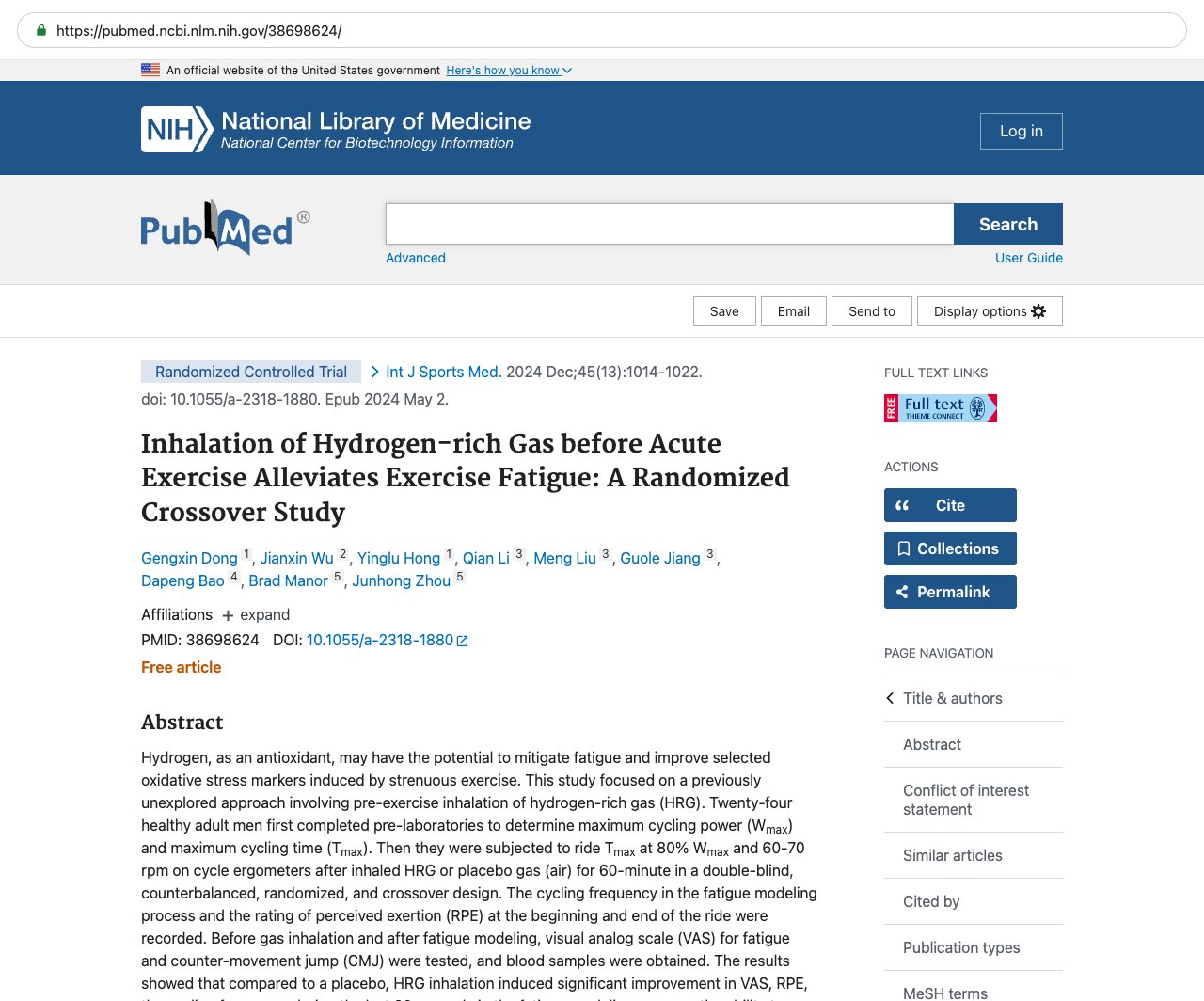
This page mirrors the published abstract (© the authors / publisher) for reference and citation. The canonical source is the PubMed record linked above. This is not medical advice.