2015 · Dubé — Direct Interspecies Electron Transfer in Anaerobic Digestion: A Review
Super-Abstract
This review covers „direct interspecies electron transfer“ (DIET) — a form of syntrophic metabolism in anaerobic microbial communities where electrons flow directly between cells without being shuttled by molecular hydrogen or formate. While H₂ is mentioned as a comparison point, this paper is about environmental microbiology and biogas production, not biomedical H₂ therapy. (Advances in Biochemical Engineering/Biotechnology, 2015.)
Commentary
In anaerobic digestion (the microbial breakdown of organic matter used in biogas/methane production), microbes transfer electrons between species either via molecular hydrogen as an intermediary (classical hydrogen-mediated interspecies electron transfer) or — as this review focuses on — by direct cell-to-cell electron flow (DIET). Dubé et al. review how granular sludge biofilms facilitate DIET between exoelectrogenic bacteria and electrotrophic methanogens. Conductive extracellular polymeric substances in biofilm matrices appear to enable this direct electron shuttling. Molecular hydrogen in this context is the classical microbial metabolite H₂ gas produced during fermentation — not the biomedical molecular hydrogen therapy studied in medicine. The study appears in an H₂ medical database due to keyword overlap (the word „hydrogen“ in the context of fermentation chemistry). There is no relevance to human health, oxidative stress, or H₂ supplementation.
Key quotes
- „Direct interspecies electrons transfer (DIET) is a syntrophic metabolism in which free electrons flow from one cell to another without being shuttled by reduced molecules such as molecular hydrogen or formate.“ — DIET is explicitly contrasted with H₂-mediated electron transfer — H₂ here is a fermentation byproduct, not a therapy
- „Exoelectrogenic bacteria degrading organic substrates or intermediates need an electron sink and electrotrophic methanogens represent perfect partners to assimilate those electrons and produce methane.“ — the ecological function of DIET in anaerobic digestion
Our assessment
This is an environmental microbiology review with no connection to human health, hydrogen medicine, or therapeutic H₂. „Molecular hydrogen“ in this paper refers to H₂ gas as a fermentation byproduct in anaerobic microbial ecosystems — a completely different context from biomedical H₂ supplementation. Its inclusion in an H₂ medicine database is a keyword-based false positive. No conclusions relevant to H₂ therapy or human health can be drawn from this paper.
Study design
- Type: narrative review (environmental microbiology / bioprocess engineering) · Scope: direct interspecies electron transfer (DIET) in anaerobic granular sludge biofilms · H₂ angle: H₂ mentioned only as the classical alternative to DIET — not as a therapeutic agent
- Result: synthesis of literature on DIET mechanisms; conductive biofilm matrices and extracellular polymeric substances enable direct electron flow; no biomedical content
Abstract
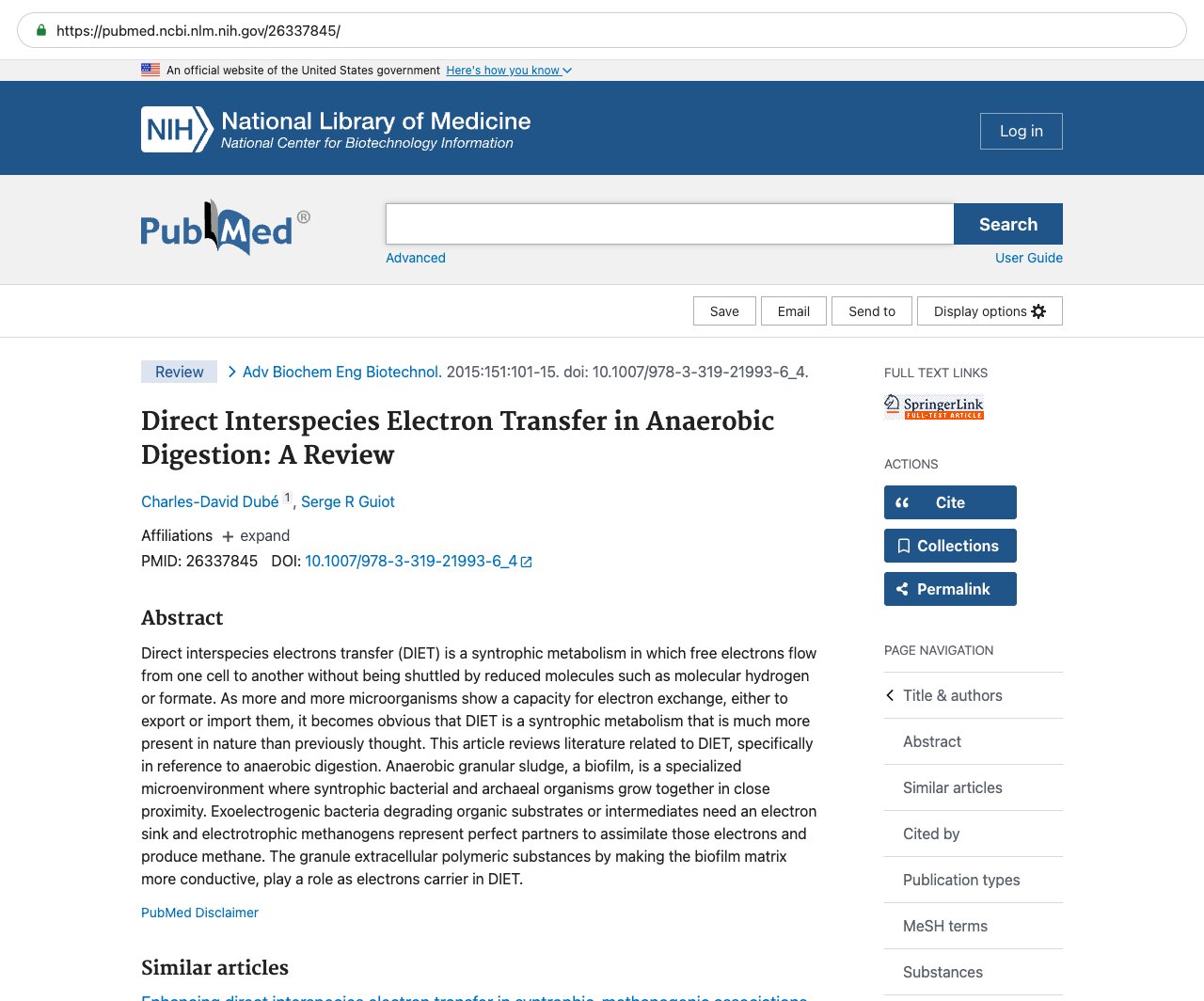
Direct interspecies electrons transfer (DIET) is a syntrophic metabolism in which free electrons flow from one cell to another without being shuttled by reduced molecules such as molecular hydrogen or formate. As more and more microorganisms show a capacity for electron exchange, either to export or import them, it becomes obvious that DIET is a syntrophic metabolism that is much more present in nature than previously thought. This article reviews literature related to DIET, specifically in reference to anaerobic digestion. Anaerobic granular sludge, a biofilm, is a specialized microenvironment where syntrophic bacterial and archaeal organisms grow together in close proximity. Exoelectrogenic bacteria degrading organic substrates or intermediates need an electron sink and electrotrophic methanogens represent perfect partners to assimilate those electrons and produce methane. The granule extracellular polymeric substances by making the biofilm matrix more conductive, play a role as electrons carrier in DIET.
Source & links
Screenshot of the PubMed page
This page mirrors the published abstract (© the authors / publisher) for reference and citation. The canonical source is the PubMed record linked above. This is not medical advice.