2022 · Eda — Effects of Intestinal Bacterial Hydrogen Gas Production on Muscle Recovery following Intense Exercise in Adult Men: A Pilot Study
Super-Abstract
A drink that stimulates gut bacteria to produce hydrogen can reduce muscle soreness and oxidative stress after intense exercise. In this double-blind crossover pilot study, after the H₂-generating drink — unlike after placebo — no rise in muscle soreness and oxidative DNA damage (8-OHdG) occurred; more breath hydrogen went hand in hand with less oxidation damage. (Nutrients, 2022 — endogenous H₂ as a new recovery strategy.)
Commentary
This study takes a clever approach: instead of drinking H₂ water or inhaling gas, you stimulate your own gut bacteria to produce hydrogen — via a special „H₂-generating milk“ drink. The resulting hydrogen diffuses into the body and acts as an antioxidant there. The design is double-blind, randomized, crossover: on the trial day participants drank either the H₂-generating drink or a placebo, 4 hours before intense exertion (60 minutes at 75% of maximal oxygen uptake). The results: on the morning after the placebo exertion, general muscle soreness was 3.8-fold higher and lower-limb soreness 2.3-fold higher — but not after the H₂ drink. The oxidative DNA damage marker 8-OHdG rose significantly in urine only with placebo, not with the test drink. The dose-response logic is intriguing: the more hydrogen in the breath (i.e. the more the bacteria produced), the less the oxidation damage — a negative correlation. In addition, post-exercise lactate was lower and fat oxidation 1.3-fold higher. Honestly: it is a pilot study with a small number of participants, the exact mechanism and optimal dosing are open, and the effect depends on the individual gut flora.
Key quotes
- „Visual analog scale scores of general and lower limb muscle soreness evaluated were 3.8- and 2.3-fold higher, respectively, on the morning after treatment than that before treatment during the placebo trial, but not during the test beverage consumption.“ — muscle soreness rose only with placebo, not with the H₂ drink
- „A negative correlation was observed between the variation of 8-OHdG and the area under the curve (AUC) of breath H2 concentrations.“ — the more breath hydrogen, the less oxidative DNA damage
- „activating intestinal bacterial H2 production by consuming a specific beverage may be a new strategy for promoting recovery and conditioning in athletes“ — conclusion: endogenous H₂ as a recovery strategy
Our assessment
This study is relevant because it confirms the H₂ principle from another angle: it is the hydrogen molecule itself that works — whether from the glass, from the inhaler or from one's own gut. The negative correlation between breath hydrogen and oxidation damage is a mechanistically strong argument that H₂ is the active factor and not a side effect. After careful review we accepted this study: hydrogen here is not merely an incidental covariate but the deliberately induced and studied intervention (the drink is designed for exactly that). For us it underpins the antioxidant core thesis. Limitation, stated honestly: pilot study with small sample, indirect H₂ source (dependent on individual gut flora), mechanism and dosing not conclusively clarified — hence evidence level 2, not 3.
Study design
- Type: pilot study, double-blind/randomized/crossover · n: small group of adult men (pilot) · Duration: acute, drink 4 h before exertion; follow-up measurement the next morning · H₂ delivery: „H₂-generating milk“ drink that stimulates intestinal bacterial H₂ production (endogenous H₂) vs. placebo
- Result: muscle soreness (VAS) general +3.8× / lower limbs +2.3× only with placebo (not with the test drink); urinary 8-OHdG significantly ↑ only with placebo; negative correlation 8-OHdG ↔ AUC breath H₂; blood lactate lower after exertion with the test drink; fat oxidation AUC 1.3× higher (significant)
Abstract
This study aimed to examine the effects of hydrogen gas (H2) produced by intestinal microbiota on participant conditioning to prevent intense exercise-induced damage. In this double-blind, randomized, crossover study, participants ingested H2-producing milk that induced intestinal bacterial H2 production or a placebo on the trial day, 4 h before performing an intense exercise at 75% maximal oxygen uptake for 60 min. Blood marker levels and respiratory variables were measured before, during, and after exercise. Visual analog scale scores of general and lower limb muscle soreness evaluated were 3.8- and 2.3-fold higher, respectively, on the morning after treatment than that before treatment during the placebo trial, but not during the test beverage consumption. Urinary 8-hydroxy-2'-deoxyguanosine (8-OHdG) concentrations and production rates significantly increased with placebo consumption; no changes were observed with test beverage consumption. After exercise, relative blood lactate levels with H2-producing milk consumption were lower than those with placebo consumption. A negative correlation was observed between the variation of 8-OHdG and the area under the curve (AUC) of breath H2 concentrations. Lipid oxidation AUC was 1.3-fold higher significantly with H2-producing milk than with placebo consumption. Conclusively, activating intestinal bacterial H2 production by consuming a specific beverage may be a new strategy for promoting recovery and conditioning in athletes frequently performing intense exercises.
Source & links
Screenshot of the PubMed page
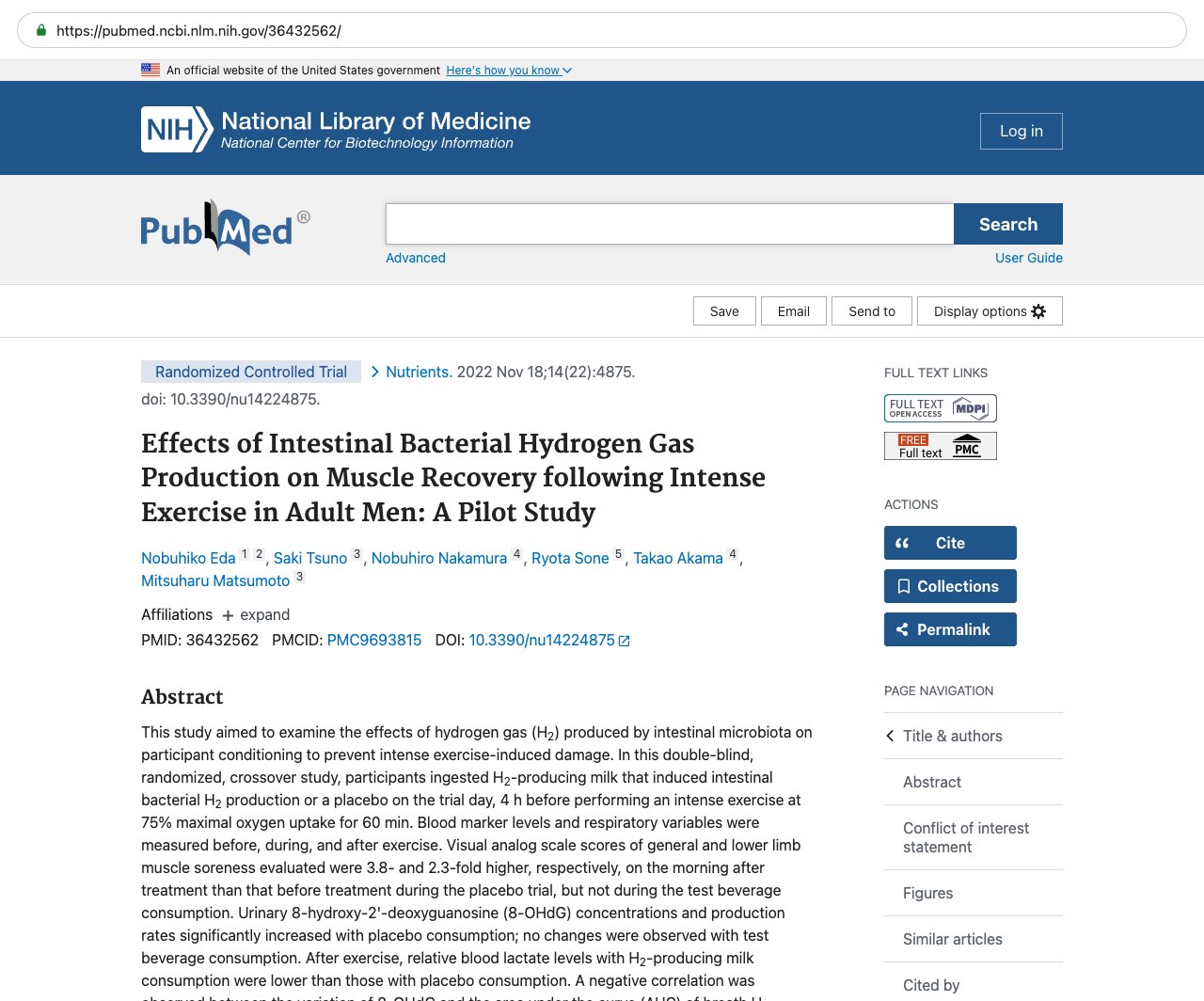
This page mirrors the published abstract (© the authors / publisher) for reference and citation. The canonical source is the PubMed record linked above. This is not medical advice.