2014 · Zhang et al. — Effect of hydrogen-rich water on acute peritonitis of rat models.
Super-Abstract
This animal study tested hydrogen-rich water (HRW) in three different rat models of acute peritonitis and found consistent protective effects: lower inflammatory markers, reduced oxidative damage, and decreased NF-κB expression in peritoneal tissue. The results support a role for H₂ as an anti-inflammatory and antioxidant agent in peritoneal infection — but entirely in rats, not humans.
Commentary
Acute peritonitis — infection of the peritoneal cavity — is a severe abdominal emergency with significant mortality. This study from Zhang et al. is methodologically notable for using three independent animal models simultaneously: LPS injection, faecal injection, and cecal ligation and puncture (CLP). All three models showed consistent results with HRW treatment, lending internal validity to the findings. Key parameters improved: white blood cell counts, plasma endotoxin, inflammatory cytokines (IL-6, TNF-α), oxidative stress markers (MDA, MPO), and the antioxidant GSH. NF-κB expression in peritoneal tissue was also reduced, suggesting a mechanistic pathway. The finding that oral HRW was effective (administered by gavage before and after injury) is interesting from a translational perspective. However, all results are from male Sprague-Dawley rats; human peritonitis is a different clinical entity and no human data exists.
Key quotes
- „Hydrogen-rich water could alleviate the severity of acute peritonitis, and it might perform this function by its anti-inflammation, anti-oxidation and anti-bacterial effects and reducing NF-κB expression in the peritoneum tissues.“ — the central conclusion and proposed mechanism
- „HRW could significantly lower the levels of WBCs, plasma endotoxin and cytokines, enhance GSH activity and reduce MPO and MDA activities in the peritoneum tissue.“ — the specific inflammatory and oxidative markers that improved
- „Three models showed the same result that hydrogen-rich water had an efficient protective effect on acute peritonitis.“ — consistency across three independent peritonitis models strengthens the preclinical findings
Our assessment
This is a preclinical animal study (rats) with methodological strength (three parallel models) but no human data. The consistent findings across different peritonitis induction methods are encouraging for the hypothesis that H₂ modulates inflammation. Limitations: all male Sprague-Dawley rats; mechanism (NF-κB reduction) is correlational; the anti-bacterial effect claim is unsubstantiated by direct microbiological data in the abstract. Results cannot be directly applied to human peritonitis treatment.
Study design
- Type: animal study (preclinical) · Model: three rat peritonitis models — LPS injection, faecal injection, CLP — in male Sprague-Dawley rats · H₂ delivery: oral HRW (3 ml/rat/day by gavage, 7 days before + 3 days after)
- Result: HRW consistently reduced WBCs, plasma endotoxin, IL-6, TNF-α, MDA, MPO; increased GSH; decreased NF-κB peritoneal expression; improved histopathology — across all three models
Abstract
OBJECTIVE: To study the effect of hydrogen-rich water (HRW) on acute peritonitis with three different rat models. METHODS: Acute peritonitis was induced by three methods including intraperitoneal injection of lipopolysaccharide (LPS), rats' feces or cecal ligation and puncture (CLP) operation. For each model, male Sprague Dawley rats were used and distributed into saline control group, HRW control group, saline plus model group, and HRW plus model group. Saline or HRW (3 ml per rat) was orally administered by gavage for 7 days beforehand and 3 days after modeling. The efficacy was tested by detecting concentrations of white blood cells (WBCs), plasma endotoxin, interleukin (IL)-6 and tumor necrosis factor (TNF)-α. The activities of malondialdehyde (MDA), myeloperoxidase (MPO) and glutathione (GSH) in visceral peritoneum tissues were also evaluated. Meanwhile, histopathology examination of visceral peritoneum was performed using hematoxylin and eosin staining. The expression and location of nuclear factor kappaB (NF-κB) in the visceral peritoneum were detected by immunohistochemistry. RESULTS: Three models showed the same result that hydrogen-rich water had an efficient protective effect on acute peritonitis. HRW could significantly lower the levels of WBCs, plasma endotoxin and cytokines, enhance GSH activity and reduce MPO and MDA activities in the peritoneum tissue when compared with that of groups with only saline treated. Simultaneously, we found that HRW could also decrease the NF-κB expression in the peritoneum tissues. CONCLUSION: Hydrogen-rich water could alleviate the severity of acute peritonitis, and it might perform this function by its anti-inflammation, anti-oxidation and anti-bacterial effects and reducing NF-κB expression in the peritoneum tissues.
Source & links
Screenshot of the PubMed page
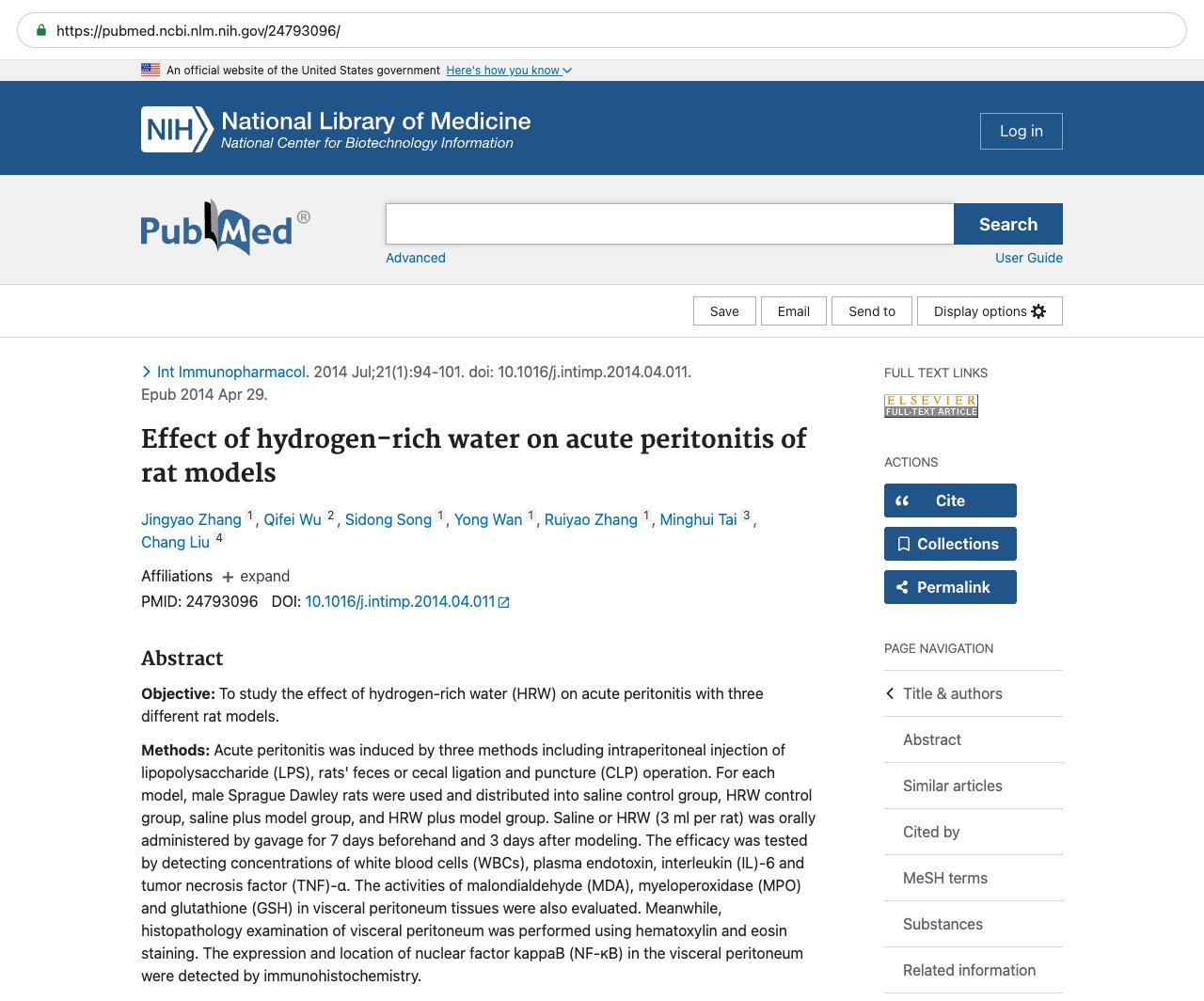
This page mirrors the published abstract (© the authors / publisher) for reference and citation. The canonical source is the PubMed record linked above. This is not medical advice.