1990 · Flores et al. — Assessment of the Sensitivity of Hydrogen Inhalation in the Detection of Left-to-Right Shunting
Super-Abstract
Inhaling a small amount of hydrogen gas and measuring its reappearance on the arterial side of the circulation is an extremely sensitive method for detecting left-to-right intracardiac shunts — far more sensitive than standard dye or oximetry techniques. In 15 patients, artificially created shunts as small as 0.7 % were reliably detected. The clinical value: earlier and more accurate diagnosis of congenital or acquired cardiac defects. (Catheterization and Cardiovascular Diagnosis, 1990.)
Commentary
This study uses hydrogen gas not as a therapeutic agent but as a <strong>diagnostic tracer</strong>. Inhaled H₂ dissolves rapidly in the blood; if it appears on the arterial side earlier than expected, a short-circuit between the right and left heart chambers is present. The technique had long been regarded as sensitive, but this was the first controlled study to actually quantify that sensitivity against a gold standard (thermodilution cardiac output plus artificially calibrated femoral arteriovenous shunts). The findings are impressive: the method detects shunts well below 1.3 % of total cardiac output — the threshold where standard oximetry and indocyanine-green dye methods become blind. For the H₂-therapy context this paper is a historical document showing that molecular hydrogen is physiologically inert enough to be used safely as a tracer — and reaches peripheral tissue very quickly after inhalation.
Key quotes
- „the hydrogen inhalation technique is extremely sensitive in identifying the presence of left-to-right shunting, far more sensitive than the oximetric and standard indocyanine green methods.“ — the core finding on diagnostic superiority
- „Hydrogen inhalation detected all shunts greater than or equal to 1.3% (Qp/Qs greater than or equal to 1.01). Of the 10 shunts less than 1.3%, it detected 5, with the smallest being 0.7%.“ — quantitative sensitivity data
Our assessment
Important note on scope: This is a diagnostic study, not a therapeutic H₂ study. H₂ is used here purely as an inert tracer gas to visualise cardiac shunts — no antioxidant, anti-inflammatory, or metabolic effect is investigated. The study is methodologically solid (n = 15, controlled artificial shunts with known sizes, simultaneous thermodilution reference), but it contributes nothing to the question of H₂ as a health intervention. Limitations: small n; exclusively diagnostic endpoint; results cannot be extrapolated to therapeutic H₂ inhalation at higher concentrations or longer durations.
Study design
- Type: prospective controlled diagnostic accuracy study · n: 15 patients (4 m / 11 f, aged 38–67 years) without intracardiac shunting · H₂ delivery: brief inhalation of H₂ gas as diagnostic tracer
- Result: all shunts ≥ 1.3 % detected; 5/10 shunts < 1.3 % detected (smallest 0.7 %); method far exceeds oximetry and indocyanine green in sensitivity · Therapeutic relevance: none — purely diagnostic tracer application
Abstract
For the detection of left-to-right intracardiac shunting, the oximetric and standard indocyanine green techniques are relatively insensitive, in that neither can reliably detect a shunt with a ratio of pulmonary to systemic flow (Qp/Qs) less than 1.3 (percentage shunt, 23%). Although the hydrogen inhalation method is said to be much more sensitive in this regard, no previous study has measured its sensitivity. Accordingly, in 15 patients (4 men, 11 women, aged 38 to 67 years) without intracardiac shunting, hydrogen inhalation was performed 1) without and 2) with an artificially created femoral arteriovenous shunt of known size, and cardiac output was measured by thermodilution. For the 15 subjects with cardiac outputs of 3.64 to 8.10 liters/min, shunts of 22 to 248 ml/min were created, so that the shunts ranged from 0.5% to 3.3%. Hydrogen inhalation detected all shunts greater than or equal to 1.3% (Qp/Qs greater than or equal to 1.01). Of the 10 shunts less than 1.3%, it detected 5, with the smallest being 0.7%. Thus, the hydrogen inhalation technique is extremely sensitive in identifying the presence of left-to-right shunting, far more sensitive than the oximetric and standard indocyanine green methods.
Source & links
Screenshot of the PubMed page
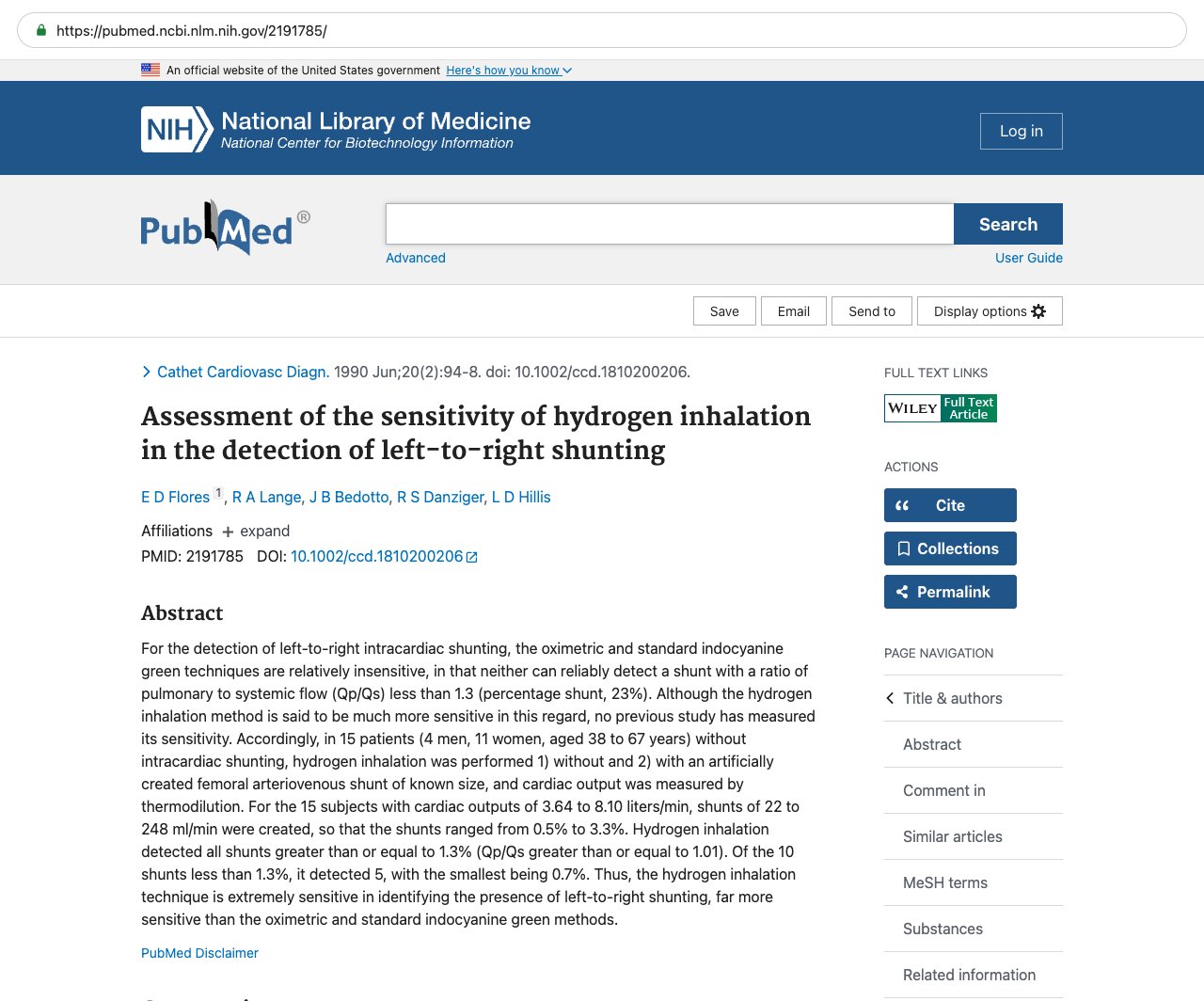
This page mirrors the published abstract (© the authors / publisher) for reference and citation. The canonical source is the PubMed record linked above. This is not medical advice.