1994 · Florin — A Possible Role for Bile Acid in the Control of Methanogenesis and the Accumulation of Hydrogen Gas in the Human Colon
Super-Abstract
This in-vitro study of anaerobic fecal cultures found that primary bile acids inhibit methanogenesis in a dose-dependent manner — suggesting that bile acids regulate the balance between H₂ accumulation and methane production in the human colon. High bile acid concentrations suppress methane-producing bacteria, leaving more H₂ to accumulate in the colon. (Journal of Gastroenterology and Hepatology, 1994.)
Commentary
This is fundamental gut microbiology — not a hydrogen therapy study. H₂ is produced abundantly in the colon through bacterial fermentation of undigested carbohydrates. Normally much of this H₂ is consumed by methanogens (producing methane), sulfate-reducing bacteria (producing H₂S), or acetogens. This study shows that bile acids inhibit methanogens, thereby altering the fate of colonic H₂. The finding has implications for understanding hydrogen breath tests, irritable bowel syndrome, and the gut microbiome, but it does not involve therapeutic administration of H₂. All experiments were conducted in anaerobic in-vitro fecal cultures — results cannot be directly extrapolated to humans in a therapeutic context.
Key quotes
- „Bile acid inhibited methanogenesis in a dose-response fashion in the in vitro 'non-methanogenic' and methanogenic faecal cultures.“ — the central in-vitro finding: bile acids suppress methane production dose-dependently
- „These in vitro data suggest a major role for bile acid in the accumulation of hydrogen gas in the colon.“ — the main conclusion: bile acids shape colonic H₂ accumulation
- „Possible links between bile acid induced accumulation of gas and irritable bowel syndrome are discussed.“ — clinical hypothesis derived from in-vitro findings — not yet proven
Our assessment
This is an in-vitro study on colonic microbiology — not a hydrogen therapy study. It is relevant to gut physiology, hydrogen breath testing, and the microbiome, but does not involve therapeutic H₂ administration. These results cannot be directly applied to human therapy. The hypothesis that bile acid–induced H₂ accumulation contributes to irritable bowel syndrome is speculative and requires in-vivo confirmation. The study was conducted in fecal cultures from only nine subjects (six non-methanogenic, three methanogenic), limiting its generalizability.
Study design
- Type: in-vitro fecal culture study · n: feces from 9 healthy humans (6 non-methanogenic, 3 methanogenic) · H₂ delivery: not applicable — H₂ is a fermentation product measured, not administered
- Result: bile acid inhibited methanogenesis dose-dependently at concentrations >0.05%; methane detectable in all cultures including „non-methanogenic” humans; bile acid also suppressed other H₂-consuming bacteria, causing net H₂ accumulation in vitro
Abstract
This study investigated a possible role for primary bile acid in the control of methanogenesis in the human colon. Production of hydrogen and methane was measured in anaerobic faecal cultures derived from faeces of six 'non-methanogenic' and three methanogenic healthy humans. Using a sensitive technique for gas measurement, methane was detected in all faecal cultures, including those from 'non-methanogenic' humans. Bile acid inhibited methanogenesis in a dose-response fashion in the in vitro 'non-methanogenic' and methanogenic faecal cultures. Inhibition was significant at bile acid concentrations > 0.05%. Methanogenesis correlated with methanogen (methanogenic bacteria) numbers. If this inhibition occurs in vivo, then it would explain much of the epidemiology of non-methanogenesis in humans. From an analysis of net hydrogen production by the faecal cultures, it is inferred that bile acid inhibits other hydrogen-consuming bacteria in addition to methanogens. These in vitro data suggest a major role for bile acid in the accumulation of hydrogen gas in the colon. Possible links between bile acid induced accumulation of gas and irritable bowel syndrome are discussed.
Source & links
Screenshot of the PubMed page
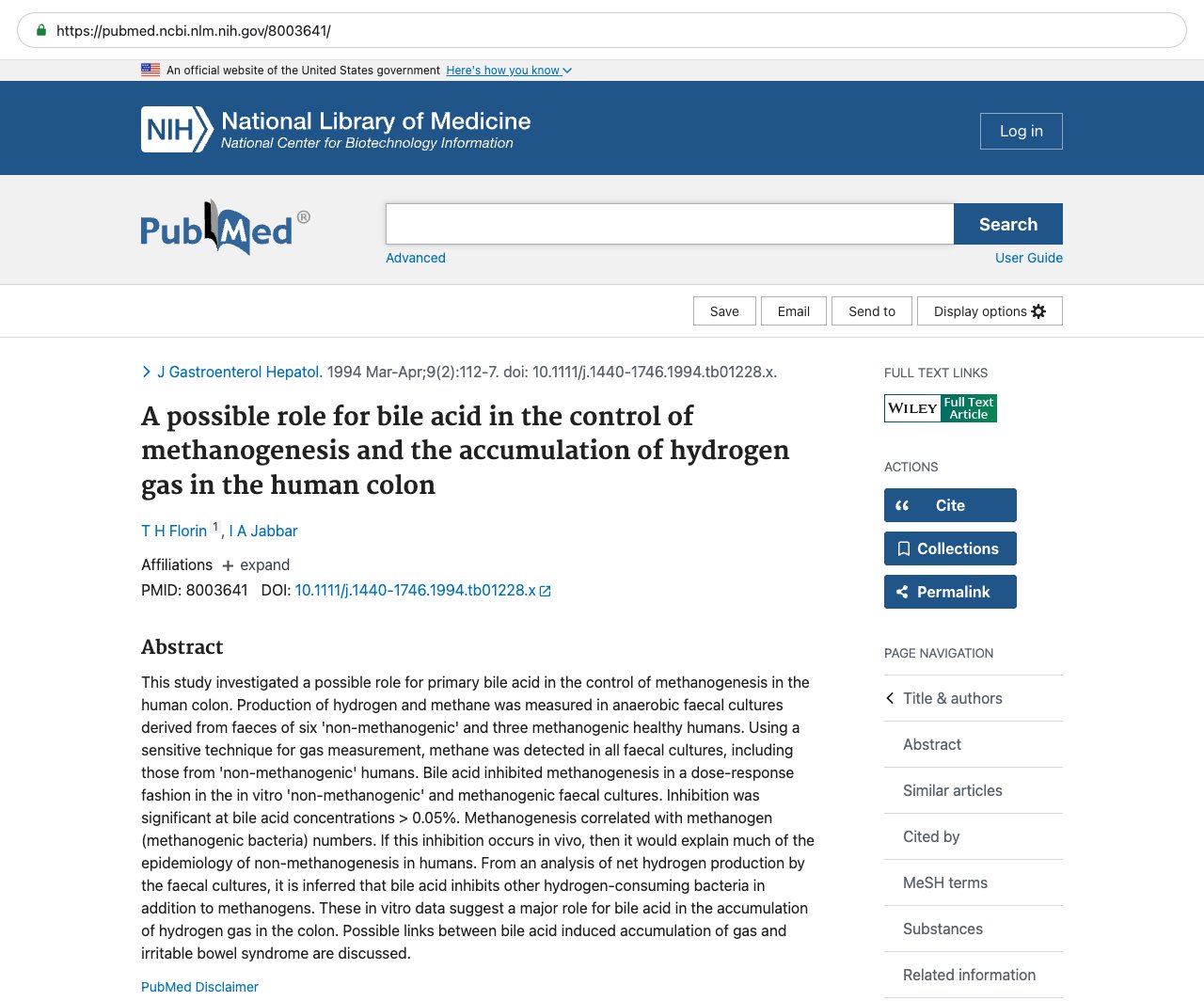
This page mirrors the published abstract (© the authors / publisher) for reference and citation. The canonical source is the PubMed record linked above. This is not medical advice.