2016 · Franceschelli — New Approach in Translational Medicine: Effects of Electrolyzed Reduced Water (ERW) on NF-κB/iNOS Pathway in U937 Cell Line under Altered Redox State
Super-Abstract
In a cell culture experiment, electrolyzed reduced water (ERW) — which contains dissolved molecular hydrogen — protected human immune cells (U937) against hydrogen-peroxide-induced oxidative damage by restoring antioxidant enzyme activity and reducing inflammatory signalling via the NF-κB/iNOS pathway. This is a laboratory finding in cells only, with no direct implications for human health. (International Journal of Molecular Sciences, 2016.)
Commentary
This in-vitro study used U937 cells — a human monocytic cell line derived from a lymphoma — as a model of immune cells under oxidative stress. The researchers exposed the cells to hydrogen peroxide (H₂O₂) to induce oxidative damage, then treated them with ERW. ERW is produced by water electrolysis near the cathode and is characterised by a high dissolved H₂ concentration, high pH, and strongly negative redox potential. The main findings were that ERW restored the activity of three key antioxidant enzymes (superoxide dismutase, catalase, glutathione peroxidase), replenished glutathione levels, and downregulated the NF-κB/iNOS inflammatory pathway, thereby reducing peroxynitrite-induced cytotoxicity. The study contributes to the mechanistic understanding of how H₂-containing water might modulate cellular redox balance. However, cell-line results are far removed from clinical reality: U937 cells are cancer-derived, the stress model is artificial, and there is no dose-response characterisation for translation to human application.
Key quotes
- „ERW inhibited oxidative stress by restoring the antioxidant capacity of superoxide dismutase, catalase and glutathione peroxidase.“ — the central finding: three antioxidant enzymes restored by ERW treatment
- „ERW can protect the cellular redox balance, reducing the risk of several diseases with altered cellular homeostasis such as inflammation.“ — the authors' broader interpretive claim — stated cautiously
- „This means a reduction of cytotoxicity induced by peroxynitrite via a downregulation of the NF-κB/iNOS pathway and could be used as an antioxidant for preventive and therapeutic application.“ — proposed mechanism: NF-κB/iNOS suppression reducing inflammatory cell damage
Our assessment
This is a cell culture (in-vitro) study — results apply to U937 cells under artificial oxidative stress conditions, and cannot be directly extrapolated to humans. The mechanistic findings are scientifically interesting and consistent with other H₂ research on antioxidant and anti-inflammatory pathways. However, cell-line studies routinely do not translate to clinical efficacy, and this study provides no evidence of benefit in living organisms. No health claims for humans can be based on this paper alone.
Study design
- Type: in-vitro cell study · Model: U937 human monocytic cell line, H₂O₂-induced oxidative stress · H₂ delivery: electrolyzed reduced water (ERW, high dissolved H₂, high pH, negative ORP)
- Result: ERW restored SOD, catalase, and glutathione peroxidase activity; replenished GSH; downregulated NF-κB/iNOS pathway; reduced peroxynitrite-mediated cytotoxicity; cellular redox balance protected under H₂O₂-induced stress
Abstract
It is known that increased levels of reactive oxygen species (ROS) and reactive nitrogen species (RNS) can exert harmful effects, altering the cellular redox state. Electrolyzed Reduced Water (ERW) produced near the cathode during water electrolysis exhibits high pH, high concentration of dissolved hydrogen and an extremely negative redox potential. Several findings indicate that ERW had the ability of a scavenger free radical, which results from hydrogen molecules with a high reducing ability and may participate in the redox regulation of cellular function. We investigated the effect of ERW on H₂O₂-induced U937 damage by evaluating the modulation of redox cellular state. Western blotting and spectrophotometrical analysis showed that ERW inhibited oxidative stress by restoring the antioxidant capacity of superoxide dismutase, catalase and glutathione peroxidase. Consequently, ERW restores the ability of the glutathione reductase to supply the cell of an important endogenous antioxidant, such as GSH, reversing the inhibitory effect of H₂O₂ on redox balance of U937 cells. Therefore, this means a reduction of cytotoxicity induced by peroxynitrite via a downregulation of the NF-κB/iNOS pathway and could be used as an antioxidant for preventive and therapeutic application. In conclusion, ERW can protect the cellular redox balance, reducing the risk of several diseases with altered cellular homeostasis such as inflammation.
Source & links
Screenshot of the PubMed page
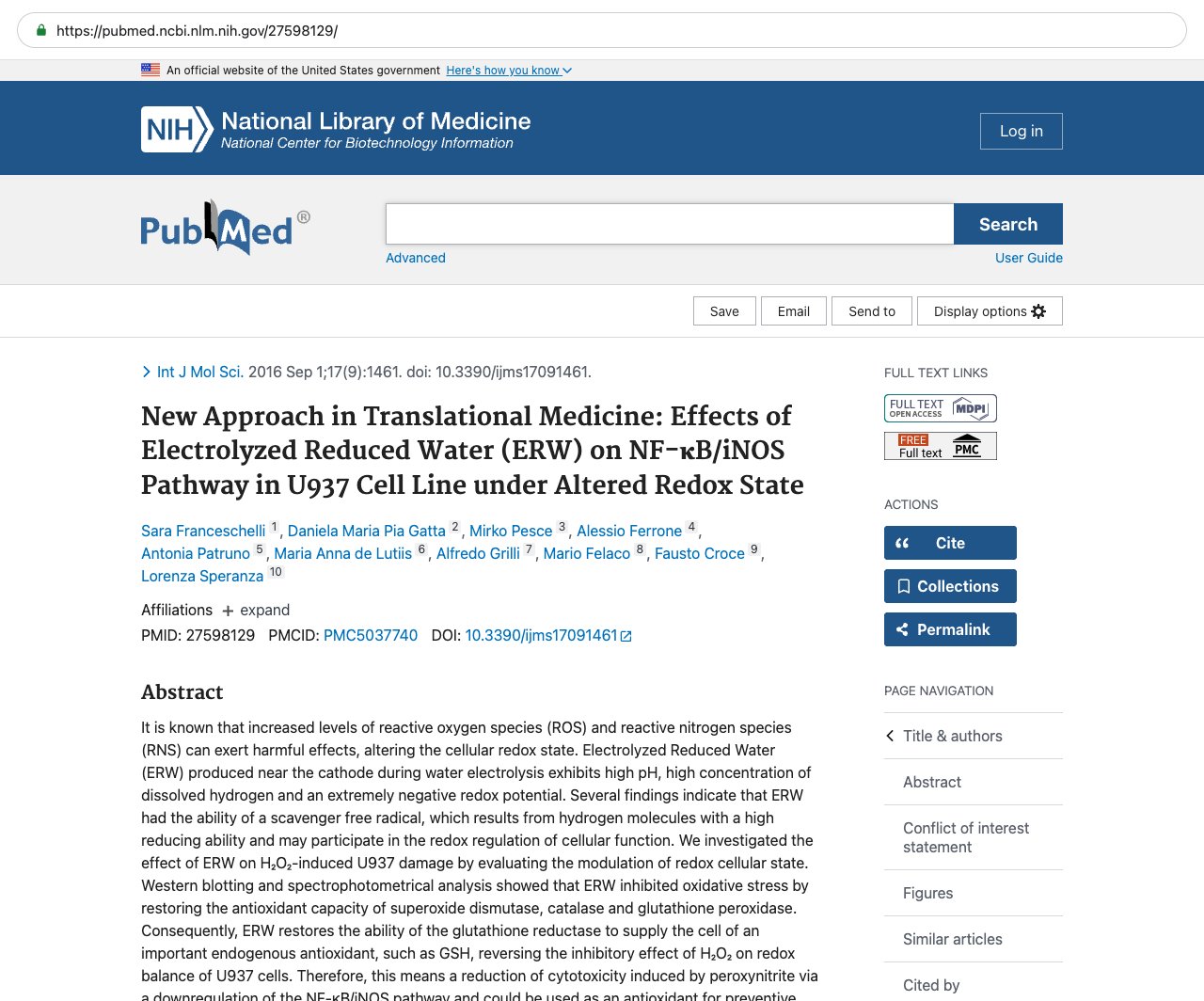
This page mirrors the published abstract (© the authors / publisher) for reference and citation. The canonical source is the PubMed record linked above. This is not medical advice.