2024 · Li — Hydrogen-rich water alleviates asthma airway inflammation by modulating tryptophan metabolism and activating aryl hydrocarbon receptor via gut microbiota regulation.
Super-Abstract
In asthmatic mice, hydrogen-rich water (HRW) shifted gut bacteria toward beneficial species and raised levels of a key bacterial metabolite that calmed airway inflammation via a specific receptor pathway. Both lab experiments and cell studies suggested HRW's anti-asthma effects work partly through the gut-lung axis. (Free Radical Biology & Medicine, 2024.)
Commentary
This animal study used 16S rRNA gut microbiome sequencing and serum metabolomics to track what happens in asthmatic mouse guts after HRW treatment. The authors found that HRW increased abundance of Ligilactobacillus and Bifidobacterium and raised serum levels of indole-3-acetic acid (IAA) — a metabolite produced from tryptophan by gut bacteria. Both in-vivo (mice) and in-vitro (cell) experiments suggested that IAA reduces asthmatic airway inflammation by activating aryl hydrocarbon receptors (AhR). The gut-lung axis angle is scientifically plausible and increasingly well-studied. However, all evidence is from mouse models, and the translation to human asthma would require clinical trials. The mechanistic chain (HRW → microbiome shift → IAA → AhR activation → reduced airway inflammation) is compelling but remains to be validated in humans.
Key quotes
- „HRW influenced gut microbiota by increasing Ligilactobacillus and Bifidobacterium abundance and enhancing the presence of indole-3-acetic acid (IAA), a microbially derived serum metabolite.“ — the microbiome-level finding: HRW shifts the bacterial community toward beneficial species
- „HRW's protective effects against airway inflammation in asthmatic mice may be linked to the gut microbiota, with IAA potentially playing a role in reducing asthmatic airway inflammation through the aryl hydrocarbon receptors (AhR) signaling pathway.“ — the proposed mechanism: gut bacteria → IAA → AhR → reduced inflammation
- „HRW can modify gut microbiota, increase Bifidobacterium abundance, elevate microbial-derived IAA levels, and activate AhR, which could potentially alleviate inflammation in asthma.“ — the authors' summary — note the hedging language (could potentially)
Our assessment
This is an animal study (mouse model of asthma). The findings are scientifically interesting — the proposed gut-lung axis mechanism is plausible and the microbiome + metabolomics evidence is detailed. However, results from asthmatic mice cannot be directly applied to human asthma patients. Mouse asthma models differ substantially from human asthma in their immunology and microbiome composition. The study demonstrates a plausible biological pathway for HRW effects on the gut-lung axis, but clinical confirmation in humans is required before any therapeutic claims can be made.
Study design
- Type: animal study (mouse) · Model: ovalbumin-induced asthmatic mice (Sprague-Dawley) · H₂ delivery: drinking hydrogen-rich water (HRW)
- Outcome measures: 16S rRNA gut microbiome sequencing, serum metabolomics (IAA), airway inflammation markers · Result: HRW increased Ligilactobacillus/Bifidobacterium, raised IAA, activated AhR signalling, reduced airway inflammation in mouse model — no human data
Abstract
Hydrogen-rich water (HRW) is a beverage containing a high concentration of hydrogen that has been researched for its antioxidant, anti-apoptotic, and anti-inflammatory properties in asthma. This study investigates the potential therapeutic impact of HRW on the gut-lung axis. Using 16S rRNA and serum metabolomics, we examined changes in gut microbiota and serum metabolites in asthmatic mice after HRW intervention, followed by validation experiments. The findings revealed that HRW influenced gut microbiota by increasing Ligilactobacillus and Bifidobacterium abundance and enhancing the presence of indole-3-acetic acid (IAA), a microbially derived serum metabolite. Both in vivo and in vitro experiments showed that HRW's protective effects against airway inflammation in asthmatic mice may be linked to the gut microbiota, with IAA potentially playing a role in reducing asthmatic airway inflammation through the aryl hydrocarbon receptors (AhR) signaling pathway. In summary, HRW can modify gut microbiota, increase Bifidobacterium abundance, elevate microbial-derived IAA levels, and activate AhR, which could potentially alleviate inflammation in asthma.
Source & links
Screenshot of the PubMed page
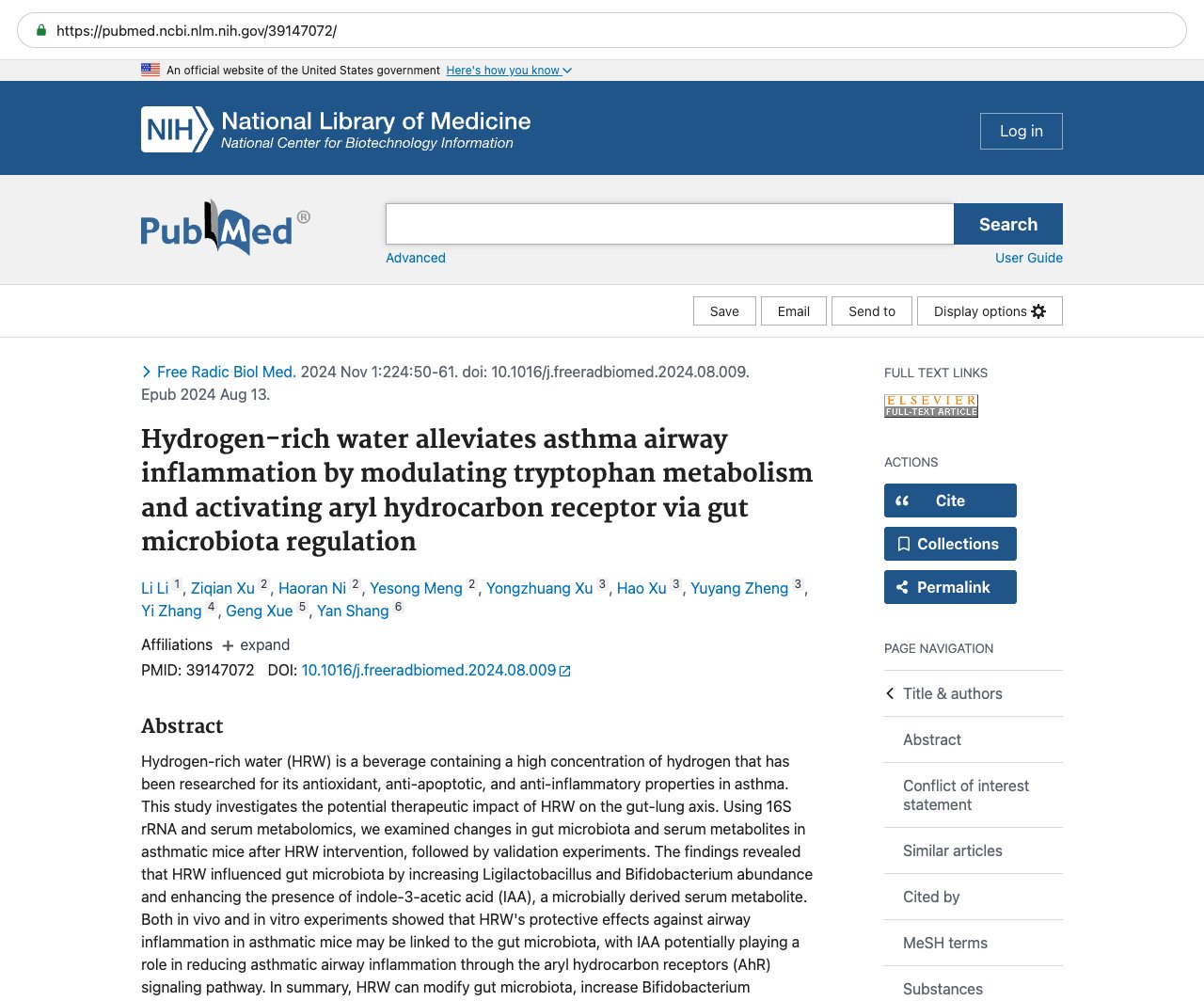
This page mirrors the published abstract (© the authors / publisher) for reference and citation. The canonical source is the PubMed record linked above. This is not medical advice.