1996 · Franić — Radiotoxicity of Tritiated Water and Tritiated Hydrogen
Super-Abstract
Tritiated water (HTO) is far more radiotoxic than tritiated hydrogen gas (HT): inhaling tritiated H₂ gas leads to partial oxidation into HTO in the lungs, meaning the effective dose is higher than previously assumed — and the official toxicity ratio of 1:25,000 (HT vs. HTO) should be corrected to 1:12,000. This theoretical dosimetry analysis has implications for radiation protection standards, not for therapeutic use of hydrogen. (Arhiv za higijenu rada i toksikologiju, 1996.)
Commentary
This is a radiation protection and dosimetry paper dealing with tritium — the radioactive isotope of hydrogen (³H). It is not a study of molecular hydrogen (H₂) as a therapeutic agent; it concerns occupational and environmental exposure to radioactive tritiated water (HTO) and tritiated hydrogen gas (HT). The key finding is a correction of the official ICRP relative toxicity ratio. Tritiated water is systemically distributed (like ordinary water) and thus far more hazardous per unit activity than tritiated gas. The paper is relevant to nuclear medicine and radiation safety, not to hydrogen-rich water therapy.
Key quotes
- „Tritium in the form of tritiated water is much more radiotoxic than tritiated hydrogen.“ — the central finding: HTO >> HT in radiotoxicity
- „The effective dose which results from tritiated water as the oxidation product of inhaled tritiated hydrogen gas makes about 55 per cent of the effective dose due to direct irradiation of the lungs by tritiated hydrogen only.“ — lung oxidation of HT to HTO increases the systemic dose
- „to assess the health hazard from tritium exposure, for the two species the relative significance of 1:12,000 should be used, instead of the relative radiotoxicity ratio of 1:25,000 as given by the International Commission on Radiological Protection.“ — the proposed correction to ICRP radiation-protection standards
Our assessment
This is a theoretical dosimetry analysis in the field of radiation protection, not a hydrogen therapy study. It concerns radioactive tritium (³H), a completely different substance from stable molecular hydrogen (H₂). No conclusions about therapeutic H₂ can be drawn from this work. Its value lies in correcting an occupational safety standard — a narrow but technically important contribution for radiation protection experts. Researchers interested in molecular H₂ as an antioxidant or therapeutic agent will find nothing applicable here.
Study design
- Type: theoretical dosimetry analysis (no animal or human experiment) · n: n/a (mathematical modeling) · H₂ delivery: not applicable — concerns radioactive tritiated hydrogen gas (HT), not molecular H₂ therapy
- Result: the ICRP relative radiotoxicity ratio of HT:HTO = 1:25,000 is recalculated to 1:12,000 when accounting for in vivo oxidation of inhaled HT to HTO in the lungs
Abstract
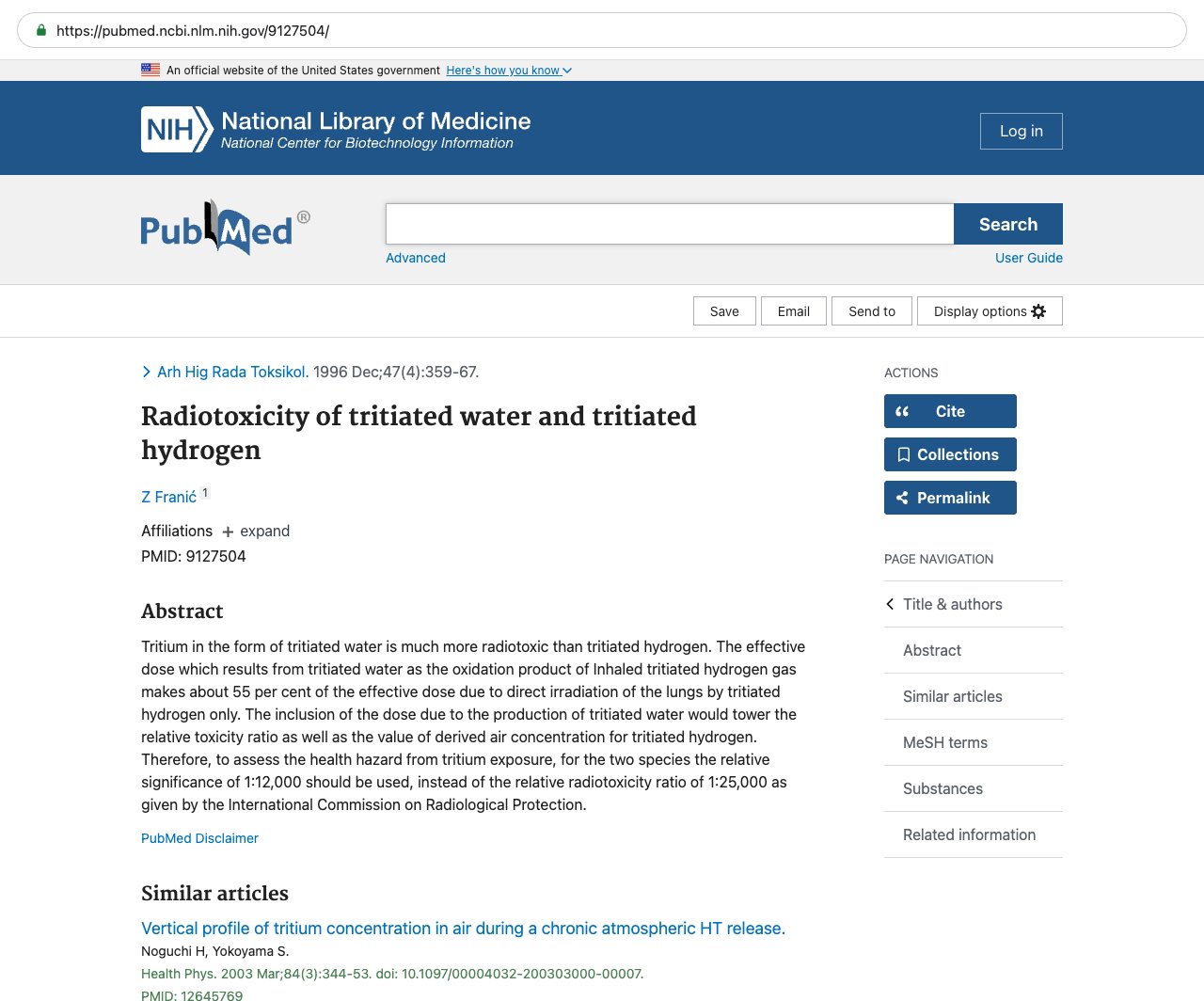
Tritium in the form of tritiated water is much more radiotoxic than tritiated hydrogen. The effective dose which results from tritiated water as the oxidation product of Inhaled tritiated hydrogen gas makes about 55 per cent of the effective dose due to direct irradiation of the lungs by tritiated hydrogen only. The inclusion of the dose due to the production of tritiated water would tower the relative toxicity ratio as well as the value of derived air concentration for tritiated hydrogen. Therefore, to assess the health hazard from tritium exposure, for the two species the relative significance of 1:12,000 should be used, instead of the relative radiotoxicity ratio of 1:25,000 as given by the International Commission on Radiological Protection.
Source & links
Screenshot of the PubMed page
This page mirrors the published abstract (© the authors / publisher) for reference and citation. The canonical source is the PubMed record linked above. This is not medical advice.