2024 · Gaboreau et al. — Molecular Hydrogen for Outpatients with COVID-19 (Hydro-COVID): A Phase 3 Randomised, Triple-Blinded, Pragmatic, Placebo-Controlled, Multicentre Trial
Super-Abstract
In 675 outpatients with mild-to-moderate COVID-19, drinking hydrogen-rich water twice daily for 21 days did not reduce clinical worsening at day 14 compared with placebo (46.1% with hydrogen, 43.5% with placebo, hazard ratio 1.09). Adverse events, the second primary endpoint, were reported in 27% and 26.2% of participants. By day 30 there was one death in the hydrogen group and two in the placebo group. The abstract does not state the hydrogen concentration or how clinical worsening was defined. (Journal of Clinical Medicine, 2024.)
Commentary
The authors tested hydrogen-rich water (HRW) as a way to reduce the risk of COVID-19 progression, citing its reported antioxidant and anti-inflammatory properties. The phase 3 trial was triple-blind, randomised and placebo-controlled. According to the title it was also pragmatic and multicentre. It enrolled primary care patients with mild-to-moderate, laboratory-confirmed COVID-19, and treatment started within 5 days after the onset of signs or symptoms. Participants were randomised to HRW or placebo, taken twice daily for 21 days. The two primary endpoints were the incidence of clinical worsening and adverse events. In total, 675 participants were followed up to day 30. The abstract does not state the hydrogen concentration, the volume drunk, the composition of the placebo, the number of participants per group or the countries involved. The full text (PMC11313273) reports 700 randomised patients in France and Serbia, of whom 675 were analysed.
Key quotes
- „HRW was not superior to placebo in preventing clinical worsening at day 14: in H2 group, 46.1% in the H2 group, 43.5% in the placebo group, hazard ratio 1.09, 90% confidence interval [0.90-1.31].“ — the primary efficacy endpoint: no advantage for hydrogen-rich water over placebo
- „Adverse events were reported in 91 (27%) and 89 (26.2%) participants, respectively.“ — the safety endpoint: adverse events were about as frequent as with placebo
- „HRW taken twice daily from the onset of COVID-19 symptoms for 21 days did not reduce clinical worsening.“ — the authors' conclusion, stated as a plain null result
Our assessment
This is a large phase 3 trial with triple blinding and a placebo control. Its primary efficacy endpoint showed no benefit: clinical worsening was slightly more frequent with hydrogen-rich water than with placebo, and the confidence interval for the hazard ratio (0.90 to 1.31) includes no effect. Adverse events occurred at almost the same rate in both groups. With one death compared with two, mortality cannot be compared. Limitations: the abstract does not define clinical worsening and does not give the hydrogen dose, the concentration or the composition of the placebo. It reports a 90% confidence interval for the hazard ratio and does not explain why this level was chosen. The abstract does not state the number randomised; the full text gives 700, of whom 675 were analysed. The result applies to outpatients with mild-to-moderate disease who started within 5 days of symptom onset and does not cover severe or hospitalised COVID-19.
Study design
- Type: phase 3, triple-blind, randomised, placebo-controlled trial in primary care (pragmatic and multicentre per title) · n: 700 randomised, 675 analysed (per full text) · H₂ delivery: hydrogen-rich water twice daily for 21 days, started within 5 days of symptom onset
- Comparator: placebo twice daily for 21 days (composition not stated in the abstract)
- Result: clinical worsening at day 14 (primary) 46.1% vs. 43.5%, hazard ratio 1.09 (90% CI 0.90–1.31), not superior to placebo. Adverse events (primary) 91 (27%) vs. 89 (26.2%). Deaths by day 30: 1 vs. 2
Abstract
Background. Due to its antioxidant, anti-inflammatory, anti-apoptosis, and anti-fatigue properties, molecular hydrogen (H2) is potentially a novel therapeutic nutrient for patients with coronavirus acute disease 2019 (COVID-19). We determined the efficacy and safety profile of hydrogen-rich water (HRW) to reduce the risk of COVID-19 progression. Methods: We also conducted a phase 3, triple-blind, randomised, placebo-controlled trial to evaluate treatment with HRW initiated within 5 days after the onset of signs or symptoms in primary care patients with mild-to-moderate, laboratory-confirmed COVID-19. Participants were randomised to receive HRW or placebo twice daily for 21 days. The incidence of clinical worsening and adverse events were the primary endpoints. Results: A total of 675 participants were followed up to day 30. HRW was not superior to placebo in preventing clinical worsening at day 14: in H2 group, 46.1% in the H2 group, 43.5% in the placebo group, hazard ratio 1.09, 90% confidence interval [0.90-1.31]. One death was reported at day 30 in the H2 group and two in the placebo group at day 30. Adverse events were reported in 91 (27%) and 89 (26.2%) participants, respectively. Conclusions: HRW taken twice daily from the onset of COVID-19 symptoms for 21 days did not reduce clinical worsening.
Source & links
Screenshot of the PubMed page
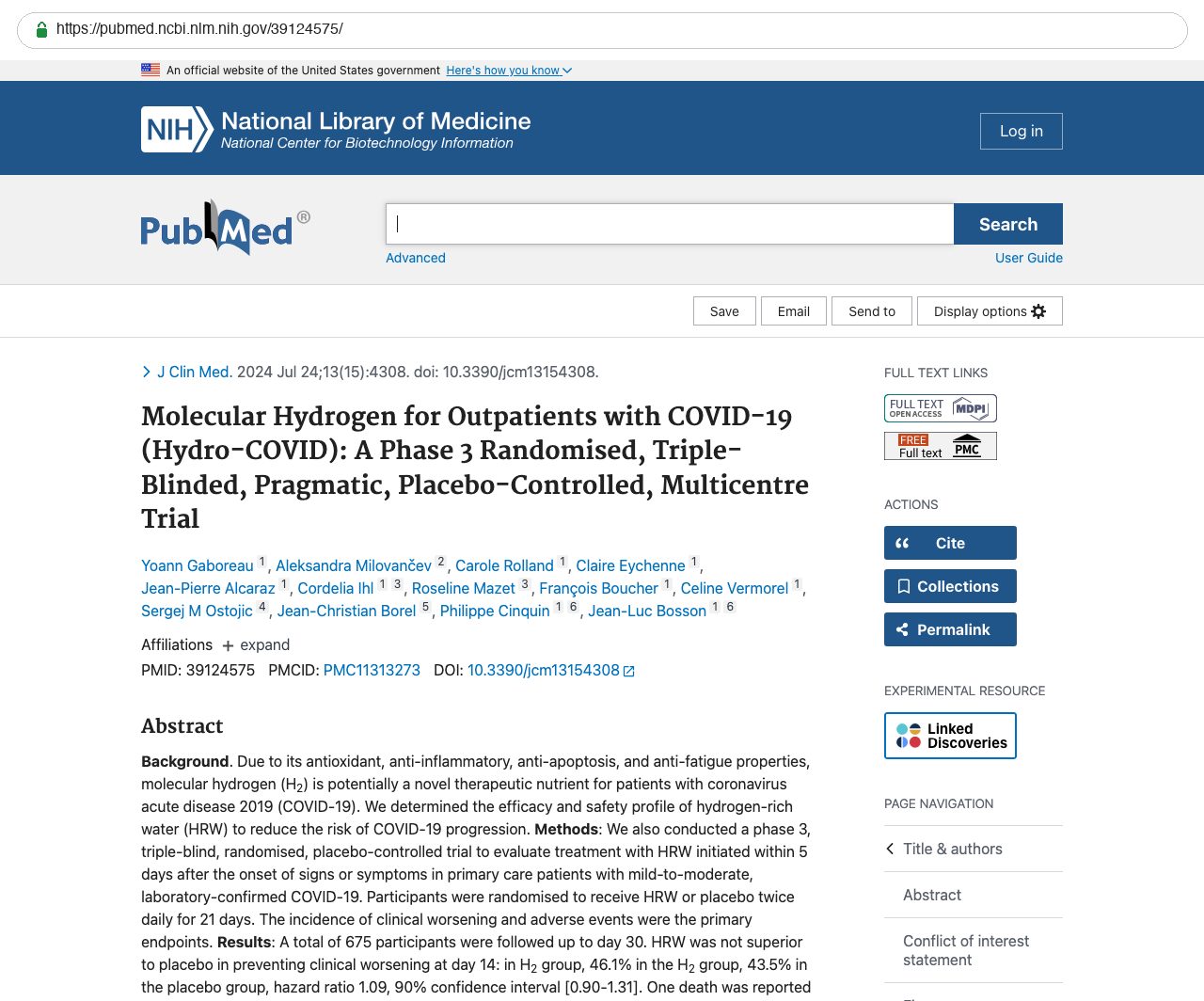
This page mirrors the published abstract (© the authors / publisher) for reference and citation. The canonical source is the PubMed record linked above. This is not medical advice.