2023 Therapeutics and clinical risk management RCT Human H₂ therapy Drinking (HRW) Respiratory / COVID
2023 · Tang et al. — Efficacy and Safety of Hydrogen Therapy in Patients with Early-Stage Interstitial Lung Disease: A Single-Center, Randomized, Parallel-Group Controlled Trial
Super-Abstract
In 87 patients with early-stage interstitial lung disease, CT findings improved more often with hydrogen therapy than with N-acetylcysteine after 48 weeks (63.6% compared with 39.5%), and the composite physiologic index fell significantly more. Diffusing capacity (DLCO-sb) also improved more with hydrogen, while other lung function values did not differ significantly. Adverse events occurred in 15.9% and 23.3% of patients (P=0.706). According to the full text, patients drank 350 mL of hydrogen-rich water (1.6 ppm) twice a day. Blinding is not described. (Therapeutics and Clinical Risk Management, 2023.)
Commentary
Several in vivo experiments had pointed to hydrogen as a candidate treatment for interstitial lung disease (ILD), and this trial compared it with N-acetylcysteine (NAC) in early-stage disease. The prospective, single-centre trial randomly assigned 87 patients with early-stage ILD in a 1:1 ratio to hydrogen therapy or NAC. The abstract does not describe the form of hydrogen therapy. The full text (PMC10723077) does: 350 mL of hydrogen-rich water (HW) at 1.6 ppm twice a day, compared with 600 mg NAC three times a day; 75 patients completed the study. The primary endpoint was the change in high-resolution computed tomography (HRCT) findings and in the composite physiologic index (CPI) from baseline to week 48. Pulmonary function was a secondary endpoint: diffusing capacity (DLCO-sb), FVC, FEV1, FEV1/FVC% and TLC. Adverse events were recorded for safety. Blinding is not mentioned in the abstract.
Key quotes
- „The rate of HRCT image improvement from the baseline in the HW group (63.6%) was higher than that in the NAC group (39.5%).“ — the imaging part of the primary endpoint, reported without a p-value
- „Changes in other pulmonary function parameters, including FVC, FEV1, FEV1/FVC%, and TLC, were not significantly different between the two groups.“ — most lung function measures showed no significant difference between the groups
- „Hydrogen therapy exhibits superior efficacy and acceptable safety compared with NAC therapy in patients with early-stage ILD.“ — the authors' conclusion, based on CT, CPI and diffusing capacity
Our assessment
The trial is randomised and uses an active comparator, so it asks whether hydrogen does better than an existing antioxidant drug, not whether it does better than no treatment. In this sample, hydrogen was associated with more CT improvement, a lower CPI and better diffusing capacity, while most lung function measures did not differ. Limitations: a single centre with 87 patients, and no blinding reported, which matters because CT improvement is a judged outcome. The abstract reports the HRCT proportions without a p-value or confidence interval for the comparison and no numbers for CPI and DLCO-sb. The abstract does not state the delivery route or dose; the full text names 350 mL of hydrogen-rich water at 1.6 ppm twice a day. Because NAC is not a placebo, the trial cannot show how either treatment compares with no treatment. The authors' conclusion of superior efficacy rests on results that the abstract only partly quantifies.
Study design
- Type: prospective, single-centre, randomised, parallel-group controlled trial (blinding not reported) · n: 87 patients with early-stage ILD (44 hydrogen, 43 NAC per full text) · H₂ delivery: drinking 350 mL hydrogen-rich water (1.6 ppm) twice a day (per full text)
- Comparator: N-acetylcysteine (NAC) 600 mg three times a day (per full text), assigned 1:1
- Result: primary: HRCT improvement 63.6% vs. 39.5% (no p-value given), significant decrease in CPI with hydrogen (no numbers given). Secondary: DLCO-sb improved significantly more with hydrogen. FVC, FEV1, FEV1/FVC% and TLC not significantly different. Adverse events 7 (15.9%) vs. 10 (23.3%), P=0.706
Abstract
PURPOSE: Several in vivo experiments have shown that molecular hydrogen is a promising therapeutic agent for interstitial lung diseases (ILD). In this study, hydrogen therapy was investigated to determine whether it is superior to N-Acetylcysteine (NAC) for the treatment of patients with early-stage ILD. PATIENTS AND METHODS: A prospective, single-center, randomized, controlled clinical trial was conducted in 87 patients with early-stage ILD. Hydrogen or NAC therapy was randomly assigned (1:1 ratio) to the eligible patients. The primary endpoint was the change in the high-resolution computed tomography (HRCT) and composite physiologic index (CPI) scores from baseline to week 48. Pulmonary function was evaluated as a secondary endpoint, and adverse events were recorded for safety analysis. RESULTS: The rate of HRCT image improvement from the baseline in the HW group (63.6%) was higher than that in the NAC group (39.5%). A significant decrease in CPI and improvement in DLCO-sb were observed in the hydrogen group compared with those in the control group. Changes in other pulmonary function parameters, including FVC, FEV1, FEV1/FVC%, and TLC, were not significantly different between the two groups. Adverse events were reported in 7 (15.9%) patients in the HW group and 10 (23.3%) patients in the NAC group, but the difference was not significant (P=0.706). CONCLUSION: Hydrogen therapy exhibits superior efficacy and acceptable safety compared with NAC therapy in patients with early-stage ILD.
Source & links
Screenshot of the PubMed page
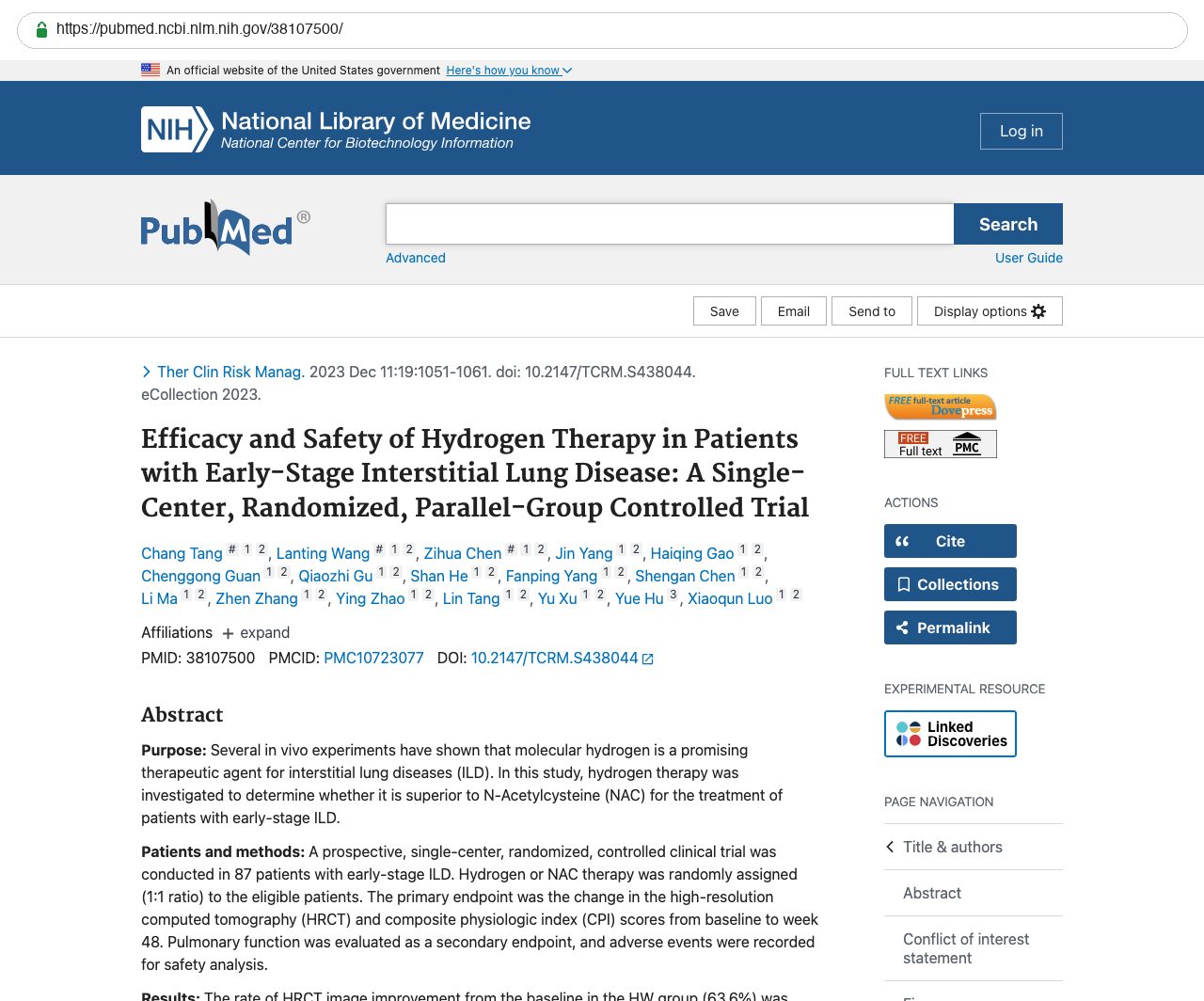
This page mirrors the published abstract (© the authors / publisher) for reference and citation. The canonical source is the PubMed record linked above. This is not medical advice.